Che-Amat Azlan, Risalde Maria Ángeles, González-Barrio David, Ortíz Jose Antonio, Gortázar Christian
SaBio, Instituto de Investigación en Recursos Cinegéticos IREC (CSIC-UCLM-JCCM), Ronda de Toledo s.n., 13005, Ciudad Real, Spain.
Faculty of Veterinary Medicine, Universiti Putra Malaysia, 43400 Serdang, Selangor, Malaysia.
BMC Vet Res. 2016 Sep 5;12(1):184. doi: 10.1186/s12917-016-0825-2.
Diagnosing tuberculosis (TB) in farmed red deer (Cervus elaphus) is challenging and might require combining cellular and humoral diagnostic tests. Repeated skin-testing with mycobacterial purified protein derivatives (PPDs) might sensitize or desensitize the subjects to both kinds of diagnostic tools. We evaluated the effect of repeated (every 6 months) comparative tuberculin skin testing on skin test and ELISA responsiveness in farmed red deer hinds from a TB-free herd. Eighteen 8-month old hinds were inoculated with bovine and avian PPDs and the mitogen phytohaemagglutinin (PHA), as positive control and concurrently tested by ELISA for antibodies against avian (avian PPD, aPPD and protoplasmatic antigen 3, PPA3) and bovine antigens (bPPD and MPB70). Blood serum was also sampled three weeks after each skin testing round and tested for antibodies against aPPD and bPPD, in order to detect eventual antibody level boosts. Testing took place every six months from winter 2012 until winter 2015.
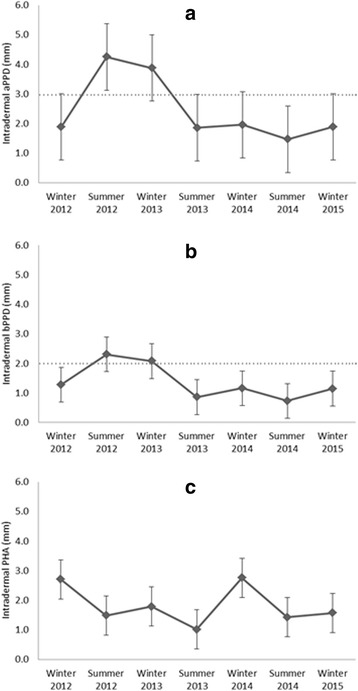
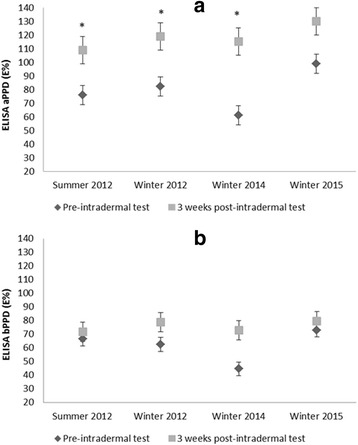
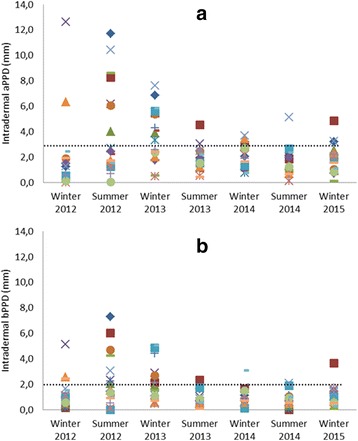
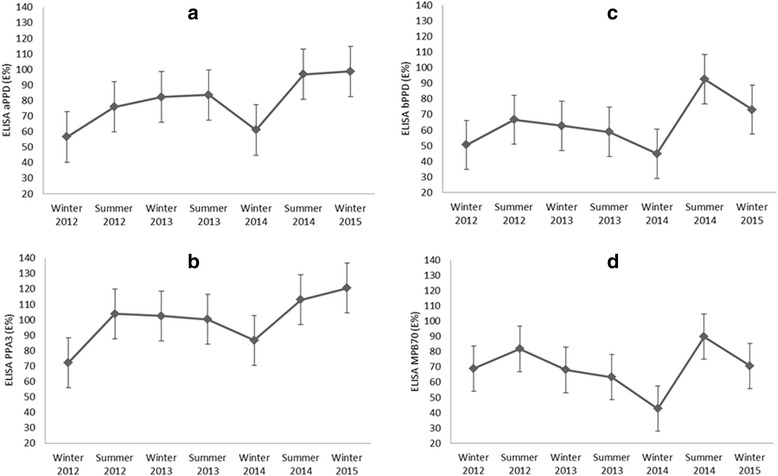
The skin test response to both PPDs peaked during the second and third test round, returning to standard values thereafter. Individual variability was particularly high at the first year and early second year testing rounds (first intradermal test and blood sampling; first winter). The antibody response to avian antigens increased through time, while no such increase was recorded for bovine antigens. The antibody boost three weeks after skin testing was more marked for avian PPD. However, there was no consistent trend in the boosting response through time.
Repeated comparative skin testing at six month intervals did not cause progressive increments in skin test responsiveness or antibody production. Specifically, we observed no loss of the skin test response to bPPD and also no progressive loss of the boosting effect in the ELISA responses. However, we recorded increases through time in the antibody levels against avian mycobacterial antigens, possibly due to the progressive exposure to MAP or to other cross-reacting environmental mycobacteria. These findings should be taken into account in designing and interpreting TB testing schemes in farmed deer.
诊断养殖马鹿( Cervus elaphus )的结核病(TB)具有挑战性,可能需要结合细胞和体液诊断测试。用分枝杆菌纯化蛋白衍生物(PPD)反复进行皮肤测试可能会使受试对象对这两种诊断工具产生致敏或脱敏作用。我们评估了在一个无结核病鹿群中,对养殖的马鹿母鹿每6个月重复进行一次比较结核菌素皮肤测试对皮肤测试和ELISA反应性的影响。18只8月龄的母鹿接种了牛型和禽型PPD以及作为阳性对照的丝裂原植物血凝素(PHA),并同时通过ELISA检测针对禽型抗原(禽型PPD、aPPD和原生质抗原3,PPA3)和牛型抗原(bPPD和MPB70)的抗体。在每次皮肤测试轮次后3周也采集血清样本,检测针对aPPD和bPPD的抗体,以检测抗体水平是否有最终提升。从2012年冬季到2015年冬季,每6个月进行一次检测。
对两种PPD的皮肤测试反应在第二轮和第三轮测试时达到峰值,此后恢复到标准值。在第一年和第二年早期的测试轮次(第一次皮内测试和血液采样;第一个冬季)个体变异性特别高。对禽型抗原的抗体反应随时间增加,而对牛型抗原未记录到这种增加。皮肤测试后3周,禽型PPD的抗体提升更为明显。然而,随时间推移的提升反应没有一致的趋势。
每6个月重复进行比较皮肤测试不会导致皮肤测试反应性或抗体产生的逐渐增加。具体而言,我们观察到对bPPD的皮肤测试反应没有丧失,ELISA反应中的增强效应也没有逐渐丧失。然而,我们记录到针对禽型分枝杆菌抗原的抗体水平随时间增加,这可能是由于逐渐接触副结核分枝杆菌或其他交叉反应的环境分枝杆菌。在设计和解释养殖鹿的结核病检测方案时应考虑这些发现。