Spector Stephen A, Brummel Sean S, Nievergelt Caroline M, Maihofer Adam X, Singh Kumud K, Purswani Murli U, Williams Paige L, Hazra Rohan, Van Dyke Russell, Seage George R
University of California, San Diego, La Jolla Rady Children's Hospital-San Diego, San Diego, CA Center for Biostatistics in AIDS Research, Harvard T.H. Chan School of Public Health, Boston, MA Albert Einstein College of Medicine, Bronx Lebanon Hospital, Bronx, New York, NY Departments of Biostatistics Epidemiology, Harvard T.H. Chan School of Public Health, Boston, MA Eunice Kennedy Shriver National Institute of Child Health and Human Development, National Institutes of Health, Bethesda, MD Tulane University School of Medicine, New Orleans, LA.
Medicine (Baltimore). 2016 Sep;95(36):e4733. doi: 10.1097/MD.0000000000004733.
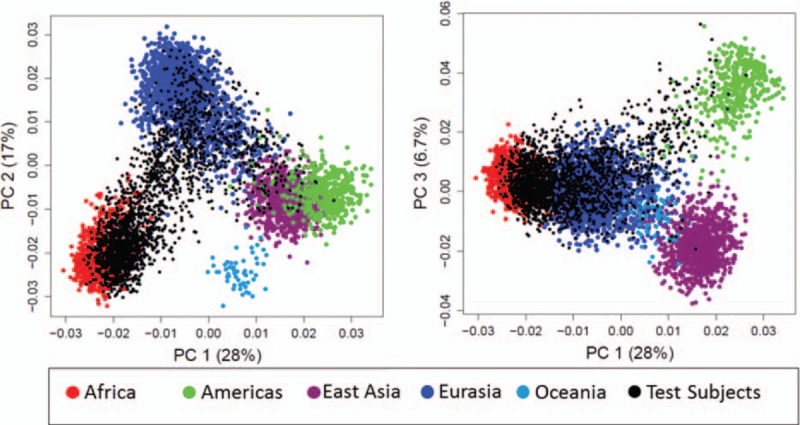
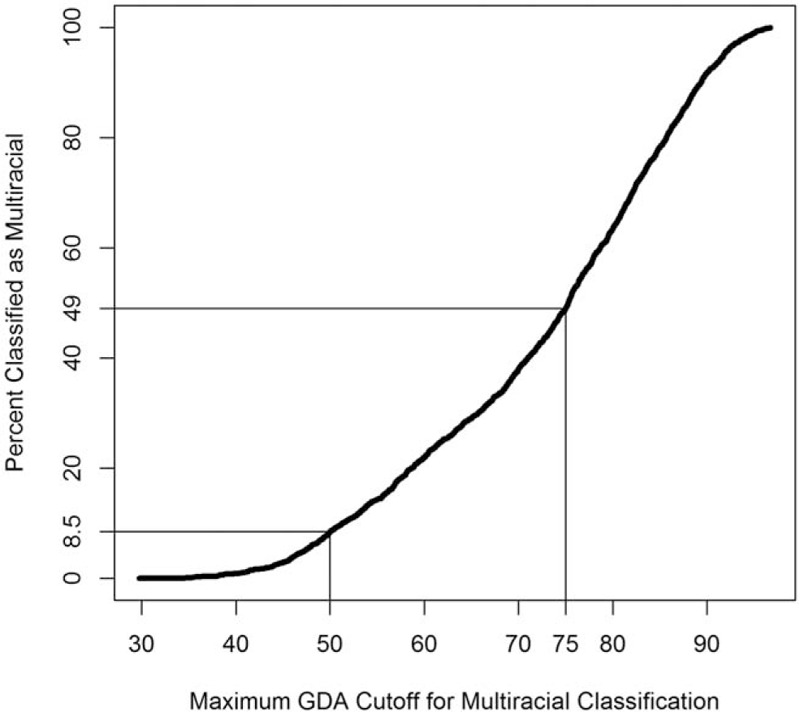
The Pediatric HIV/AIDS Cohort Study (PHACS), the largest ongoing longitudinal study of perinatal HIV-infected (PHIV) and HIV-exposed, uninfected (PHEU) children in the United States, comprises the Surveillance Monitoring of Antiretroviral Therapy [ART] Toxicities (SMARTT) Study in PHEU children and the Adolescent Master Protocol (AMP) that includes PHIV and PHEU children ≥7 years. Although race/ethnicity is often used to assess health outcomes, this approach remains controversial and may fail to accurately reflect the backgrounds of ancestry-diverse populations as represented in the PHACS participants.In this study, we compared genetically determined ancestry (GDA) and self-reported race/ethnicity (SRR) in the PHACS cohort. GDA was estimated using a highly discriminative panel of 41 single nucleotide polymorphisms and compared to SRR. Because SRR was similar between the PHIV and PHEU, and between the AMP and SMARTT cohorts, data for all unique 1958 participants were combined.According to SRR, 63% of study participants identified as Black/African-American, 27% White, and 34% Hispanic. Using the highest percentage of ancestry/ethnicity to identify GDA, 9.5% of subjects were placed in the incorrect superpopulation based on SRR. When ≥50% or ≥75% GDA of a given superpopulation was required, 12% and 25%, respectively, of subjects were placed in the incorrect superpopulation based on SRR, and the percent of subjects classified as multiracial increased. Of 126 participants with unidentified SRR, 71% were genetically identified as Eurasian.GDA provides a more robust assessment of race/ethnicity when compared to self-report, and study participants with unidentified SRR could be assigned GDA using genetic markers. In addition, identification of continental ancestry removes the taxonomic identification of race as a variable when identifying risk for clinical outcomes.
儿科艾滋病毒/艾滋病队列研究(PHACS)是美国正在进行的关于围产期感染艾滋病毒(PHIV)和接触艾滋病毒但未感染(PHEU)儿童的最大规模纵向研究,它包括对PHEU儿童的抗逆转录病毒疗法(ART)毒性监测(SMARTT)研究以及包含7岁及以上PHIV和PHEU儿童的青少年主方案(AMP)。尽管种族/族裔常被用于评估健康结果,但这种方法仍存在争议,可能无法准确反映PHACS参与者所代表的祖先背景多样人群的情况。在本研究中,我们比较了PHACS队列中基因确定的祖先(GDA)和自我报告的种族/族裔(SRR)。使用由41个单核苷酸多态性组成的高分辨率面板估计GDA,并与SRR进行比较。由于PHIV和PHEU之间以及AMP和SMARTT队列之间的SRR相似,因此将所有1958名独特参与者的数据进行了合并。根据SRR,63%的研究参与者被认定为黑人/非裔美国人,27%为白人,34%为西班牙裔。使用祖先/族裔的最高百分比来确定GDA时,9.5%的受试者基于SRR被归入错误的超人群体。当要求给定超人群体的GDA≥50%或≥75%时,分别有12%和25%的受试者基于SRR被归入错误的超人群体,且被归类为多种族的受试者百分比增加。在126名SRR未确定的参与者中,71%在基因上被鉴定为欧亚混血。与自我报告相比,GDA能更有力地评估种族/族裔,对于SRR未确定的研究参与者,可以使用基因标记来确定其GDA。此外,确定大陆祖先在识别临床结果风险时消除了将种族作为分类变量的识别。