Ismail M S, Siti-Zahrah A, Syafiq M R M, Amal M N A, Firdaus-Nawi M, Zamri-Saad M
Department of Veterinary Laboratory Diagnosis, Faculty of Veterinary Medicine, Universiti Putra Malaysia, 43400, Serdang, Malaysia.
National Fish Research and Disease Diagnosis, Fisheries Research Institute, 11960, Batu Maung, Penang, Malaysia.
BMC Vet Res. 2016 Sep 8;12(1):194. doi: 10.1186/s12917-016-0834-1.
Streptococcosis is an important disease of tilapia throughout the world. In Malaysia, streptococcosis outbreak was commonly reported during the 3-month period of high water temperature between April and July. This study describes the duration of protection following single and double booster dose regimes against streptococcosis in tilapia using a feed-based vaccine containing formalin-killed Streptococcus agalactiae. A total of 510 tilapias of 120 ± 10 g were selected and divided into 3 groups. Fish of Group 1 were vaccinated at weeks 0 and 2 (single booster group) while fish of Group 2 were vaccinated at weeks 0, 2 and 6 (double booster group) with a feed-based vaccine against streptococcosis. Fish of Group 3 was not vaccinated. Serum samples were collected weekly to determine the antibody level while samples of eye, brain and kidney were collected for bacterial isolation. At week 10, all fish were challenged with live S. agalactiae and the survival rate was determined.
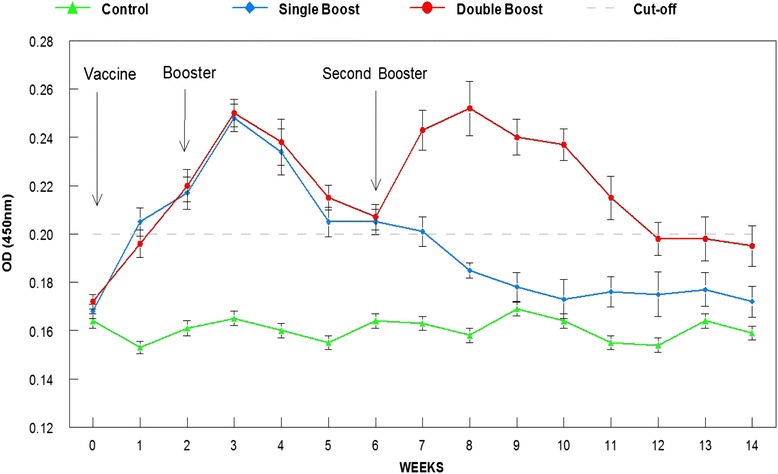
Both vaccinated groups showed significant (p < 0.05) increase in the antibody levels following the first booster dose, which lasted until week 6. Group 2 showed consistent high level of antibody following the second booster dose at week 6 and remained high until week 12. Challenge trial at week 10 resulted in 45 %, 70 % and 0 % rate of survival for Groups 1, 2 and 3, respectively.
Double booster regime is most suitable to be applied for feed-based vaccination against streptococcosis prior to the start of the hot season.
链球菌病是全球罗非鱼的一种重要疾病。在马来西亚,4月至7月水温较高的3个月期间,经常报告有链球菌病暴发。本研究描述了使用含有福尔马林灭活无乳链球菌的饲料型疫苗,对罗非鱼进行单剂量和双剂量加强免疫后预防链球菌病的保护期。共挑选510尾体重120±10克的罗非鱼,分为3组。第1组的鱼在第0周和第2周接种疫苗(单剂量加强组),而第2组的鱼在第0周、第2周和第6周接种疫苗(双剂量加强组),使用预防链球菌病的饲料型疫苗。第3组的鱼未接种疫苗。每周采集血清样本以测定抗体水平,同时采集眼睛、大脑和肾脏样本进行细菌分离。在第10周,所有鱼用活的无乳链球菌进行攻毒,并测定存活率。
两个接种组在首次加强免疫后抗体水平均显著(p<0.05)升高,这种升高持续到第6周。第2组在第6周第二次加强免疫后抗体水平持续保持较高,并一直保持到第12周。第10周的攻毒试验结果显示,第1组、第2组和第3组的存活率分别为45%、70%和0%。
双剂量加强免疫方案最适合在炎热季节开始前用于基于饲料的链球菌病疫苗接种。