Biasutti Michele, Concina Eleonora, Wasley David, Williamon Aaron
Dipartimento di Filosofia, Sociologia, Pedagogia e Psicologia Applicata, Padova University Padova, Italy.
Cardiff School of Sport, Cardiff Metropolitan University Cardiff, UK.
Front Psychol. 2016 Aug 25;7:1229. doi: 10.3389/fpsyg.2016.01229. eCollection 2016.
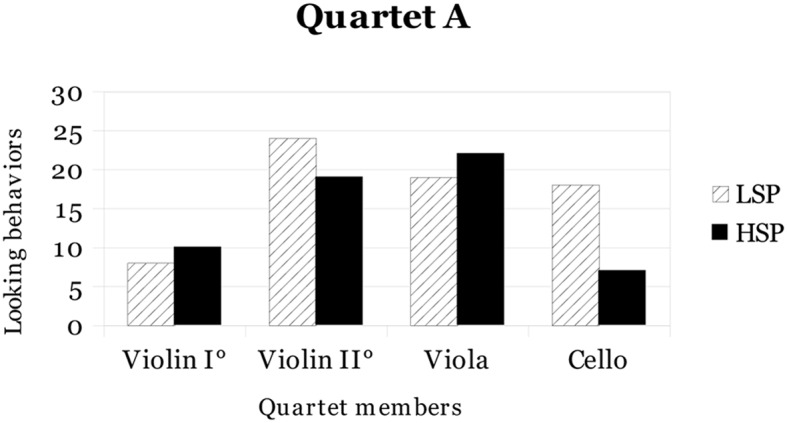
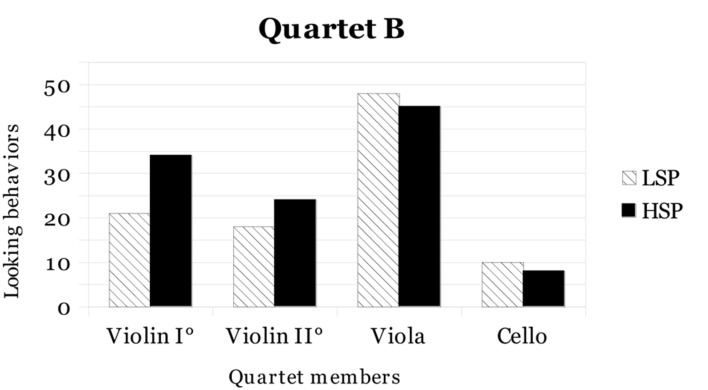
In ensemble performances, group members use particular bodily behaviors as a sort of "language" to supplement the lack of verbal communication. This article focuses on music regulators, which are defined as signs to other group members for coordinating performance. The following two music regulators are considered: body gestures for articulating attacks (a set of movements externally directed that are used to signal entrances in performance) and eye contact. These regulators are recurring observable behaviors that play an important role in non-verbal communication among ensemble members. To understand how they are used by chamber musicians, video recordings of two string quartet performances (Quartet A performing Bartók and Quartet B performing Haydn) were analyzed under two conditions: a low stress performance (LSP), undertaken in a rehearsal setting, and a high stress performance (HSP) during a public recital. The results provide evidence for more emphasis in gestures for articulating attacks (i.e., the perceived strength of a performed attack-type body gesture) during HSP than LSP. Conversely, no significant differences were found for the frequency of eye contact between HSP and LSP. Moreover, there was variability in eye contact during HSP and LSP, showing that these behaviors are less standardized and may change according to idiosyncratic performance conditions. Educational implications are discussed for improving interpersonal communication skills during ensemble performance.
在合奏表演中,小组成员会使用特定的身体行为作为一种“语言”来弥补言语交流的不足。本文聚焦于音乐调节因素,它被定义为向其他小组成员传达的用于协调表演的信号。我们考虑了以下两种音乐调节因素:用于明确起奏的身体手势(一组向外的动作,用于在表演中示意入场)和眼神交流。这些调节因素是反复出现的可观察行为,在合奏成员的非言语交流中起着重要作用。为了了解室内乐音乐家如何使用这些调节因素,我们对两场弦乐四重奏表演(A组演奏巴托克作品和B组演奏海顿作品)的视频记录在两种条件下进行了分析:一种是在排练环境中进行的低压力表演(LSP),另一种是在公开演奏会上的高压力表演(HSP)。结果表明,与低压力表演相比,高压力表演中用于明确起奏的手势(即所感知到的已执行的起奏型身体手势的力度)更受重视。相反,高压力表演和低压力表演之间在眼神交流频率上没有发现显著差异。此外,在高压力表演和低压力表演过程中,眼神交流存在变化,这表明这些行为的标准化程度较低,可能会根据独特的表演条件而改变。文中还讨论了对于提高合奏表演中人际沟通技巧的教育意义。