Schiavio Andrea, Benedek Mathias
Centre for Systematic Musicology, University of Graz, Graz, Austria.
Institute of Psychology, University of Graz, Graz, Austria.
Front Neurosci. 2020 Nov 30;14:578932. doi: 10.3389/fnins.2020.578932. eCollection 2020.
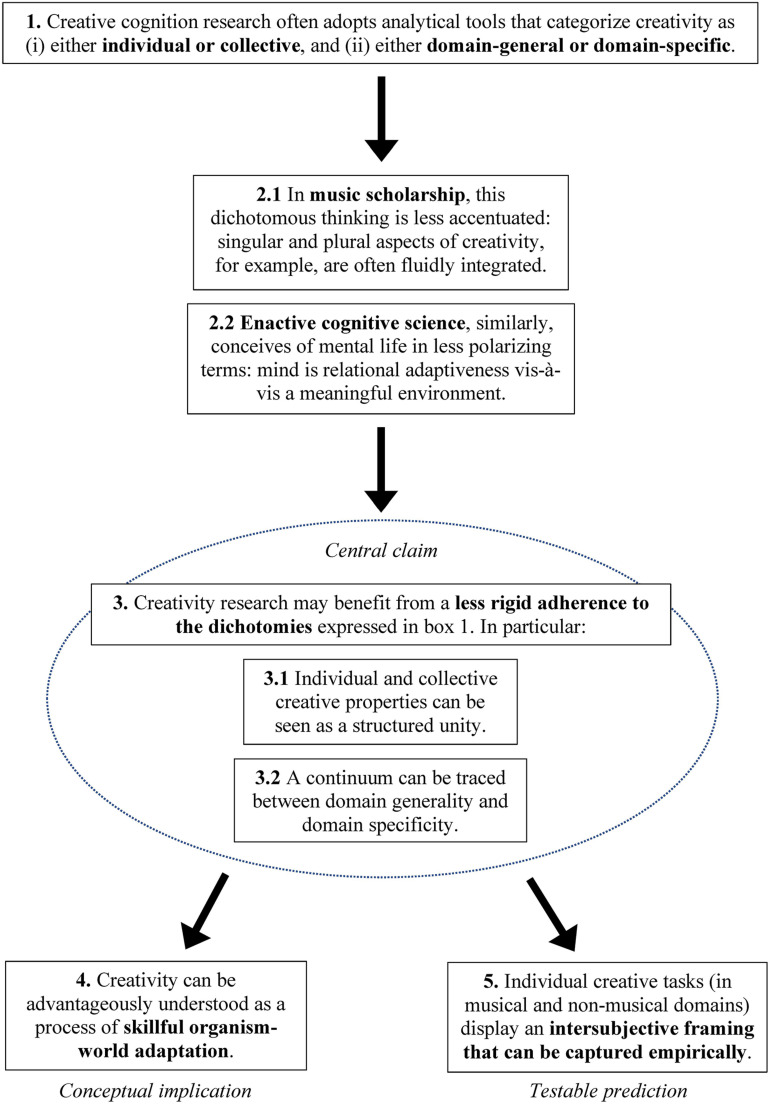
Current literature on creative cognition has developed rich conceptual landscapes dedicated to the analysis of both individual and collective forms of creativity. This work has favored the emergence of unifying theories on domain-general creative abilities in which the main experiential, behavioral, computational, and neural aspects involved in everyday creativity are examined and discussed. But while such accounts have gained important analytical leverage for describing the overall conditions and mechanisms through which creativity emerges and operates, they necessarily leave contextual forms of creativity less explored. Among the latter, musical practices have recently drawn the attention of scholars interested in its creative properties as well as in the creative potential of those who engage with them. In the present article, we compare previously posed theories of creativity in musical and non-musical domains to lay the basis of a conceptual framework that mitigates the tension between (i) individual and collective and (ii) domain-general and domain-specific perspectives on creativity. In doing so, we draw from a range of scholarship in music and enactive cognitive science, and propose that creative cognition may be best understood as a process of skillful organism-environment adaptation that one cultivates endlessly. With its focus on embodiment, plurality, and adaptiveness, our account points to a structured unity between living systems and their world, disclosing a variety of novel analytical resources for research and theory across different dimensions of (musical) creativity.
当前关于创造性认知的文献已经构建起丰富的概念框架,致力于分析个体和集体形式的创造力。这项工作推动了关于领域通用创造性能力的统一理论的出现,其中对日常创造力所涉及的主要经验、行为、计算和神经方面进行了审视和讨论。然而,尽管这些论述在描述创造力产生和运作的总体条件及机制方面获得了重要的分析优势,但它们必然较少探讨情境性的创造力形式。在后者当中,音乐实践最近引起了对其创造性特质以及参与其中者的创造潜力感兴趣的学者们的关注。在本文中,我们比较先前提出的音乐和非音乐领域的创造力理论,为一个概念框架奠定基础,该框架缓和了(一)个体与集体以及(二)领域通用与领域特定的创造力视角之间的紧张关系。在此过程中,我们借鉴了音乐和具身认知科学领域的一系列学术成果,并提出创造性认知或许最好被理解为一个个体不断培养的、巧妙的有机体与环境适应过程。基于对具身性、多元性和适应性的关注,我们的论述指出了生命系统与其世界之间的结构化统一,揭示了跨(音乐)创造力不同维度的研究和理论的各种新颖分析资源。