Howell Katharine R, Shrestha Pitambar, Dodd Ian C
Lancaster Environment Centre Lancaster University Lancaster LA1 4YQ UK.
Local Initiatives for Biodiversity Research and Development (LIBIRD) PO Box 324 Pokhara Nepal.
Food Energy Secur. 2015 Jul;4(2):144-157. doi: 10.1002/fes3.58. Epub 2015 May 22.
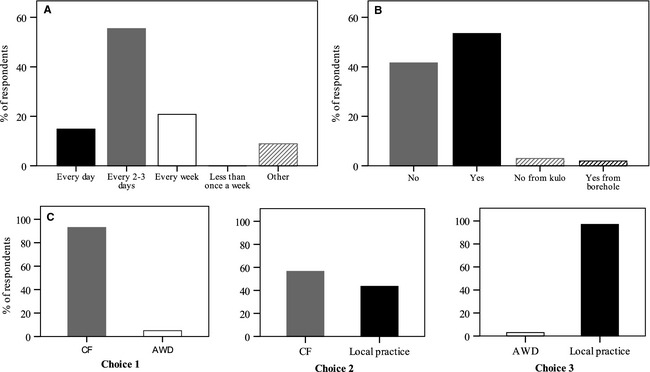
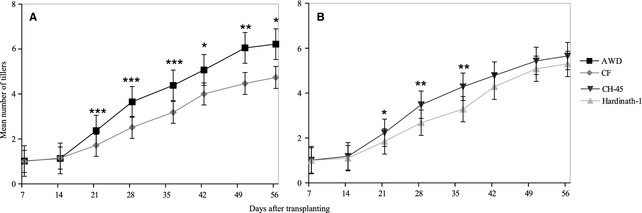
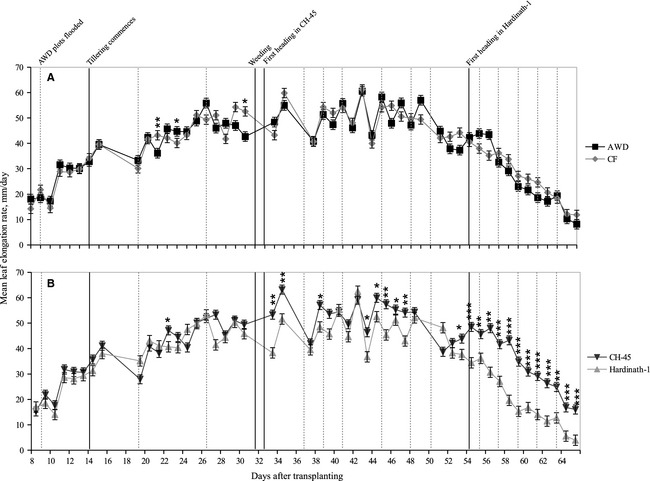
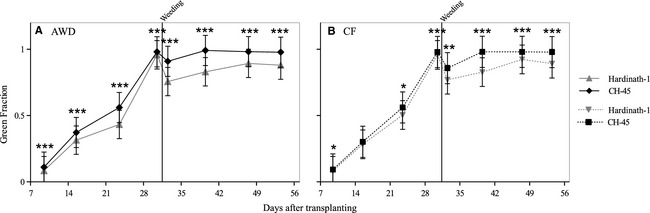
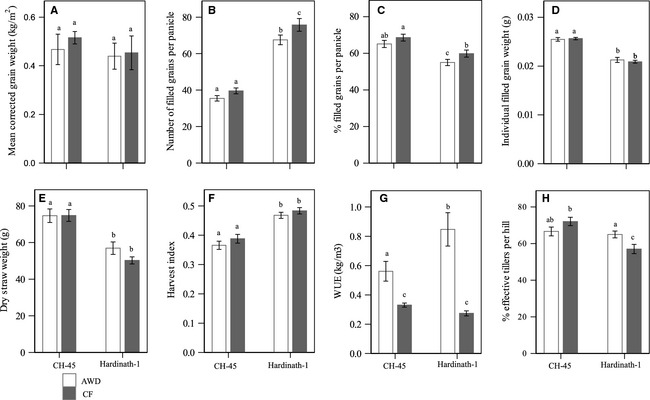
Alternate wetting and drying (AWD) irrigation can save water while maintaining rice yields, but in some countries its adoption by farmers remains limited. Key knowledge gaps include the effect of AWD on early vegetative vigor and its relationship with yield; the effects of AWD on yield and water use efficiency of local cultivars used by smallholder farmers; and the socio-economic factors influencing current irrigation scheduling. To address these questions, an on-farm field trial of dry-season () rice, comparing two locally important cultivars (Hardinath-1 and CH-45) under AWD imposed from 1 week after transplanting to flowering and continuous flooding (CF), was carried out in Agyauli in the central Terai region of Nepal, and triangulated with social research methods exploring the rationale for current irrigation scheduling and perceptions of AWD. Although AWD plots received on average 57% less irrigation water than CF plots, yields did not significantly differ between irrigation treatments, indicating that AWD could considerably enhance crop water use efficiency in this region. In the earlier flowering, more vigorous CH-45, there were no treatment differences in any yield component while in the later flowering Hardinath-1, an 11% decrease in filled grain number was compensated by a 14% increase in the percentage of effective tillers per hill. Although leaf elongation rate on the main tiller did not differ between treatments, tillering and green fraction (a measure of canopy closure) were significantly higher under AWD. Surveys established that most local farmers are already using a local adaptation of AWD to modify irrigation volumes, in some cases in response to a limited and unreliable water supply. However, farmers have few direct incentives to reduce overall water use under current water governance, and formal AWD practices are therefore unlikely to be adopted despite their viability as a water-saving irrigation technique.
干湿交替灌溉(AWD)在保持水稻产量的同时能够节水,但在一些国家,农民对其采用率仍然有限。关键的知识空白包括AWD对早期营养生长活力的影响及其与产量的关系;AWD对小农户使用的当地品种的产量和水分利用效率的影响;以及影响当前灌溉调度的社会经济因素。为了解决这些问题,在尼泊尔中部特莱地区的阿贾乌利进行了一项旱季水稻的田间试验,比较了两个当地重要品种(哈迪纳特-1和CH-45),从移栽后1周开始至开花期采用AWD和持续淹灌(CF),并结合社会研究方法进行三角测量,以探究当前灌溉调度的基本原理和对AWD的看法。尽管AWD地块的灌溉水量平均比CF地块少57%,但灌溉处理之间的产量没有显著差异,这表明AWD可以显著提高该地区作物的水分利用效率。在开花较早、生长更旺盛的CH-45品种中,各产量构成因素在处理间没有差异,而在开花较晚的哈迪纳特-1品种中,每穗实粒数减少11%,但每蔸有效分蘖率增加14%,从而得到了补偿。尽管主茎的叶片伸长率在处理间没有差异,但在AWD条件下,分蘖和绿叶部分(衡量冠层郁闭度的指标)显著更高。调查表明,大多数当地农民已经在采用当地改良的AWD来调整灌溉量,在某些情况下是为了应对有限且不可靠的供水。然而,在当前的水治理模式下,农民几乎没有直接的动力去减少总体用水量,因此,尽管AWD作为一种节水灌溉技术具有可行性,但正式的AWD做法不太可能被采用。