Bavo A M, Pouch A M, Degroote J, Vierendeels J, Gorman J H, Gorman R C, Segers P
ELIS Department, IBiTech-bioMMeda, Ghent University, Ghent, Belgium.
Gorman Cardiovascular Research Group, University of Pennsylvania, Philadelphia, PA, USA.
Biomed Eng Online. 2016 Sep 9;15(1):107. doi: 10.1186/s12938-016-0231-9.
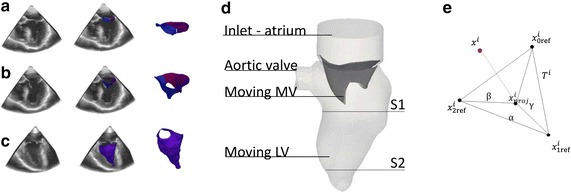
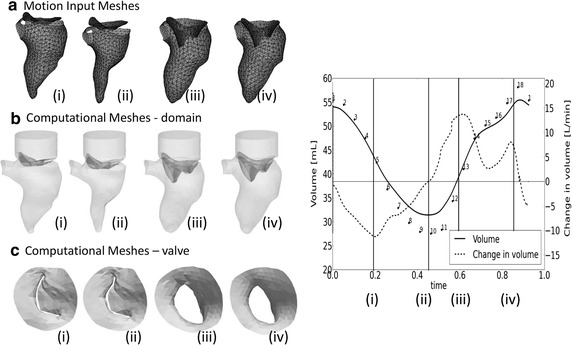
The goal of this paper is to present a computational fluid dynamic (CFD) model with moving boundaries to study the intraventricular flows in a patient-specific framework. Starting from the segmentation of real-time transesophageal echocardiographic images, a CFD model including the complete left ventricle and the moving 3D mitral valve was realized. Their motion, known as a function of time from the segmented ultrasound images, was imposed as a boundary condition in an Arbitrary Lagrangian-Eulerian framework.
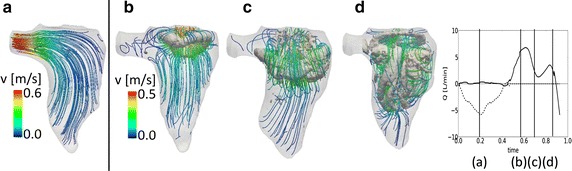
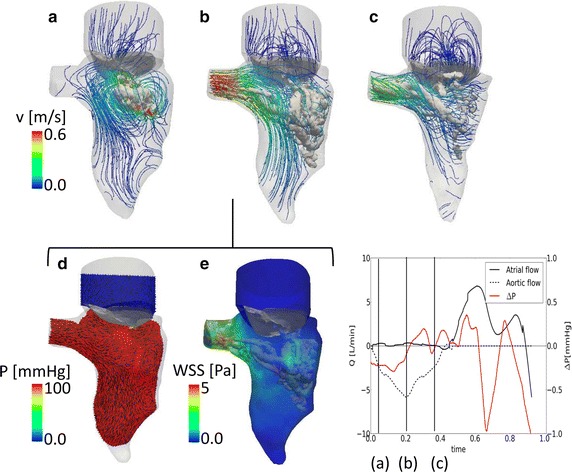
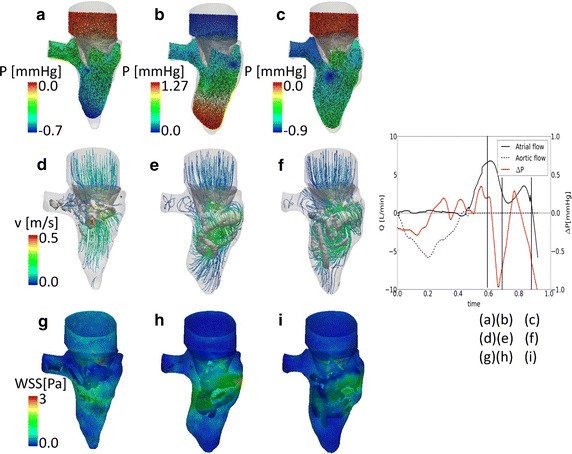
The model allowed for a realistic description of the displacement of the structures of interest and for an effective analysis of the intraventricular flows throughout the cardiac cycle. The model provides detailed intraventricular flow features, and highlights the importance of the 3D valve apparatus for the vortex dynamics and apical flow.
The proposed method could describe the haemodynamics of the left ventricle during the cardiac cycle. The methodology might therefore be of particular importance in patient treatment planning to assess the impact of mitral valve treatment on intraventricular flow dynamics.
本文的目的是提出一个具有移动边界的计算流体动力学(CFD)模型,以在患者特异性框架内研究心室内血流。从实时经食管超声心动图图像的分割开始,实现了一个包括完整左心室和移动三维二尖瓣的CFD模型。它们的运动作为时间的函数从分割后的超声图像中获取,并作为任意拉格朗日-欧拉框架中的边界条件施加。
该模型能够真实地描述感兴趣结构的位移,并有效地分析整个心动周期的心室内血流。该模型提供了详细的心室内血流特征,并突出了三维瓣膜装置对涡旋动力学和心尖血流的重要性。
所提出的方法可以描述心动周期期间左心室的血流动力学。因此,该方法在患者治疗计划中评估二尖瓣治疗对心室内血流动力学的影响可能具有特别重要的意义。