Shen Shengfu, Loh Tiing Jen, Shen Hongling, Zheng Xuexiu, Shen Haihong
Willston Northampton School, Easthampton, MA 01027, USA.
School of Life Sciences, Gwangju Institute of Science and Technology, Gwangju 61005, Korea.
BMB Rep. 2017 Jan;50(1):20-24. doi: 10.5483/bmbrep.2017.50.1.128.
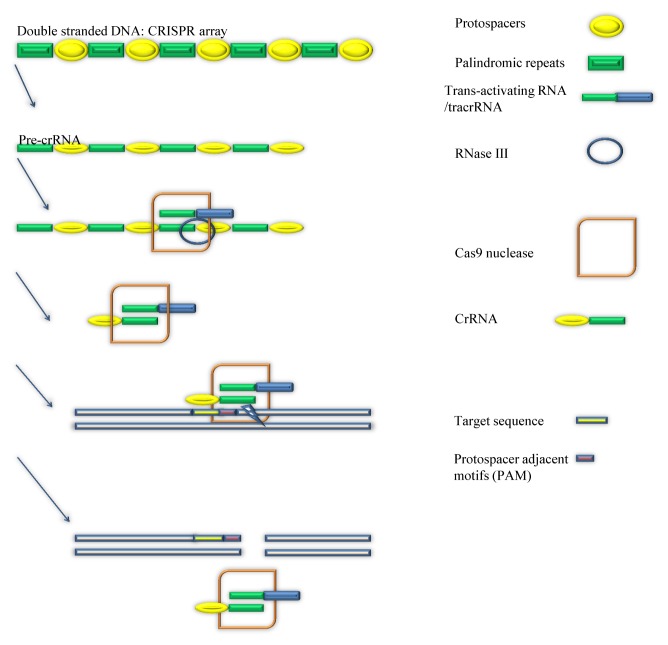
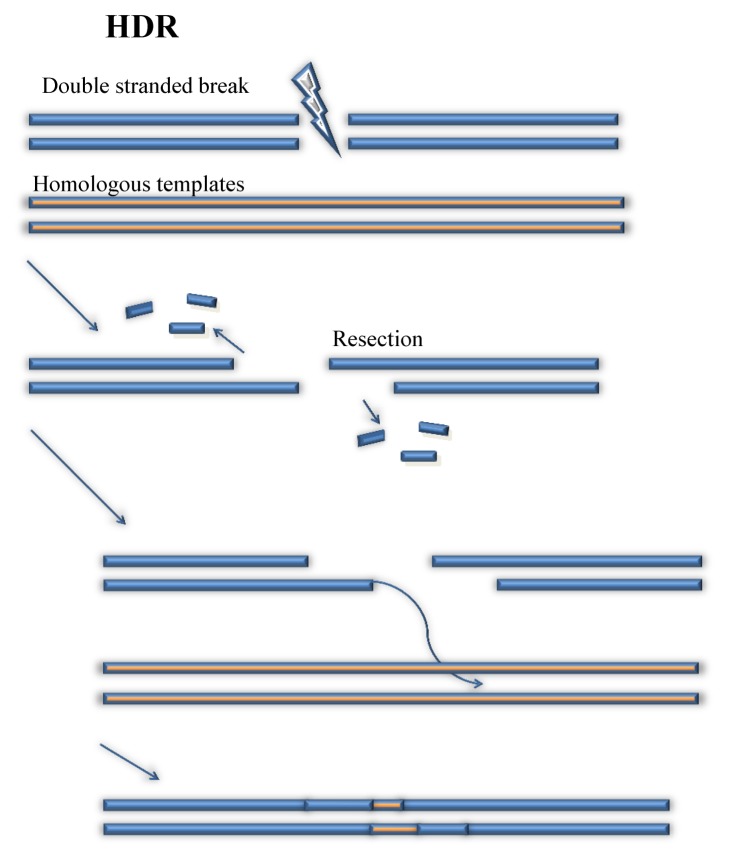
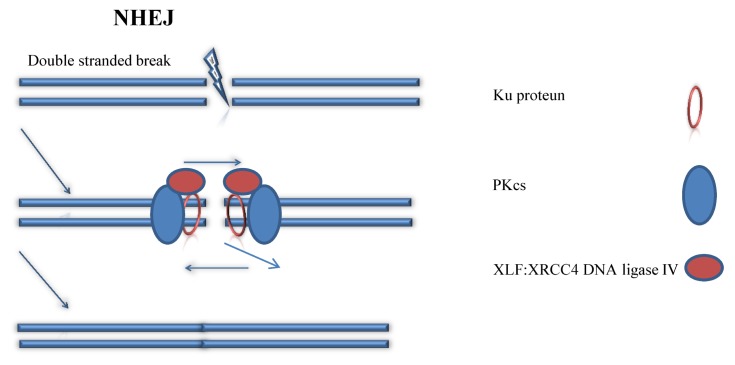
Clustered regularly-interspaced short palindromic repeats (CRISPR) is a new and effective genetic editing tool. CRISPR was initially found in bacteria to protect it from virus invasions. In the first step, specific DNA strands of virus are identified by guide RNA that is composed of crRNA and tracrRNA. Then RNAse III is required for producing crRNA from pre-crRNA. In The second step, a crRNA:tracrRNA:Cas9 complex guides RNase III to cleave target DNA. After cleavage of DNA by CRISPR-Cas9, DNA can be fixed by Non- Homologous End Joining (NHEJ) and Homology Directed Repair (HDR). Whereas NHEJ is simple and random, HDR is much more complex and accurate. Gene editing by CRISPR is able to be applied to various biological field such as agriculture and treating genetic diseases in human. [BMB Reports 2017; 50(1): 20-24].
成簇规律间隔短回文重复序列(CRISPR)是一种新型有效的基因编辑工具。CRISPR最初在细菌中被发现,用于保护其免受病毒入侵。第一步,由crRNA和tracrRNA组成的引导RNA识别病毒的特定DNA链。然后需要RNAse III从pre-crRNA产生crRNA。第二步,crRNA:tracrRNA:Cas9复合物引导RNase III切割靶DNA。CRISPR-Cas9切割DNA后,DNA可通过非同源末端连接(NHEJ)和同源定向修复(HDR)进行修复。NHEJ简单且随机,而HDR则更为复杂和精确。CRISPR介导的基因编辑能够应用于各种生物学领域,如农业和治疗人类遗传疾病。[《BMB报告》2017年;50(1): 20 - 24]