Dizon Janine Margarita, Machingaidze Shingai, Grimmer Karen
Faculty of Medicine and Health Sciences, Centre for Evidence-Based Health Care (CEBHC), Stellenbosch University, Francie van Zijl Drive, Tygerberg, Cape Town, 7505, South Africa.
Center for Health Research and Movement Science, College of Rehabilitation Sciences, University of Santo Tomas, 1018, Manila, Philippines.
BMC Res Notes. 2016 Sep 13;9(1):442. doi: 10.1186/s13104-016-2244-7.
Developing new clinical practice guidelines (CPGs) can be time-consuming and expensive. A more efficient approach could be to adopt, adapt or contextualise recommendations from existing good quality CPGs so that the resultant guidance is tailored to the local context.
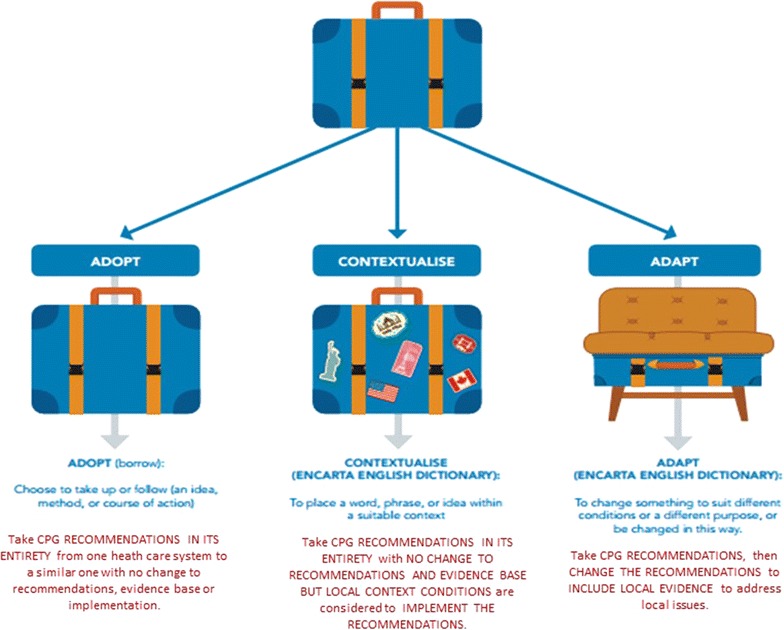
The first steps are to search for international CPGs that have a similar purpose, end-users and patients to your situation. The second step is to critically appraise the methodological quality of the CPGs to ensure that your guidance is based on credible evidence. Then the decisions begin. Can you simply 'adopt' this (parent) clinical practice guidelines, and implement the recommendations in their entirety, without any changes, in your setting? If so, then no further work is required. However this situation is rare. What is more likely, is that even if recommendations from the parent clinical practice guidelines can be adopted, how they are implemented needs to address local issues. Thus you may need to 'contextualise' the guidance, by addressing implementation issues such as local workforce, training, health systems, equipment and/or access to services. Generally this means that additional information is required (Practice/Context Points) to support effective implementation of the clinical practice guidelines recommendations. In some cases, you may need to 'adapt' the guidance, where you will make changes to the recommendations so that care is relevant to your local environments. This may involve additional work to search for local research, or obtain local consensus, regarding how best to adapt recommendations. For example, adaptation might reflect substituting one drug for another (drugs have similar effects, but the alternative drug to the recommended one may be cheaper, more easily obtained or more culturally acceptable). There is lack of standardisation of clinical practice guidelines terminology, leading clinical practice guideline activities often being poorly conceptualised or reported. We provide an approach that would help improve efficiency and standardisation of clinical practice guidelines activities.
制定新的临床实践指南可能既耗时又昂贵。一种更有效的方法可能是采用、调整或根据现有高质量临床实践指南的建议进行情境化处理,以便最终的指南能够适应当地情况。
第一步是寻找与你的情况具有相似目的、最终用户和患者的国际临床实践指南。第二步是严格评估临床实践指南的方法学质量,以确保你的指南基于可靠的证据。然后决策开始。你能否简单地“采用”这份(母本)临床实践指南,并在你的环境中不加任何修改地完全实施这些建议?如果可以,那么无需进一步工作。然而这种情况很少见。更有可能的是,即使可以采用母本临床实践指南的建议,其实施方式也需要解决当地问题。因此,你可能需要通过解决诸如当地劳动力、培训、卫生系统、设备和/或服务可及性等实施问题,对指南进行“情境化”处理。通常这意味着需要额外的信息(实践/情境要点)来支持临床实践指南建议的有效实施。在某些情况下,你可能需要“调整”指南,即对建议进行修改,以使护理与当地环境相关。这可能涉及额外的工作,以寻找关于如何最佳调整建议的当地研究或达成当地共识。例如,调整可能意味着用一种药物替代另一种药物(两种药物效果相似,但替代推荐药物的另一种药物可能更便宜、更容易获得或在文化上更易接受)。临床实践指南术语缺乏标准化,导致临床实践指南活动往往概念不清或报告不佳。我们提供一种有助于提高临床实践指南活动效率和标准化的方法。