Scult M A, Paulli A R, Mazure E S, Moffitt T E, Hariri A R, Strauman T J
Department of Psychology & Neuroscience,Duke University,Durham, NC,USA.
Duke University Medical Center Library & Archives, Duke University Medical Center,Durham, NC,USA.
Psychol Med. 2017 Jan;47(1):1-17. doi: 10.1017/S0033291716002075. Epub 2016 Sep 14.
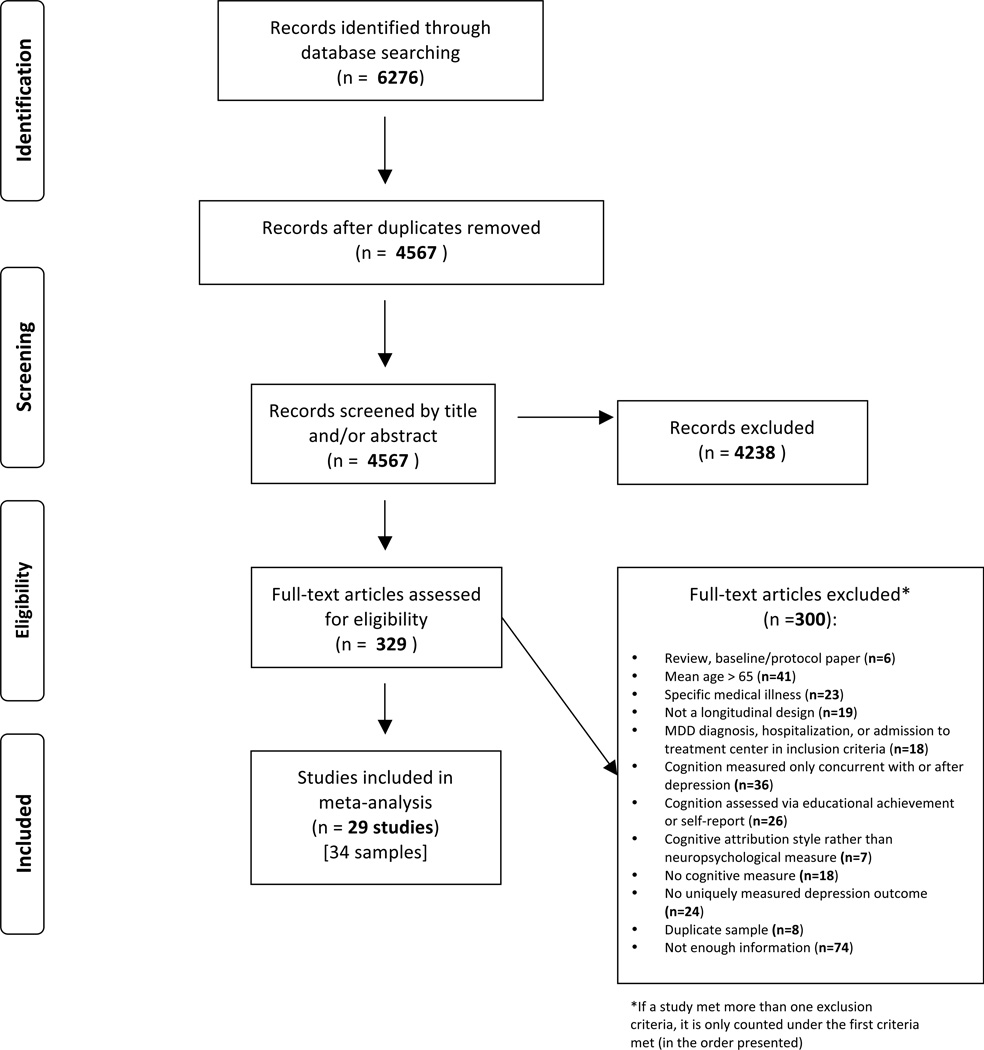
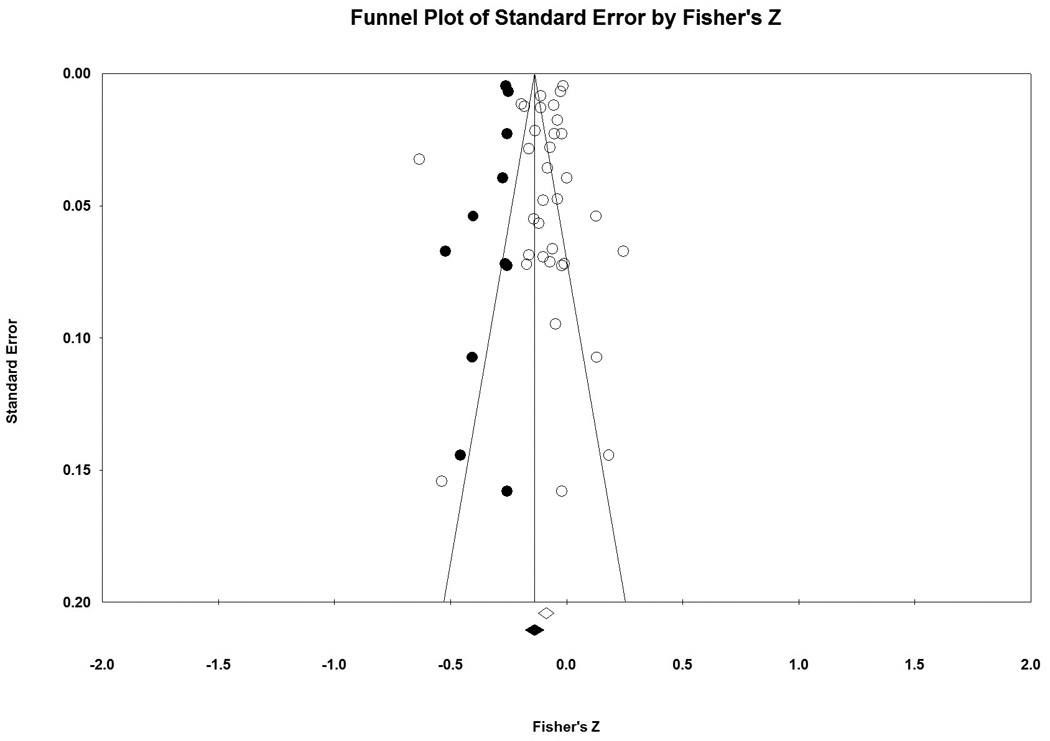
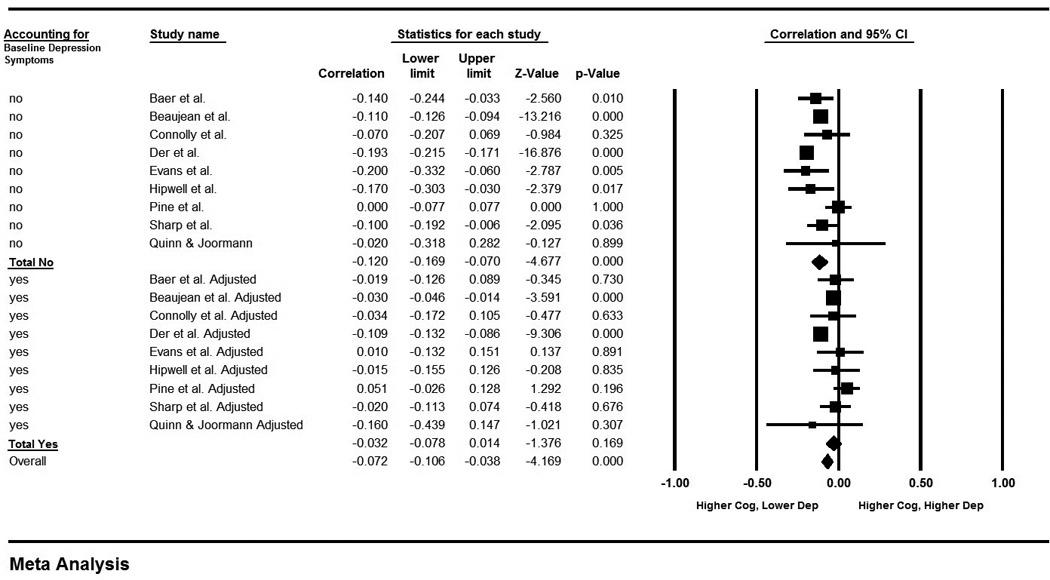
Despite a growing interest in understanding the cognitive deficits associated with major depressive disorder (MDD), it is largely unknown whether such deficits exist before disorder onset or how they might influence the severity of subsequent illness. The purpose of the present study was to conduct a systematic review and meta-analysis of longitudinal datasets to determine whether cognitive function acts as a predictor of later MDD diagnosis or change in depression symptoms. Eligible studies included longitudinal designs with baseline measures of cognitive functioning, and later unipolar MDD diagnosis or symptom assessment. The systematic review identified 29 publications, representing 34 unique samples, and 121 749 participants, that met the inclusion/exclusion criteria. Quantitative meta-analysis demonstrated that higher cognitive function was associated with decreased levels of subsequent depression (r = -0.088, 95% confidence interval. -0.121 to -0.054, p < 0.001). However, sensitivity analyses revealed that this association is likely driven by concurrent depression symptoms at the time of cognitive assessment. Our review and meta-analysis indicate that the association between lower cognitive function and later depression is confounded by the presence of contemporaneous depression symptoms at the time of cognitive assessment. Thus, cognitive deficits predicting MDD likely represent deleterious effects of subclinical depression symptoms on performance rather than premorbid risk factors for disorder.
尽管人们对理解与重度抑郁症(MDD)相关的认知缺陷的兴趣日益浓厚,但在很大程度上尚不清楚这些缺陷是否在疾病发作之前就已存在,以及它们如何可能影响后续疾病的严重程度。本研究的目的是对纵向数据集进行系统评价和荟萃分析,以确定认知功能是否可作为后期MDD诊断或抑郁症状变化的预测指标。符合条件的研究包括具有认知功能基线测量以及后期单相MDD诊断或症状评估的纵向设计。该系统评价确定了29篇出版物,代表34个独特样本和121749名参与者,符合纳入/排除标准。定量荟萃分析表明,较高的认知功能与后续抑郁水平降低相关(r = -0.088,95%置信区间为-0.121至-0.054,p < 0.001)。然而,敏感性分析显示,这种关联可能是由认知评估时同时存在的抑郁症状驱动的。我们的评价和荟萃分析表明,较低的认知功能与后期抑郁之间的关联因认知评估时同时存在的抑郁症状而混淆。因此,预测MDD的认知缺陷可能代表亚临床抑郁症状对表现的有害影响,而不是疾病的病前危险因素。