Lovely C, Rampersad Mindy, Fernandes Yohaan, Eberhart Johann
Department of Molecular Biosciences, University of Texas at Austin, Austin, TX, USA.
Wiley Interdiscip Rev Dev Biol. 2017 Jan;6(1). doi: 10.1002/wdev.247. Epub 2016 Sep 14.
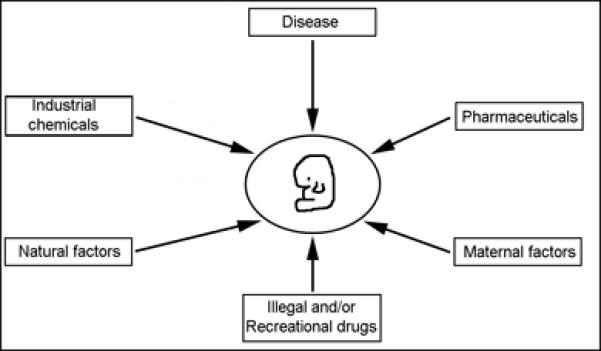
Developmental geneticists continue to make substantial jumps in our understanding of the genetic pathways that regulate development. This understanding stems predominantly from analyses of genetically tractable model organisms developing in laboratory environments. This environment is vastly different from that in which human development occurs. As such, most causes of developmental defects in humans are thought to involve multifactorial gene-gene and gene-environment interactions. In this review, we discuss how gene-environment interactions with environmental teratogens may predispose embryos to structural malformations. We elaborate on the growing number of gene-ethanol interactions that might underlie susceptibility to fetal alcohol spectrum disorders. WIREs Dev Biol 2017, 6:e247. doi: 10.1002/wdev.247 For further resources related to this article, please visit the WIREs website.
发育遗传学家在我们对调控发育的遗传途径的理解上持续取得重大进展。这种理解主要源于对在实验室环境中发育的易于进行遗传学研究的模式生物的分析。这种环境与人类发育所处的环境大不相同。因此,人们认为人类发育缺陷的大多数原因涉及多因素的基因-基因和基因-环境相互作用。在这篇综述中,我们讨论基因与环境致畸物的相互作用如何可能使胚胎易患结构畸形。我们详细阐述了越来越多可能是胎儿酒精谱系障碍易感性基础的基因-乙醇相互作用。《WIREs发育生物学》2017年,6:e247。doi:10.1002/wdev.247 有关本文的更多资源,请访问WIREs网站。