Dunker Kristine J, Sepulveda Adam J, Massengill Robert L, Olsen Jeffrey B, Russ Ora L, Wenburg John K, Antonovich Anton
Alaska Department of Fish and Game, Sport Fish Division, Anchorage, Alaska, United States of America.
U.S. Geological Survey, Northern Rocky Mountain Science Center, Bozeman, Montana, United States of America.
PLoS One. 2016 Sep 14;11(9):e0162277. doi: 10.1371/journal.pone.0162277. eCollection 2016.
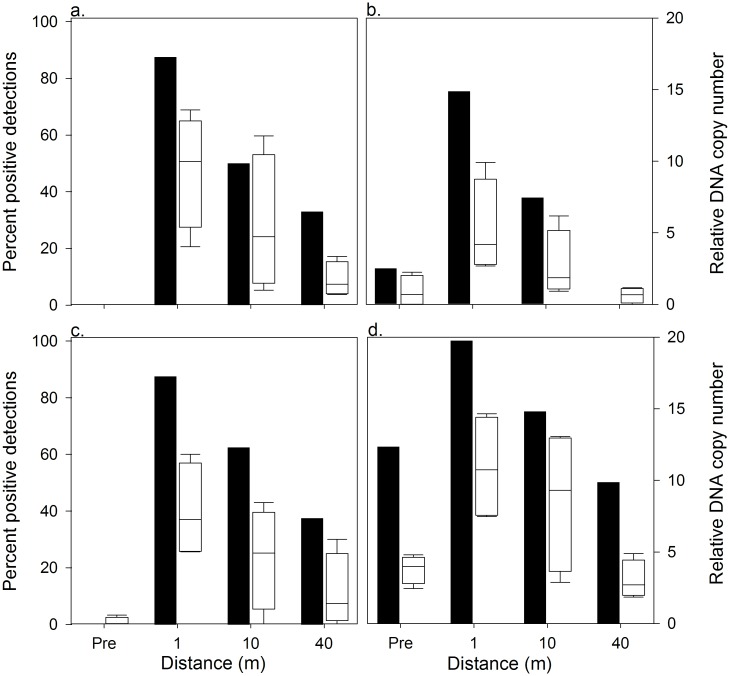
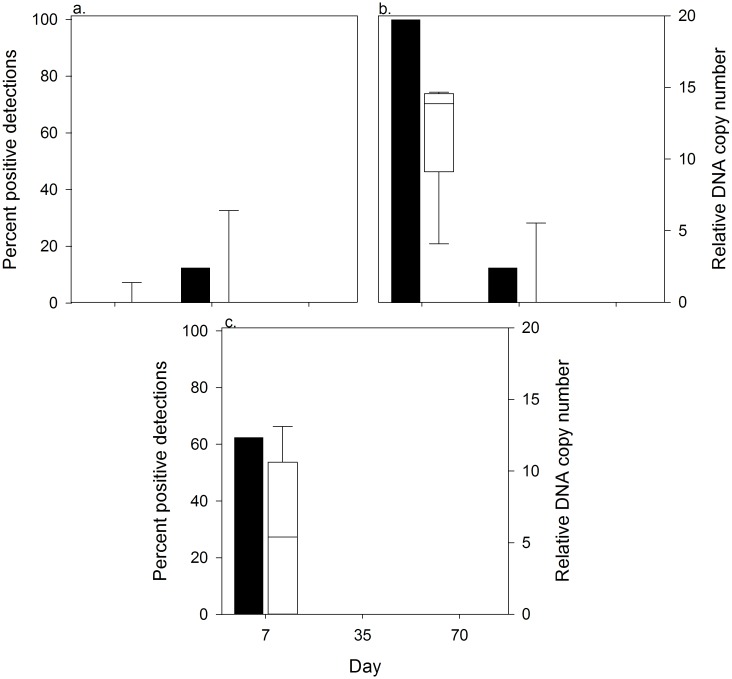
Determining the success of invasive species eradication efforts is challenging because populations at very low abundance are difficult to detect. Environmental DNA (eDNA) sampling has recently emerged as a powerful tool for detecting rare aquatic animals; however, detectable fragments of DNA can persist over time despite absence of the targeted taxa and can therefore complicate eDNA sampling after an eradication event. This complication is a large concern for fish eradication efforts in lakes since killed fish can sink to the bottom and slowly decay. DNA released from these carcasses may remain detectable for long periods. Here, we evaluated the efficacy of eDNA sampling to detect invasive Northern pike (Esox lucius) following piscicide eradication efforts in southcentral Alaskan lakes. We used field observations and experiments to test the sensitivity of our Northern pike eDNA assay and to evaluate the persistence of detectable DNA emitted from Northern pike carcasses. We then used eDNA sampling and traditional sampling (i.e., gillnets) to test for presence of Northern pike in four lakes subjected to a piscicide-treatment designed to eradicate this species. We found that our assay could detect an abundant, free-roaming population of Northern pike and could also detect low-densities of Northern pike held in cages. For these caged Northern pike, probability of detection decreased with distance from the cage. We then stocked three lakes with Northern pike carcasses and collected eDNA samples 7, 35 and 70 days post-stocking. We detected DNA at 7 and 35 days, but not at 70 days. Finally, we collected eDNA samples ~ 230 days after four lakes were subjected to piscicide-treatments and detected Northern pike DNA in 3 of 179 samples, with a single detection at each of three lakes, though we did not catch any Northern pike in gillnets. Taken together, we found that eDNA can help to inform eradication efforts if used in conjunction with multiple lines of inquiry and sampling is delayed long enough to allow full degradation of DNA in the water.
确定入侵物种根除工作的成效具有挑战性,因为极低丰度的种群很难被检测到。环境DNA(eDNA)采样最近已成为检测珍稀水生动物的有力工具;然而,尽管目标分类群不存在,但可检测到的DNA片段可能会随着时间持续存在,因此在根除事件后会使eDNA采样变得复杂。这种复杂性是湖泊鱼类根除工作的一大担忧,因为被杀死的鱼会沉入水底并慢慢腐烂。这些尸体释放的DNA可能会在很长一段时间内保持可检测状态。在此,我们评估了在阿拉斯加中南部湖泊进行鱼药根除工作后,eDNA采样检测入侵性白斑狗鱼(Esox lucius)的效果。我们通过实地观察和实验来测试我们的白斑狗鱼eDNA检测方法的灵敏度,并评估白斑狗鱼尸体释放的可检测DNA的持久性。然后,我们使用eDNA采样和传统采样(即刺网)来检测四个经过鱼药处理以根除该物种的湖泊中是否存在白斑狗鱼。我们发现,我们的检测方法能够检测到数量众多、自由游动的白斑狗鱼种群,也能检测到关在笼子里低密度的白斑狗鱼。对于这些关在笼子里的白斑狗鱼,检测概率随着与笼子距离的增加而降低。然后,我们在三个湖泊中投放了白斑狗鱼尸体,并在投放后7天、35天和70天采集eDNA样本。我们在7天和35天检测到了DNA,但在70天未检测到。最后,在四个湖泊接受鱼药处理约230天后,我们采集了eDNA样本,在179个样本中的3个检测到了白斑狗鱼DNA,在三个湖泊中的每个湖泊各有一次检测到,尽管我们用刺网没有捕到任何白斑狗鱼。综合来看,我们发现,如果与多条调查线结合使用,并且采样延迟足够长的时间以使水中的DNA完全降解,eDNA可以有助于为根除工作提供信息。