Research Institute for Humanity and Nature, Kyoto, Japan.
PLoS One. 2012;7(4):e35868. doi: 10.1371/journal.pone.0035868. Epub 2012 Apr 26.
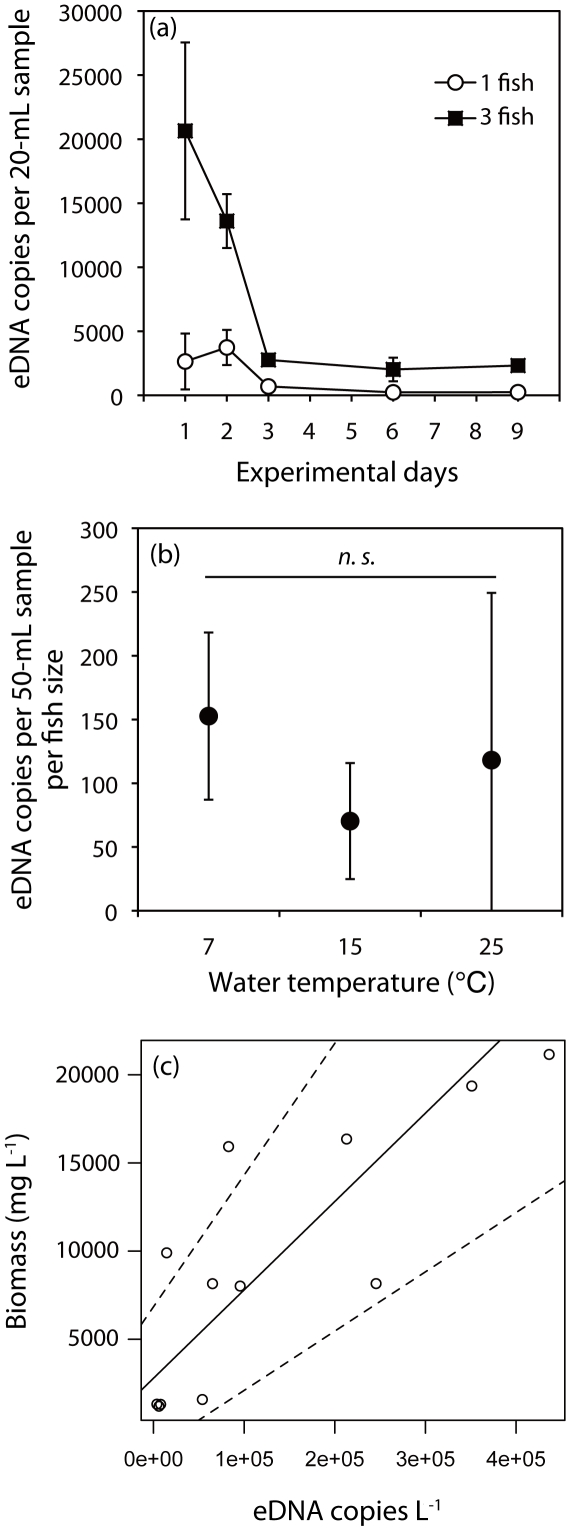
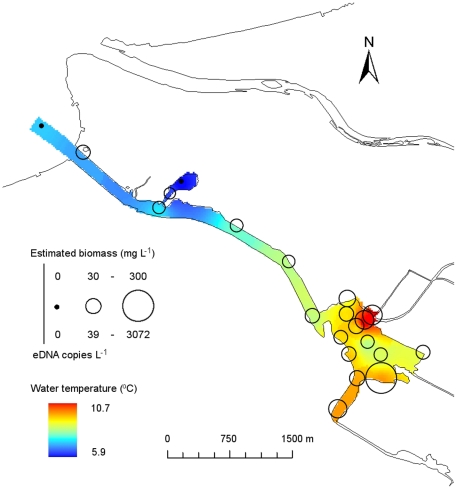
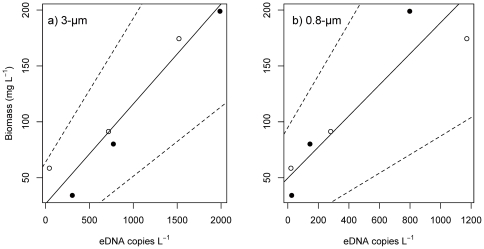
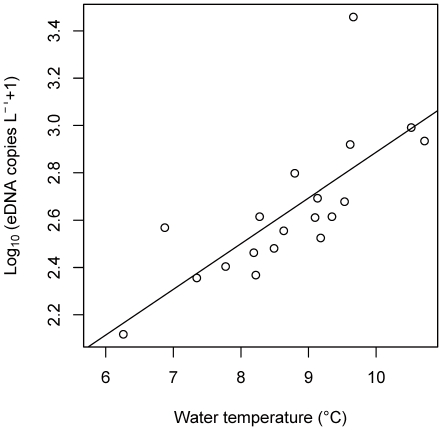
Environmental DNA (eDNA) from aquatic vertebrates has recently been used to estimate the presence of a species. We hypothesized that fish release DNA into the water at a rate commensurate with their biomass. Thus, the concentration of eDNA of a target species may be used to estimate the species biomass. We developed an eDNA method to estimate the biomass of common carp (Cyprinus carpio L.) using laboratory and field experiments. In the aquarium, the concentration of eDNA changed initially, but reached an equilibrium after 6 days. Temperature had no effect on eDNA concentrations in aquaria. The concentration of eDNA was positively correlated with carp biomass in both aquaria and experimental ponds. We used this method to estimate the biomass and distribution of carp in a natural freshwater lagoon. We demonstrated that the distribution of carp eDNA concentration was explained by water temperature. Our results suggest that biomass data estimated from eDNA concentration reflects the potential distribution of common carp in the natural environment. Measuring eDNA concentration offers a non-invasive, simple, and rapid method for estimating biomass. This method could inform management plans for the conservation of ecosystems.
环境 DNA(eDNA)最近被用于估计水生脊椎动物的存在。我们假设鱼类以与其生物量相称的速度将 DNA 释放到水中。因此,目标物种的 eDNA 浓度可用于估计物种的生物量。我们使用实验室和野外实验开发了一种使用 eDNA 方法来估计鲤鱼(Cyprinus carpio L.)的生物量。在水族箱中,eDNA 的浓度最初发生变化,但在 6 天后达到平衡。温度对水族箱中的 eDNA 浓度没有影响。eDNA 浓度与水族箱和实验池塘中的鲤鱼生物量呈正相关。我们使用这种方法来估计天然淡水泻湖中鲤鱼的生物量和分布。我们证明了鲤鱼 eDNA 浓度的分布受水温的解释。我们的结果表明,从 eDNA 浓度估计的生物量数据反映了鲤鱼在自然环境中的潜在分布。测量 eDNA 浓度提供了一种非侵入性、简单、快速的估计生物量的方法。这种方法可以为保护生态系统的管理计划提供信息。