Klepin Heidi D, Tooze Janet A, Pardee Timothy S, Ellis Leslie R, Berenzon Dmitriy, Mihalko Shannon L, Danhauer Suzanne C, Rao Arati V, Wildes Tanya M, Williamson Jeff D, Powell Bayard L, Kritchevsky Stephen B
Wake Forest Baptist Comprehensive Cancer Center, Wake Forest University, Winston-Salem, North Carolina.
Division of Public Health Sciences, Wake Forest School of Medicine, Wake Forest University, Winston-Salem, North Carolina.
J Am Geriatr Soc. 2016 Oct;64(10):1988-1995. doi: 10.1111/jgs.14301. Epub 2016 Sep 14.
To measure short-term changes in physical and cognitive function and emotional well-being of older adults receiving intensive chemotherapy for acute myeloid leukemia (AML).
Prospective observational study.
Single academic institution.
Individuals aged 60 and older with newly diagnosed AML who received induction chemotherapy (N = 49, mean age 70 ± 6.2, 56% male).
Geriatric assessment (GA) was performed during inpatient examination for AML and within 8 weeks after hospital discharge after induction chemotherapy. Measures were the Pepper Assessment Tool for Disability (activity of daily living, instrumental activity of daily living (IADL), mobility questions), Short Physical Performance Battery (SPPB), grip strength, Modified Mini-Mental State examination, Center for Epidemiologic Studies Depression Scale, and the Distress Thermometer. Changes in GA measures were assessed using paired t-tests. Analysis of variance models were used to evaluate relationships between GA variables and change in function over time.
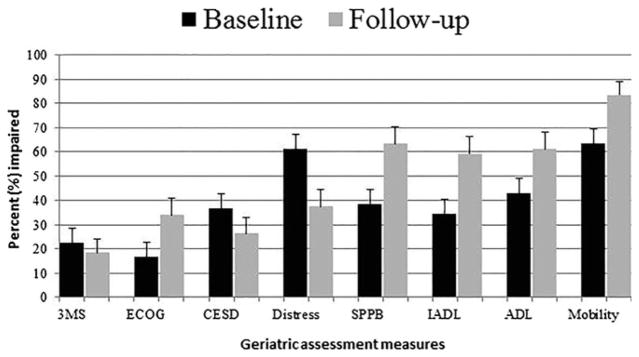
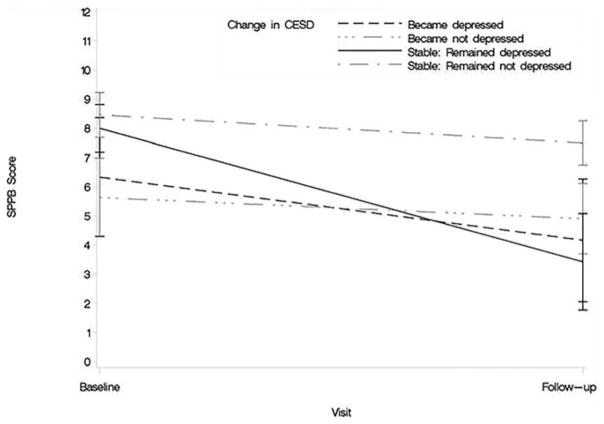
After chemotherapy, IADL dependence worsened (mean 1.4 baseline vs 2.1 follow-up, P < .001), as did mean SPPB scores (7.5 vs 5.9, P = .02 for total). Grip strength also declined (38.9 ± 7.7 vs 34.2 ± 10.3 kg, P < .001 for men; 24.5 ± 4.8 vs 21.8 ± 4.7 kg, P = .007 for women). No significant changes in cognitive function (mean 84.7 vs 85.1, P = .72) or depressive symptoms (14.0 vs. 11.3, P = .11) were detected, but symptoms of distress declined (5.0 vs 3.2, P < .001). Participants with depressive symptoms at baseline and follow-up had greater declines in SPPB scores those without at both time points.
Short-term survivors of intensive chemotherapy for AML had clinically meaningful declines in physical function. These data support the importance of interventions to maintain physical function during and after chemotherapy. Depressive symptoms before and during chemotherapy may be linked to potentially modifiable physical function declines.
测量接受急性髓系白血病(AML)强化化疗的老年人身体和认知功能以及情绪健康的短期变化。
前瞻性观察研究。
单一学术机构。
60岁及以上新诊断为AML且接受诱导化疗的个体(N = 49,平均年龄70±6.2岁,56%为男性)。
在AML住院检查期间以及诱导化疗出院后8周内进行老年评估(GA)。测量工具包括佩珀残疾评估工具(日常生活活动、工具性日常生活活动(IADL)、活动能力问题)、简短体能测试电池(SPPB)、握力、改良简易精神状态检查、流行病学研究中心抑郁量表以及痛苦温度计。使用配对t检验评估GA测量值的变化。方差分析模型用于评估GA变量与功能随时间变化之间的关系。
化疗后,IADL依赖情况恶化(平均基线值1.4 vs随访值2.1,P <.001),SPPB总分也下降(7.5 vs 5.9,P =.02)。握力也下降(男性:38.9±7.7 vs 34.2±10.3 kg,P <.001;女性:24.5±4.8 vs 21.8±4.7 kg,P =.007)。未检测到认知功能(平均84.7 vs 85.1,P =.72)或抑郁症状(14.0 vs. 11.3,P =.11)有显著变化,但痛苦症状有所下降(5.0 vs 3.2,P <.001)。在基线和随访时都有抑郁症状的参与者,其SPPB分数下降幅度比在两个时间点都没有抑郁症状的参与者更大。
AML强化化疗的短期幸存者身体功能出现了具有临床意义的下降。这些数据支持了在化疗期间及化疗后进行干预以维持身体功能的重要性。化疗前和化疗期间的抑郁症状可能与潜在的可改变的身体功能下降有关。