• 文献检索
  • 文档翻译
  • 深度研究
  • 学术资讯
  • Suppr Zotero 插件Zotero 插件
  • 邀请有礼
  • 套餐&价格
  • 历史记录
应用&插件
Suppr Zotero 插件Zotero 插件浏览器插件Mac 客户端Windows 客户端微信小程序
定价
高级版会员购买积分包购买API积分包
服务
文献检索文档翻译深度研究API 文档MCP 服务
关于我们
关于 Suppr公司介绍联系我们用户协议隐私条款
关注我们

Suppr 超能文献

核心技术专利:CN118964589B侵权必究
粤ICP备2023148730 号-1Suppr @ 2026

文献检索

告别复杂PubMed语法,用中文像聊天一样搜索,搜遍4000万医学文献。AI智能推荐,让科研检索更轻松。

立即免费搜索

文件翻译

保留排版,准确专业,支持PDF/Word/PPT等文件格式,支持 12+语言互译。

免费翻译文档

深度研究

AI帮你快速写综述,25分钟生成高质量综述,智能提取关键信息,辅助科研写作。

立即免费体验

使用基于口腔液的艾滋病毒快速检测方法进行监督下自我检测的可行性:印度农村孕妇的横断面混合方法研究

Feasibility of supervised self-testing using an oral fluid-based HIV rapid testing method: a cross-sectional, mixed method study among pregnant women in rural India.

作者信息

Sarkar Archana, Mburu Gitau, Shivkumar Poonam Varma, Sharma Pankhuri, Campbell Fiona, Behera Jagannath, Dargan Ritu, Mishra Surendra Kumar, Mehra Sunil

机构信息

Research, Innovations, and Monitoring Unit, MAMTA Health Institute for Mother & Child, New Delhi, India;

Program Impact Unit, International HIV/AIDS Alliance, East Sussex, UK.

出版信息

J Int AIDS Soc. 2016 Sep 12;19(1):20993. doi: 10.7448/IAS.19.1.20993. eCollection 2016.

DOI:10.7448/IAS.19.1.20993
PMID:27630096
原文链接:https://pmc.ncbi.nlm.nih.gov/articles/PMC5023853/
Abstract

INTRODUCTION

HIV self-testing can increase coverage of essential HIV services. This study aimed to establish the acceptability, concordance and feasibility of supervised HIV self-testing among pregnant women in rural India.

METHODS

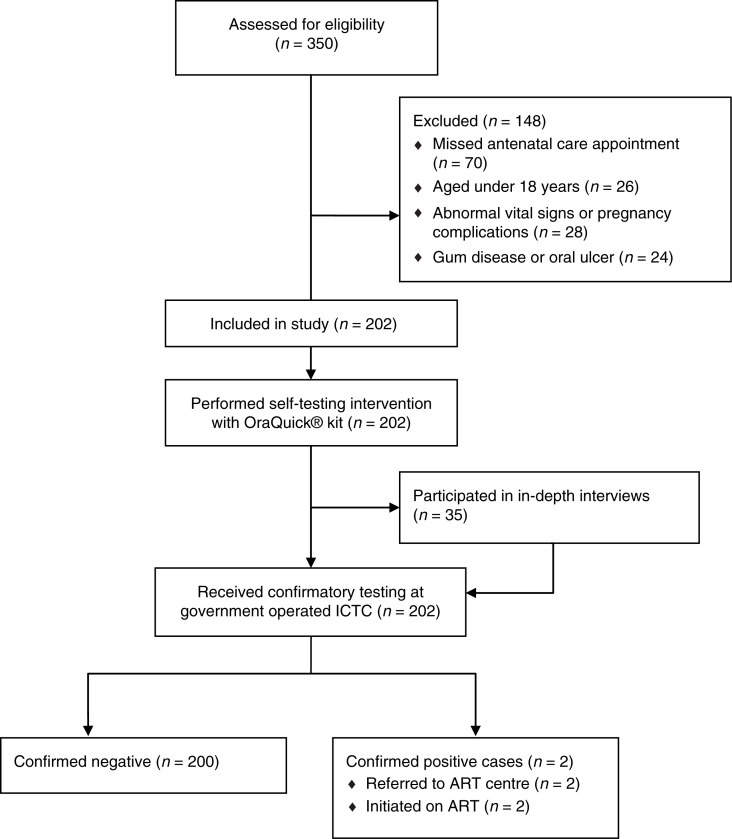
A cross-sectional, mixed methods study was conducted among 202 consenting pregnant women in a rural Indian hospital between August 2014 and January 2015. Participants were provided with instructions on how to self-test using OraQuick(®) HIV antibody test, and subsequently asked to self-test under supervision of a community health worker. Test results were confirmed at a government-run integrated counselling and testing centre. A questionnaire was used to obtain information on patient demographics and the ease, acceptability and difficulties of self-testing. In-depth interviews were conducted with a sub-sample of 35 participants to understand their experiences.

RESULTS

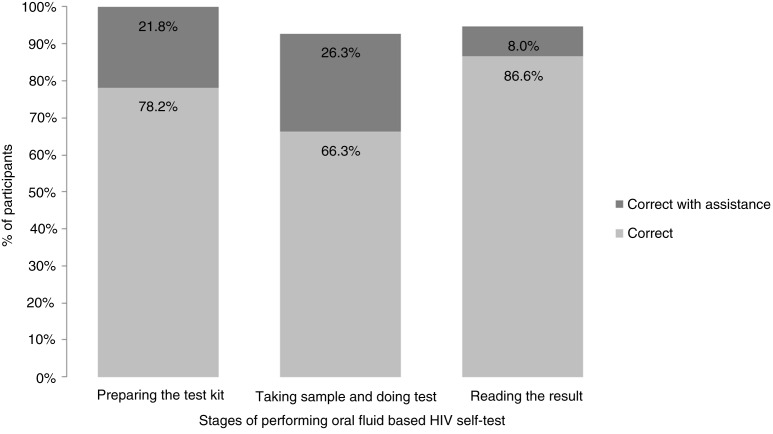
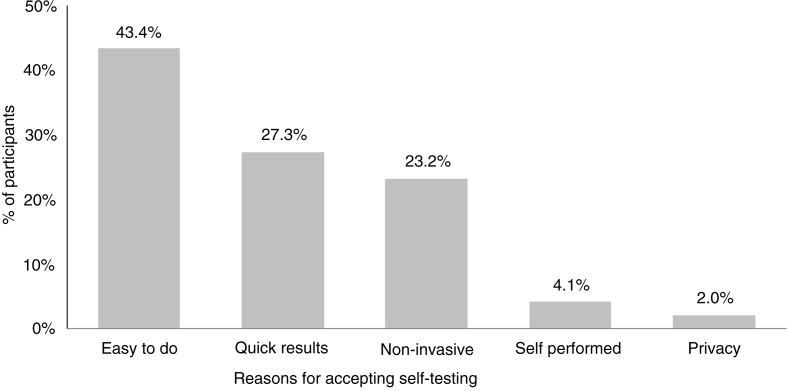
In total, 202 participants performed the non-invasive, oral fluid-based, rapid test under supervision for HIV screening. Acceptance rate was 100%. Motivators for self-testing included: ease of testing (43.4%), quick results (27.3%) and non-invasive procedure (23.2%). Sensitivity and specificity were 100% for 201 tests, and one test was invalid. Concordance of test result interpretation between community health workers and participants was 98.5% with a Cohen's Kappa (k) value of k=0.566 with p<0.001 for inter-rater agreement. Although 92.6% participants reported that the instructions for the test were easy to understand, 18.7% required the assistance of a supervisor to self-test. Major themes that emerged from the qualitative interviews indicated the importance of the following factors in influencing acceptability of self-testing: clarity and accessibility of test instructions; time-efficiency and convenience of testing; non-invasiveness of the test; and fear of incorrect results. Overall, 96.5% of the participants recommended that the OraQuick(®) test kits should become publicly available.

CONCLUSIONS

Self-testing for HIV status using an oral fluid-based rapid test under the supervision of a community health worker was acceptable and feasible among pregnant women in rural India. Participants were supportive of making self-testing publicly available. Policy guidelines and implementation research are required to advance HIV self-testing for larger populations at scale.

摘要

引言

艾滋病毒自我检测可提高基本艾滋病毒服务的覆盖范围。本研究旨在确定印度农村地区孕妇接受监督的艾滋病毒自我检测的可接受性、一致性和可行性。

方法

2014年8月至2015年1月期间,在印度一家农村医院对202名同意参与的孕妇进行了一项横断面混合方法研究。向参与者提供了如何使用奥芮可(®)艾滋病毒抗体检测进行自我检测的说明,随后要求她们在社区卫生工作者的监督下进行自我检测。检测结果在政府运营的综合咨询和检测中心得到确认。使用问卷调查获取患者人口统计学信息以及自我检测的难易程度、可接受性和困难情况。对35名参与者的子样本进行了深入访谈,以了解她们的经历。

结果

共有202名参与者在监督下进行了非侵入性的基于口腔液的快速艾滋病毒筛查检测。接受率为100%。自我检测的动机包括:检测简便(43.4%)、结果快速(27.3%)和检测非侵入性(23.2%)。201次检测的灵敏度和特异性均为100%,一次检测无效。社区卫生工作者与参与者之间检测结果解读的一致性为98.5%,科恩kappa(k)值为k = 0.566,评分者间一致性p < 0.001。尽管92.6%的参与者表示检测说明易于理解,但18.7%的人在自我检测时需要监督人员的协助。定性访谈中出现的主要主题表明,以下因素对影响自我检测的可接受性很重要:检测说明的清晰度和可获取性;检测的时间效率和便利性;检测的非侵入性;以及对错误结果的担忧。总体而言,96.5%的参与者建议奥芮可(®)检测试剂盒应公开提供。

结论

在印度农村地区的孕妇中,在社区卫生工作者的监督下使用基于口腔液的快速检测进行艾滋病毒状态自我检测是可接受且可行的。参与者支持公开提供自我检测服务。需要政策指南和实施研究,以便为更多人群大规模推进艾滋病毒自我检测。
https://cdn.ncbi.nlm.nih.gov/pmc/blobs/089d/5023853/7c06b960e757/JIAS-19-20993-g003.jpg
https://cdn.ncbi.nlm.nih.gov/pmc/blobs/089d/5023853/93d24ae564bd/JIAS-19-20993-g001.jpg
https://cdn.ncbi.nlm.nih.gov/pmc/blobs/089d/5023853/fecd39f1f568/JIAS-19-20993-g002.jpg
https://cdn.ncbi.nlm.nih.gov/pmc/blobs/089d/5023853/7c06b960e757/JIAS-19-20993-g003.jpg
https://cdn.ncbi.nlm.nih.gov/pmc/blobs/089d/5023853/93d24ae564bd/JIAS-19-20993-g001.jpg
https://cdn.ncbi.nlm.nih.gov/pmc/blobs/089d/5023853/fecd39f1f568/JIAS-19-20993-g002.jpg
https://cdn.ncbi.nlm.nih.gov/pmc/blobs/089d/5023853/7c06b960e757/JIAS-19-20993-g003.jpg

相似文献

1
Feasibility of supervised self-testing using an oral fluid-based HIV rapid testing method: a cross-sectional, mixed method study among pregnant women in rural India.使用基于口腔液的艾滋病毒快速检测方法进行监督下自我检测的可行性:印度农村孕妇的横断面混合方法研究
J Int AIDS Soc. 2016 Sep 12;19(1):20993. doi: 10.7448/IAS.19.1.20993. eCollection 2016.
2
Acceptability, feasibility, and individual preferences of blood-based HIV self-testing in a population-based sample of adolescents in Kisangani, Democratic Republic of the Congo.基于刚果民主共和国基桑加尼的青少年人群的基于血液的 HIV 自我检测的可接受性、可行性和个体偏好。
PLoS One. 2019 Jul 1;14(7):e0218795. doi: 10.1371/journal.pone.0218795. eCollection 2019.
3
Evaluation of diagnostic accuracy, feasibility and client preference for rapid oral fluid-based diagnosis of HIV infection in rural India.评价在印度农村地区,基于快速口腔液的 HIV 感染诊断的准确性、可行性和客户偏好。
PLoS One. 2007 Apr 11;2(4):e367. doi: 10.1371/journal.pone.0000367.
4
Supervised oral HIV self-testing is accurate in rural KwaZulu-Natal, South Africa.在南非夸祖鲁-纳塔尔省农村地区,监督下的口服艾滋病毒自我检测是准确的。
Trop Med Int Health. 2016 Jun;21(6):759-67. doi: 10.1111/tmi.12703. Epub 2016 May 11.
5
Evaluation of diagnostic performance of non-invasive HIV self-testing kit using oral fluid in Addis Ababa, Ethiopia: A facility-based cross-sectional study.采用口腔液的非侵入性 HIV 自我检测试剂盒在埃塞俄比亚亚的斯亚贝巴的诊断性能评估:一项基于机构的横断面研究。
PLoS One. 2019 Jan 25;14(1):e0210866. doi: 10.1371/journal.pone.0210866. eCollection 2019.
6
Impact of round-the-clock, rapid oral fluid HIV testing of women in labor in rural India.印度农村地区对分娩期妇女进行全天候快速口服液体HIV检测的影响
PLoS Med. 2008 May 6;5(5):e92. doi: 10.1371/journal.pmed.0050092.
7
Accuracy and user-acceptability of HIV self-testing using an oral fluid-based HIV rapid test.基于口腔液的 HIV 快速检测的 HIV 自我检测的准确性和用户可接受性。
PLoS One. 2012;7(9):e45168. doi: 10.1371/journal.pone.0045168. Epub 2012 Sep 17.
8
Acceptability and performance of a directly assisted oral HIV self-testing intervention in adolescents in rural Mozambique.在莫桑比克农村地区,青少年直接辅助口腔艾滋病毒自我检测干预措施的可接受性和效果。
PLoS One. 2018 Apr 5;13(4):e0195391. doi: 10.1371/journal.pone.0195391. eCollection 2018.
9
Sensitivity and specificity of rapid HIV testing of pregnant women in India.印度孕妇快速艾滋病毒检测的敏感性和特异性。
Int J STD AIDS. 2003 Jan;14(1):37-41. doi: 10.1258/095646203321043246.
10
Assessment of Oral Fluid HIV Test Performance in an HIV Pre-Exposure Prophylaxis Trial in Bangkok, Thailand.泰国曼谷一项HIV暴露前预防试验中口腔液体HIV检测性能评估
PLoS One. 2015 Dec 30;10(12):e0145859. doi: 10.1371/journal.pone.0145859. eCollection 2015.

引用本文的文献

1
Barriers, Facilitators and Preferences for HIV Testing Services among Adolescent Girls (15-19) and Young Women (20-24) in Rakai District, Central Uganda.乌干达中部拉凯区15至19岁少女及20至24岁年轻女性对艾滋病毒检测服务的障碍、促进因素及偏好
Res Sq. 2025 Jul 14:rs.3.rs-6744863. doi: 10.21203/rs.3.rs-6744863/v1.
2
Feasibility of HIV self-test implementation among Mizo youths: a field investigation from Northeast India bordering Myanmar.在米佐青年中开展艾滋病毒自我检测的可行性:来自与缅甸接壤的印度东北部的实地调查。
Front Public Health. 2025 Feb 5;13:1408990. doi: 10.3389/fpubh.2025.1408990. eCollection 2025.
3
Prevalence, associated factors, barriers and facilitators for oral HIV self-testing among partners of pregnant women attending antenatal care clinics in Wakiso, Uganda.

本文引用的文献

1
Acceptability and Feasibility of HIV Self-Testing Among Transgender Women in San Francisco: A Mixed Methods Pilot Study.旧金山跨性别女性中HIV自我检测的可接受性与可行性:一项混合方法试点研究
AIDS Behav. 2016 Apr;20(4):928-38. doi: 10.1007/s10461-015-1236-2.
2
Uptake, Accuracy, Safety, and Linkage into Care over Two Years of Promoting Annual Self-Testing for HIV in Blantyre, Malawi: A Community-Based Prospective Study.在马拉维布兰太尔开展的为期两年的促进艾滋病毒年度自我检测项目中的接受情况、准确性、安全性及与护理的联系:一项基于社区的前瞻性研究
PLoS Med. 2015 Sep 8;12(9):e1001873. doi: 10.1371/journal.pmed.1001873. eCollection 2015 Sep.
3
乌干达瓦基索省孕妇产前保健诊所就诊孕妇伴侣中进行口腔 HIV 自我检测的流行情况、相关因素、障碍和促进因素。
AIDS Res Ther. 2024 Nov 13;21(1):82. doi: 10.1186/s12981-024-00672-x.
4
Preferences and uptake of home-based HIV self-testing for maternal retesting in Kenya.肯尼亚母婴 HIV 重复检测中基于家庭的 HIV 自我检测的偏好和采用情况。
PLoS One. 2024 Aug 13;19(8):e0302077. doi: 10.1371/journal.pone.0302077. eCollection 2024.
5
Acceptability, usability, and willingness to pay for HIV self-test kits distributed through community-based, PLHIV network-led and private practitioners models in India: Results from the STAR III Initiative.在印度,通过社区为基础、PLHIV 网络主导和私人从业者模式分发 HIV 自检试剂盒的可接受性、可用性和支付意愿:STAR III 倡议的结果。
J Int AIDS Soc. 2024 Aug;27(8):e26348. doi: 10.1002/jia2.26348.
6
Self-Testing for Dementia: A Phenomenological Analysis of Fear.自我痴呆症检测:恐惧的现象学分析。
J Med Humanit. 2024 Sep;45(3):267-281. doi: 10.1007/s10912-024-09849-x. Epub 2024 Jun 12.
7
Prevalence, Associated Factors, Barriers and Facilitators for Oral HIV Self-Testing among Partners of Pregnant Women Attending Antenatal Care Clinics in Wakiso, Uganda.乌干达瓦基索区产前保健诊所孕妇伴侣中口腔HIV自我检测的患病率、相关因素、障碍及促进因素
Res Sq. 2024 May 15:rs.3.rs-4378165. doi: 10.21203/rs.3.rs-4378165/v1.
8
Prehospital use of point-of-care tests by community health workers: a scoping review.社区卫生工作者在院前使用即时检测:范围综述。
Front Public Health. 2024 Apr 24;12:1360322. doi: 10.3389/fpubh.2024.1360322. eCollection 2024.
9
Preferences and uptake of home-based HIV self-testing for maternal retesting in Kenya.肯尼亚孕产妇复诊中基于家庭的艾滋病毒自我检测的偏好与接受情况
medRxiv. 2024 Mar 30:2024.03.28.24305050. doi: 10.1101/2024.03.28.24305050.
10
Preferences for oral- blood-based human immunodeficiency virus self-testing: A scoping review of the literature.口腔与血液检测的人类免疫缺陷病毒自我检测偏好:文献综述
World J Methodol. 2023 Jun 20;13(3):142-152. doi: 10.5662/wjm.v13.i3.142.
Attitudes and Acceptability on HIV Self-testing Among Key Populations: A Literature Review.
关键人群对艾滋病毒自我检测的态度及可接受性:文献综述
AIDS Behav. 2015 Nov;19(11):1949-65. doi: 10.1007/s10461-015-1097-8.
4
What are the constraints and opportunities for HIVST scale-up in Africa? Evidence from Kenya, Malawi and South Africa.在非洲扩大艾滋病毒自我检测(HIVST)的制约因素和机遇有哪些?来自肯尼亚、马拉维和南非的证据。
J Int AIDS Soc. 2015 Mar 20;18(1):19445. doi: 10.7448/IAS.18.1.19445. eCollection 2015.
5
Assessment of the Potential Impact and Cost-effectiveness of Self-Testing for HIV in Low-Income Countries.评估在低收入国家进行 HIV 自我检测的潜在影响和成本效益。
J Infect Dis. 2015 Aug 15;212(4):570-7. doi: 10.1093/infdis/jiv040. Epub 2015 Mar 12.
6
Barriers associated with the utilization of continued care among HIV-infected women who had previously enrolled in a private sector PMTCT program in Maharashtra, India.在印度马哈拉施特拉邦曾参加过私营部门预防母婴传播项目的感染艾滋病毒妇女中,与持续护理利用相关的障碍。
AIDS Care. 2015;27(5):642-8. doi: 10.1080/09540121.2014.990868. Epub 2015 Jan 3.
7
Arguments for and against HIV self-testing.支持和反对艾滋病毒自我检测的论据。
HIV AIDS (Auckl). 2014 Aug 2;6:117-26. doi: 10.2147/HIV.S49083. eCollection 2014.
8
HIV self-testing among online MSM in China: implications for expanding HIV testing among key populations.中国男男性行为者网络群体中的艾滋病毒自我检测:对扩大重点人群艾滋病毒检测的启示
J Acquir Immune Defic Syndr. 2014 Oct 1;67(2):216-21. doi: 10.1097/QAI.0000000000000278.
9
Realizing the potential for HIV self-testing.认识到艾滋病毒自我检测的潜力。
AIDS Behav. 2014 Jul;18 Suppl 4:S391-5. doi: 10.1007/s10461-014-0832-x.
10
Unsupervised self-testing as part public health screening for HIV in resource-poor environments: some ethical considerations.在资源匮乏环境中,将无监督自我检测作为艾滋病毒公共卫生筛查的一部分:一些伦理考量。
AIDS Behav. 2014 Jul;18 Suppl 4:S438-44. doi: 10.1007/s10461-014-0833-9.