Ahn Nayoung, Kim Kijin
Department of Physical Education, College of Physical Education, Keimyung University, Republic of Korea.
J Phys Ther Sci. 2016 Aug;28(8):2227-31. doi: 10.1589/jpts.28.2227. Epub 2016 Aug 31.
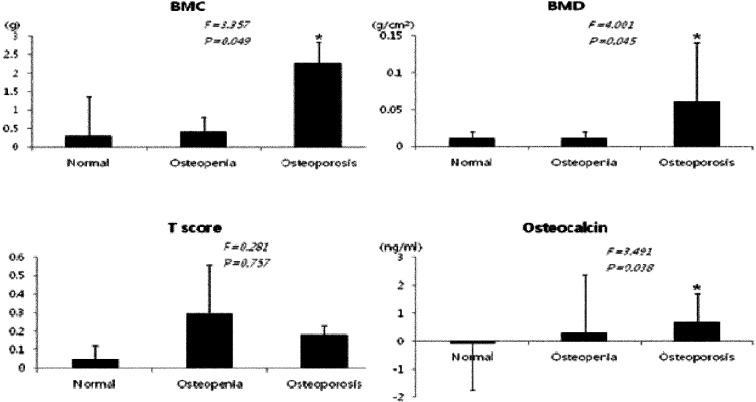
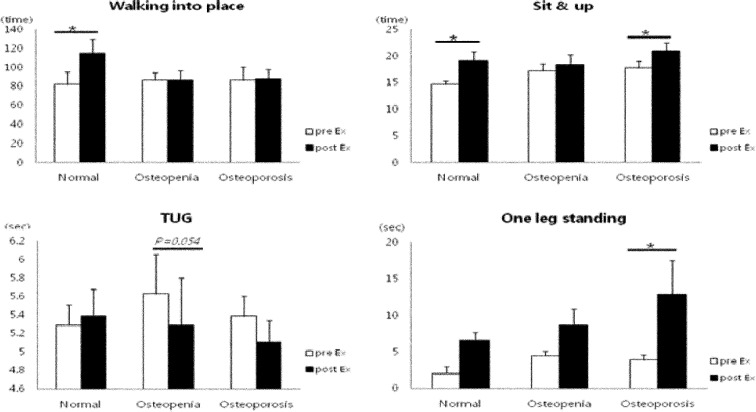
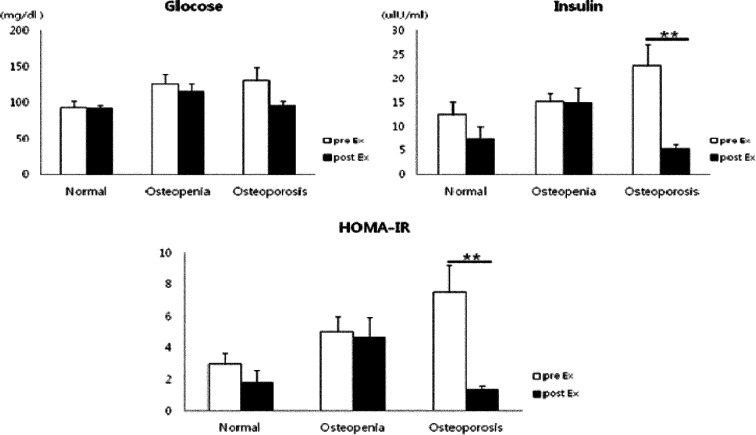
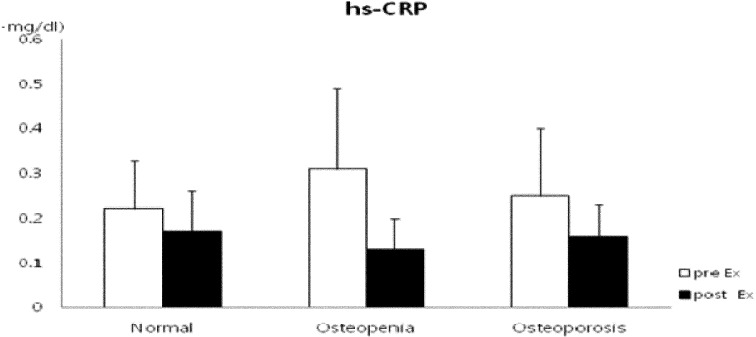
[Purpose] This study examined the effects of exercise training on bone metabolism markers, inflammatory markers, and physical fitness in patients with osteoporosis from an osteoporosis-related immunological perspective. [Subjects and Methods] Twenty-nine elderly female subjects (age, 74.2 ± 3.2 years) were classified into normal, osteopenia, and osteoporosis groups based on the T-score measured using dual-energy X-ray absorptiometry. The exercise was performed voluntarily by the patients for 1 hour per day, three times per week, for 12 weeks. [Results] The differences between bone mineral content, bone mineral density, and osteocalcin concentrations increased significantly in the osteoporosis group after 12 weeks of exercise and were significantly higher than those in the normal and osteopenia groups. However, the homeostatic model assessment of insulin resistance score decreased significantly in the osteoporosis group after 12 weeks of exercise. High-sensitivity C-reactive protein concentrations tended to decrease in all groups after 12 weeks of exercise and showed an inverse correlation with osteocalcin concentration; however, no statistical significance was observed. [Conclusion] Our findings suggest that an exercise program in patients with osteopenia and osteoporosis effectively reduces the risk of osteoporotic fracture and related diseases since it improves bone density and physical fitness and reduces inflammatory marker levels.
[目的] 本研究从骨质疏松相关免疫学角度,探讨运动训练对骨质疏松患者骨代谢标志物、炎症标志物及体能的影响。[对象与方法] 29名老年女性受试者(年龄74.2±3.2岁),根据双能X线吸收法测得的T值分为正常组、骨量减少组和骨质疏松组。患者自行进行运动,每天1小时,每周3次,共12周。[结果] 运动12周后,骨质疏松组骨矿物质含量、骨密度和骨钙素浓度的差异显著增加,且显著高于正常组和骨量减少组。然而,运动12周后,骨质疏松组胰岛素抵抗稳态模型评估得分显著降低。运动12周后,所有组的高敏C反应蛋白浓度均呈下降趋势,且与骨钙素浓度呈负相关,但未观察到统计学意义。[结论] 我们的研究结果表明,骨量减少和骨质疏松患者的运动计划可有效降低骨质疏松性骨折及相关疾病的风险,因为它能提高骨密度和体能,并降低炎症标志物水平。