Cuppen Bart V J, Fu Junzeng, van Wietmarschen Herman A, Harms Amy C, Koval Slavik, Marijnissen Anne C A, Peeters Judith J W, Bijlsma Johannes W J, Tekstra Janneke, van Laar Jacob M, Hankemeier Thomas, Lafeber Floris P J G, van der Greef Jan
Rheumatology & Clinical Immunology, University Medical Center Utrecht, Utrecht, The Netherlands.
Leiden Academic Center for Drug Research, Leiden University, Leiden, The Netherlands.
PLoS One. 2016 Sep 15;11(9):e0163087. doi: 10.1371/journal.pone.0163087. eCollection 2016.
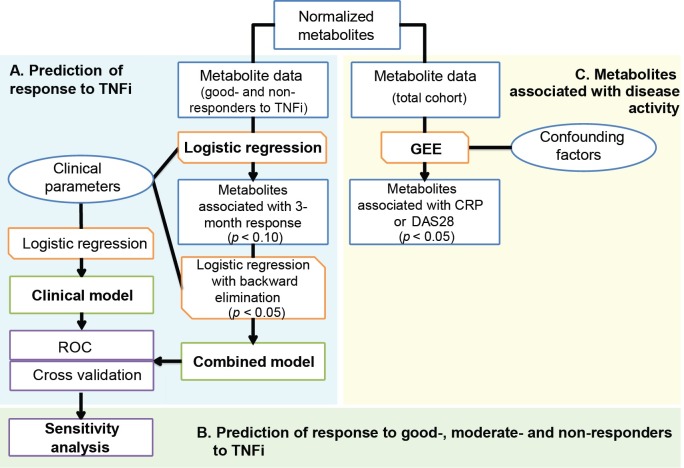
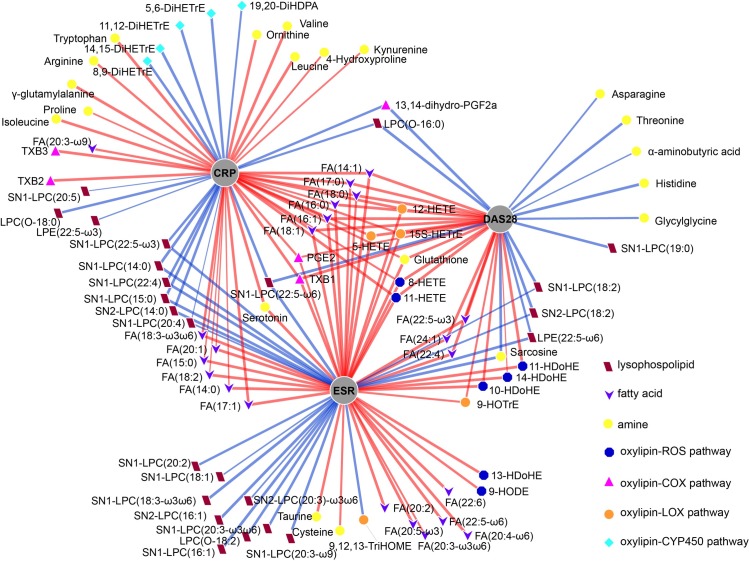
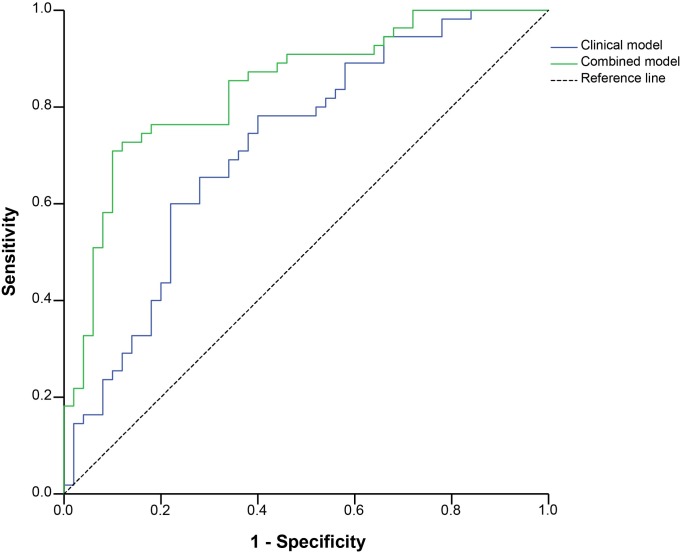
In clinical practice, approximately one-third of patients with rheumatoid arthritis (RA) respond insufficiently to TNF-α inhibitors (TNFis). The aim of the study was to explore the use of a metabolomics to identify predictors for the outcome of TNFi therapy, and study the metabolomic fingerprint in active RA irrespective of patients' response. In the metabolomic profiling, lipids, oxylipins, and amines were measured in serum samples of RA patients from the observational BiOCURA cohort, before start of biological treatment. Multivariable logistic regression models were established to identify predictors for good- and non-response in patients receiving TNFi (n = 124). The added value of metabolites over prediction using clinical parameters only was determined by comparing the area under receiver operating characteristic curve (AUC-ROC), sensitivity, specificity, positive- and negative predictive value and by the net reclassification index (NRI). The models were further validated by 10-fold cross validation and tested on the complete TNFi treatment cohort including moderate responders. Additionally, metabolites were identified that cross-sectionally associated with the RA disease activity score based on a 28-joint count (DAS28), erythrocyte sedimentation rate (ESR) or C-reactive protein (CRP). Out of 139 metabolites, the best-performing predictors were sn1-LPC(18:3-ω3/ω6), sn1-LPC(15:0), ethanolamine, and lysine. The model that combined the selected metabolites with clinical parameters showed a significant larger AUC-ROC than that of the model containing only clinical parameters (p = 0.01). The combined model was able to discriminate good- and non-responders with good accuracy and to reclassify non-responders with an improvement of 30% (total NRI = 0.23) and showed a prediction error of 0.27. For the complete TNFi cohort, the NRI was 0.22. In addition, 88 metabolites were associated with DAS28, ESR or CRP (p<0.05). Our study established an accurate prediction model for response to TNFi therapy, containing metabolites and clinical parameters. Associations between metabolites and disease activity may help elucidate additional pathologic mechanisms behind RA.
在临床实践中,约三分之一的类风湿关节炎(RA)患者对肿瘤坏死因子-α抑制剂(TNFi)反应不足。本研究的目的是探索利用代谢组学来识别TNFi治疗结果的预测指标,并研究无论患者反应如何,活动期RA的代谢组学特征。在代谢组学分析中,对来自观察性BiOCURA队列的RA患者血清样本在开始生物治疗前进行脂质、氧化脂质和胺类的检测。建立多变量逻辑回归模型以识别接受TNFi治疗患者(n = 124)中良好反应和无反应的预测指标。通过比较受试者工作特征曲线下面积(AUC-ROC)、敏感性、特异性、阳性和阴性预测值以及净重新分类指数(NRI)来确定代谢物相对于仅使用临床参数进行预测的附加值。通过10倍交叉验证对模型进行进一步验证,并在包括中度反应者的完整TNFi治疗队列上进行测试。此外,识别出与基于28个关节计数的RA疾病活动评分(DAS28)、红细胞沉降率(ESR)或C反应蛋白(CRP)横断面相关的代谢物。在139种代谢物中,表现最佳的预测指标是sn1-溶血磷脂酰胆碱(18:3-ω3/ω6)、sn1-溶血磷脂酰胆碱(15:0)、乙醇胺和赖氨酸。将选定代谢物与临床参数相结合的模型显示AUC-ROC显著大于仅包含临床参数的模型(p = 0.01)。联合模型能够以良好的准确性区分良好反应者和无反应者,并将无反应者重新分类,改善率为30%(总NRI = 0.23),预测误差为0.27。对于完整的TNFi队列,NRI为0.22。此外,88种代谢物与DAS28、ESR或CRP相关(p<0.05)。我们的研究建立了一个包含代谢物和临床参数的对TNFi治疗反应的准确预测模型。代谢物与疾病活动之间的关联可能有助于阐明RA背后的其他病理机制。