Rich Zachary C, Chu Carissa, Mao Jessica, Zhou Kali, Cai Weiping, Ma Qingyan, Volberding Paul, Tucker Joseph D
UNC Project China, Guangdong Provincial Dermatovenerology Hospital, Guangdong Province, 2 Lujing Road, Floor 11, Guangzhou, 510095, Guangdong, China.
Department of Medicine, School of Medicine, University of California San Francisco, San Francisco, 94143, California, USA.
BMC Public Health. 2016 Sep 20;16:994. doi: 10.1186/s12889-016-3671-z.
While the public health benefits of new HCV treatments depend on treatment adherence, particularly among people who inject drugs (PWID), several social and medical factors can jeopardize treatment adherence. The aim of this study is to examine the qualitative literature on facilitators to HCV treatment adherence among PWID.
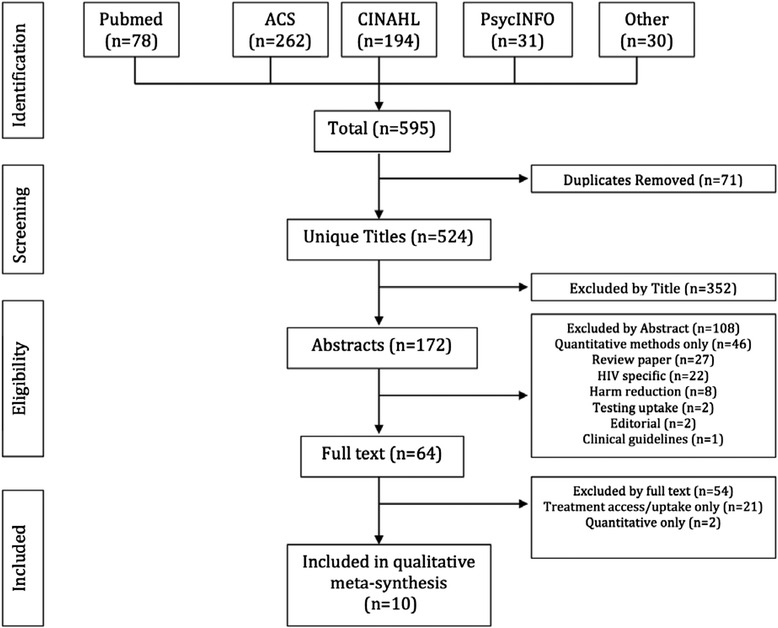
We searched six databases to identify qualitative research studies on HCV treatment adherence facilitators among PWID. Two reviewers independently extracted and analyzed data using PRISMA guidelines and the CASP tool to evaluate study quality.
From ten studies representing data from 525 participants, three major themes emerged across studies: logistical facilitators within health systems enhanced HCV treatment adherence, positive social interactions between PWID and staff provided positive feedback during treatment, and HCV treatment may complicate the addiction recovery process.
Although PWID face several barriers to adherence, we identified treatment adherence facilitators that could be incorporated into clinical practice.
虽然新型丙型肝炎病毒(HCV)治疗方法对公众健康的益处取决于治疗依从性,尤其是在注射吸毒者(PWID)中,但一些社会和医学因素可能会危及治疗依从性。本研究的目的是审查关于促进PWID坚持HCV治疗的定性文献。
我们检索了六个数据库,以确定关于PWID坚持HCV治疗促进因素的定性研究。两名评审员使用PRISMA指南和CASP工具独立提取和分析数据,以评估研究质量。
从代表525名参与者数据的十项研究中,出现了三个主要主题:卫生系统内的后勤促进因素提高了HCV治疗依从性,PWID与工作人员之间的积极社会互动在治疗期间提供了积极反馈,并且HCV治疗可能会使成瘾恢复过程复杂化。
虽然PWID在坚持治疗方面面临若干障碍,但我们确定了可以纳入临床实践的治疗依从性促进因素。