School of Life Sciences, Shanghai University , Shanghai, China.
National Center for Protein Science Shanghai, State Key Laboratory of Molecular Biology, Institute of Biochemistry and Cell Biology, Shanghai Institutes for Biological Sciences, Chinese Academy of Sciences , Shanghai, China.
Cell Discov. 2016 Sep 13;2:16035. doi: 10.1038/celldisc.2016.35. eCollection 2016.
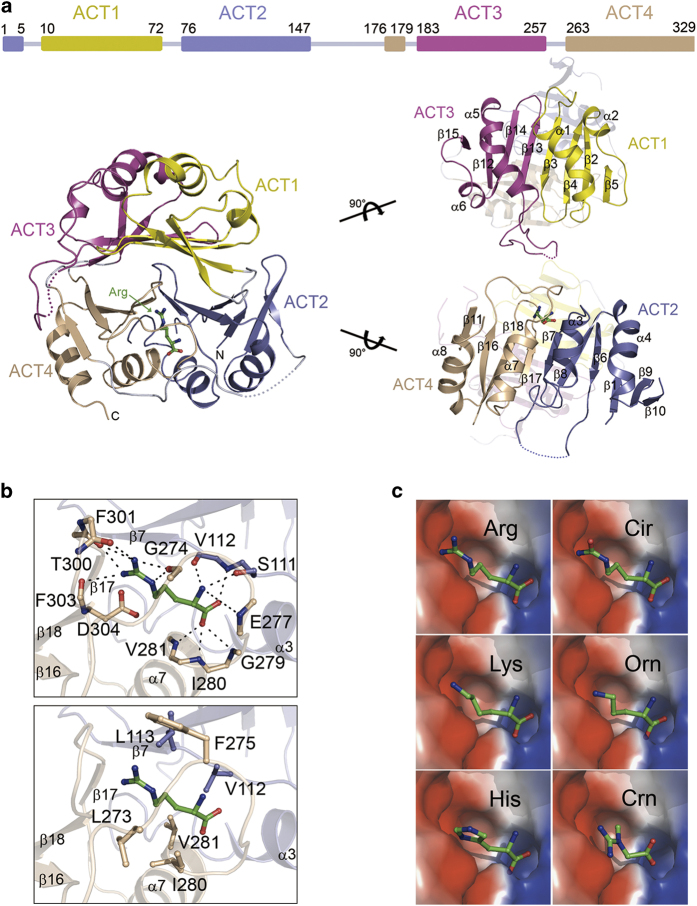
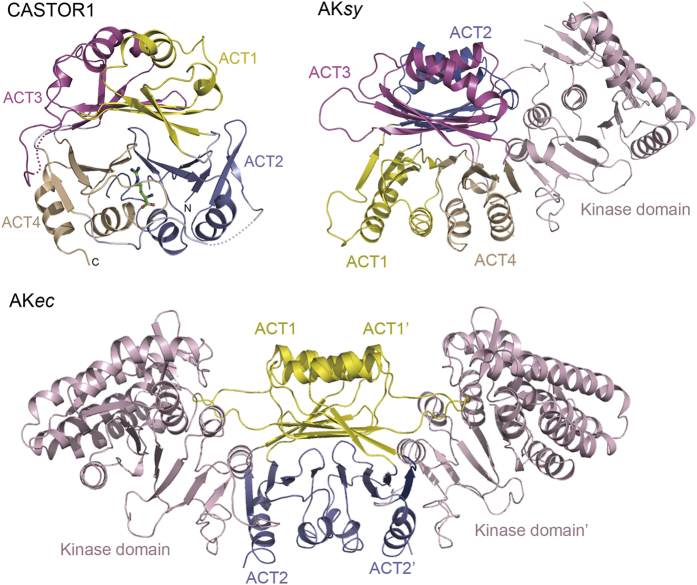
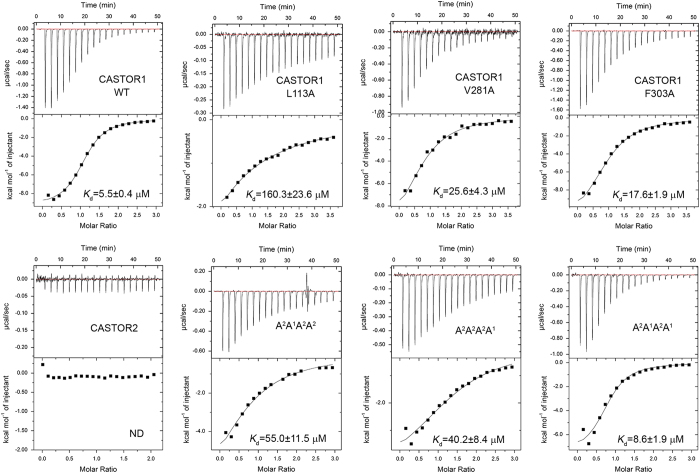
The mechanistic Target Of Rapamycin Complex 1 (mTORC1) is central to the cellular response to changes in nutrient signals such as amino acids. CASTOR1 is shown to be an arginine sensor, which plays an important role in the activation of the mTORC1 pathway. In the deficiency of arginine, CASTOR1 interacts with GATOR2, which together with GATOR1 and Rag GTPases controls the relocalization of mTORC1 to lysosomes. The binding of arginine to CASTOR1 disrupts its association with GATOR2 and hence activates the mTORC1 signaling. Here, we report the crystal structure of CASTOR1 in complex with arginine at 2.5 Å resolution. CASTOR1 comprises of four tandem ACT domains with an architecture resembling the C-terminal allosteric domains of aspartate kinases. ACT1 and ACT3 adopt the typical βαββαβ topology and function in dimerization via the conserved residues from helices α1 of ACT1 and α5 of ACT3; whereas ACT 2 and ACT4, both comprising of two non-sequential regions, assume the unusual ββαββα topology and contribute an arginine-binding pocket at the interface. The bound arginine makes a number of hydrogen-bonding interactions and extensive hydrophobic contacts with the surrounding residues of the binding pocket. The functional roles of the key residues are validated by mutagenesis and biochemical assays. Our structural and functional data together reveal the molecular basis for the arginine-binding specificity of CASTOR1 in the arginine-dependent activation of the mTORC1 signaling.
雷帕霉素靶蛋白复合物 1(mTORC1)是细胞对氨基酸等营养信号变化反应的核心。现已证实 CASTOR1 是一种精氨酸传感器,在 mTORC1 通路的激活中发挥重要作用。在精氨酸缺乏的情况下,CASTOR1 与 GATOR2 相互作用,GATOR2 与 GATOR1 和 Rag GTPases 一起控制 mTORC1 向溶酶体的重定位。精氨酸与 CASTOR1 的结合破坏了其与 GATOR2 的结合,从而激活了 mTORC1 信号。在这里,我们报告了 2.5Å分辨率下 CASTOR1 与精氨酸复合物的晶体结构。CASTOR1 由四个串联的 ACT 结构域组成,其结构类似于天冬氨酸激酶的 C 末端别构结构域。ACT1 和 ACT3 采用典型的 βαββαβ拓扑结构,并通过来自 ACT1 的α1 螺旋和 ACT3 的α5 螺旋的保守残基进行二聚化;而 ACT2 和 ACT4 均由两个非连续区域组成,采用不寻常的ββαββα拓扑结构,并在界面处贡献一个精氨酸结合口袋。结合的精氨酸与结合口袋周围的残基形成多个氢键和广泛的疏水相互作用。通过突变和生化分析验证了关键残基的功能作用。我们的结构和功能数据共同揭示了 CASTOR1 在精氨酸依赖的 mTORC1 信号激活中精氨酸结合特异性的分子基础。