Gai Zhongchao, Wang Qian, Yang Can, Wang Lei, Deng Wei, Wu Geng
State Key Laboratory of Microbial Metabolism, School of Life Sciences & Biotechnology, Shanghai Jiao Tong University , Shanghai, China.
National Center for Protein Science Shanghai , Shanghai, China.
Cell Discov. 2016 Dec 27;2:16051. doi: 10.1038/celldisc.2016.51. eCollection 2016.
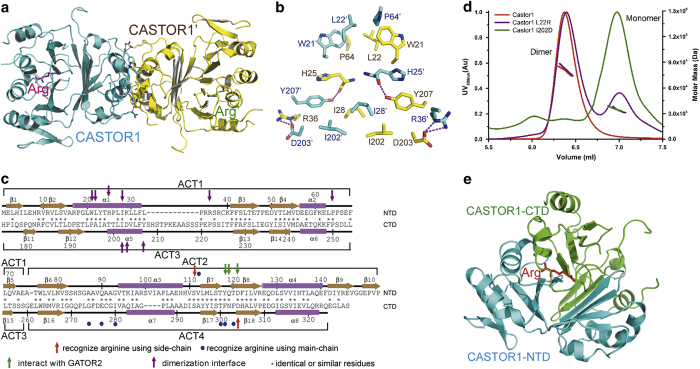
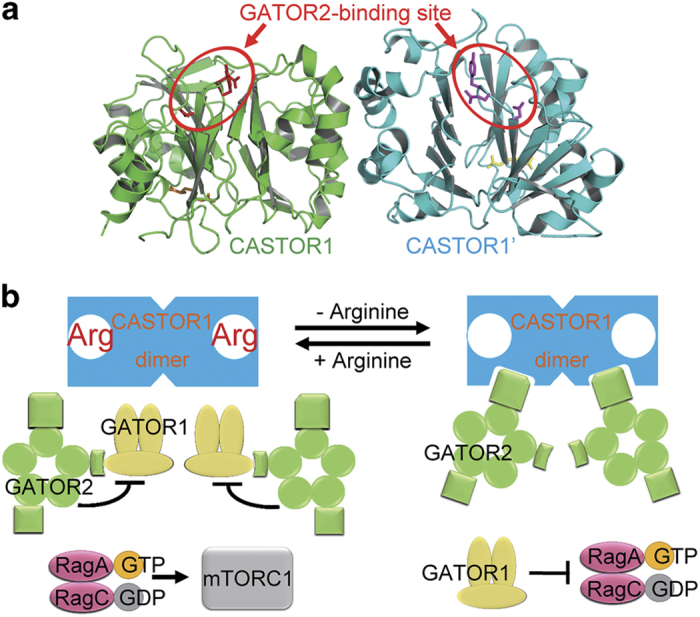
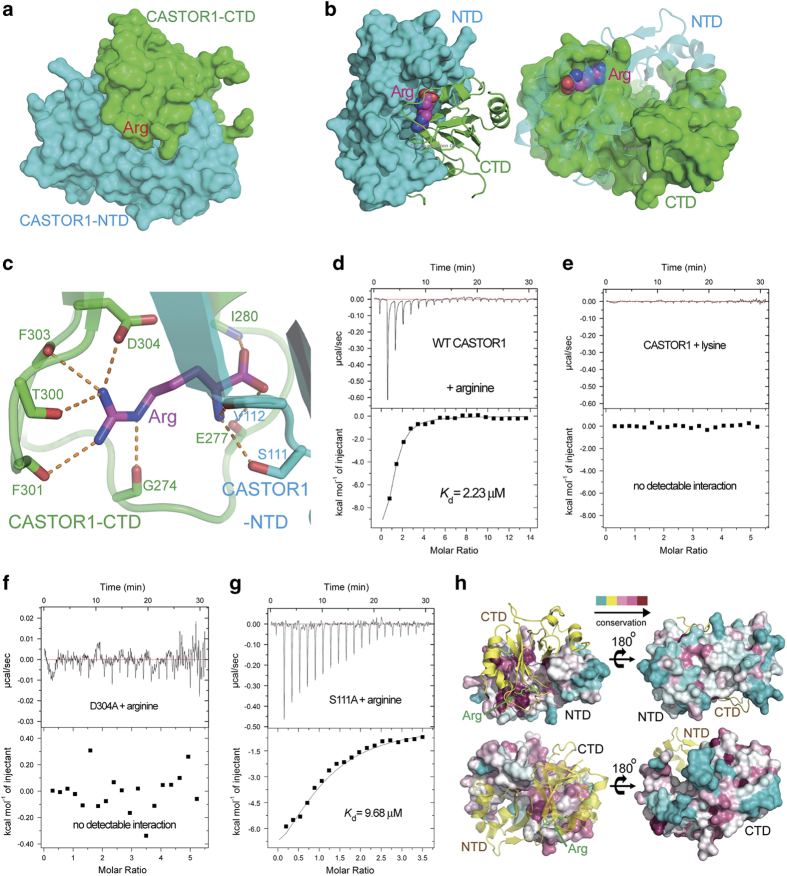
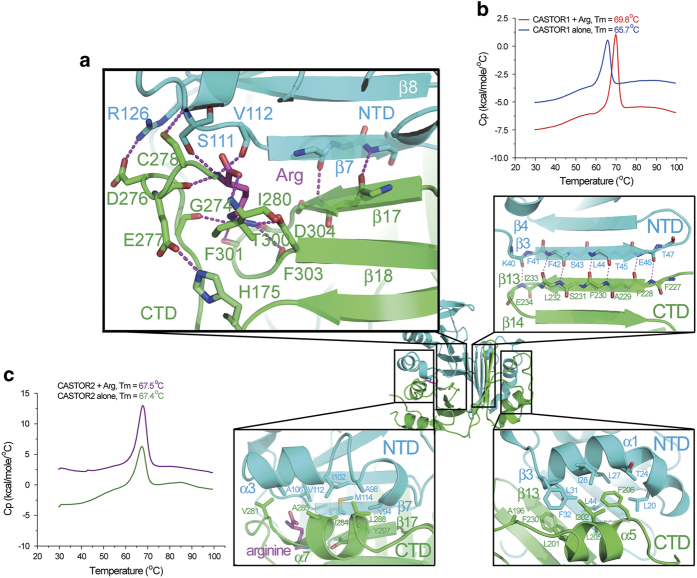
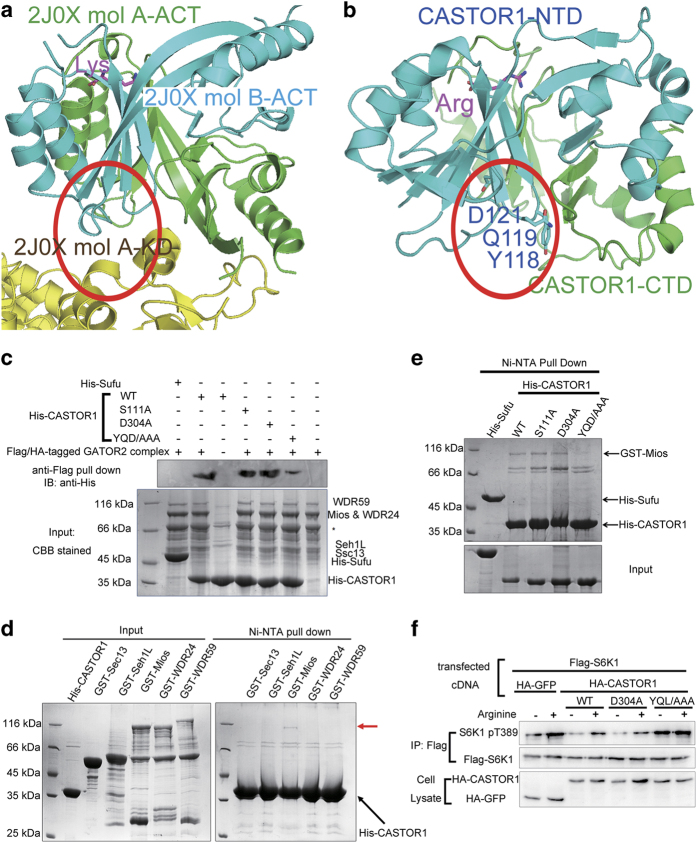
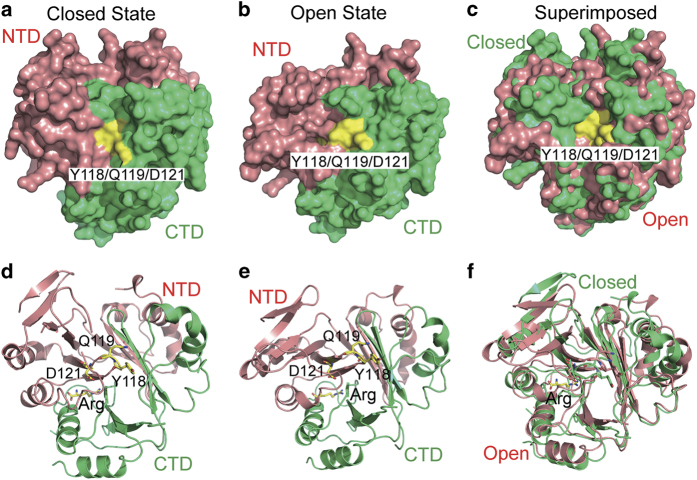
The mTOR complex I (mTORC1) signaling pathway controls many metabolic processes and is regulated by amino acid signals, especially arginine. CASTOR1 has been identified as the cytosolic arginine sensor for the mTORC1 pathway, but the molecular mechanism of how it senses arginine is elusive. Here, by determining the crystal structure of human CASTOR1 in complex with arginine, we found that an exquisitely tailored pocket, carved between the NTD and the CTD domains of CASTOR1, is employed to recognize arginine. Mutation of critical residues in this pocket abolished or diminished arginine binding. By comparison with structurally similar aspartate kinases, a surface patch of CASTOR1-NTD on the opposite side of the arginine-binding site was identified to mediate direct physical interaction with its downstream effector GATOR2, via GATOR2 subunit Mios. Mutation of this surface patch disrupted CASTOR1's recognition and inhibition of GATOR2, revealed by pull-down assay. Normal mode (NM) analysis revealed an 'open'-to-'closed' conformational change for CASTOR1, which is correlated to the switching between the exposing and concealing of its GATOR2-binding residues, and is most likely related to arginine binding. Interestingly, the GATOR2-binding sites on the two protomers of CASTOR1 dimer face the same direction, which prompted us to propose a model for how dimerization of CASTOR1 relieves the inhibition of GATOR1 by GATOR2. Our study thus provides a thorough analysis on how CASTOR1 recognizes arginine, and describes a possible mechanism of how arginine binding induces the inter-domain movement of CASTOR1 to affect its association with GATOR2.
mTOR复合物I(mTORC1)信号通路控制着许多代谢过程,并受氨基酸信号尤其是精氨酸的调节。CASTOR1已被确定为mTORC1通路的胞质精氨酸传感器,但其感知精氨酸的分子机制尚不清楚。在这里,通过确定与精氨酸结合的人CASTOR1的晶体结构,我们发现CASTOR1的NTD和CTD结构域之间形成了一个精心定制的口袋来识别精氨酸。该口袋中关键残基的突变消除或减少了精氨酸结合。通过与结构相似的天冬氨酸激酶比较,发现CASTOR1-NTD在精氨酸结合位点另一侧的一个表面区域通过GATOR2亚基Mios介导与其下游效应物GATOR2的直接物理相互作用。下拉试验表明,该表面区域的突变破坏了CASTOR1对GATOR2的识别和抑制。正常模式(NM)分析揭示了CASTOR1从“开放”到“关闭”的构象变化,这与它的GATOR2结合残基的暴露和隐藏之间的转换相关,并且很可能与精氨酸结合有关。有趣的是,CASTOR1二聚体两个原体上的GATOR2结合位点面向同一方向,这促使我们提出一个关于CASTOR1二聚化如何解除GATOR2对GATOR1抑制的模型。因此,我们的研究全面分析了CASTOR1如何识别精氨酸,并描述了精氨酸结合如何诱导CASTOR1的结构域间运动以影响其与GATOR2结合的可能机制。