Conte Antonella, Belvisi Daniele, Manzo Nicoletta, Bologna Matteo, Barone Francesca, Tartaglia Matteo, Upadhyay Neeraj, Berardelli Alfredo
IRCCS Neuromed, Pozzilli (IS), Italy.
Department of Neurology and Psychiatry, Sapienza University Rome, Rome, Italy.
Physiol Rep. 2016 Sep;4(18). doi: 10.14814/phy2.12899.
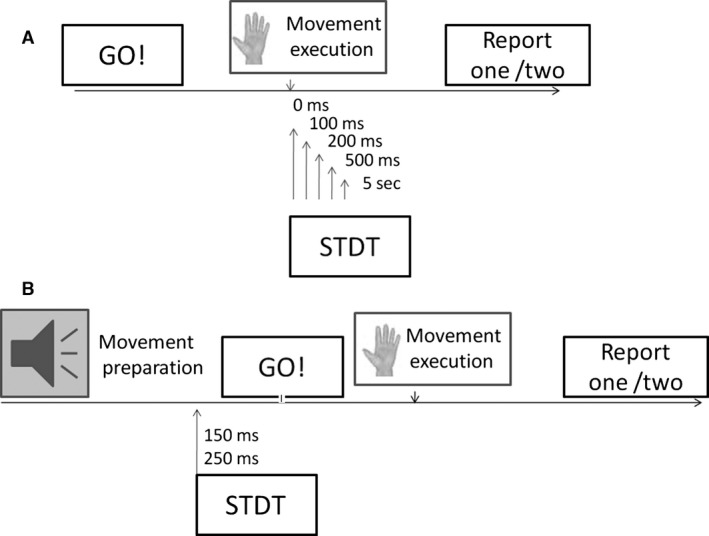
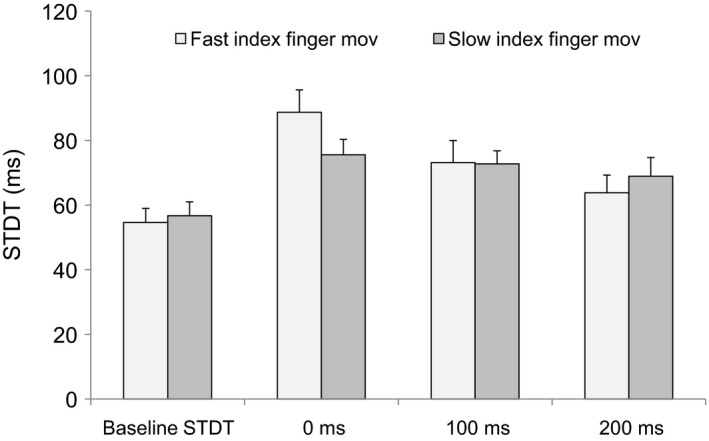
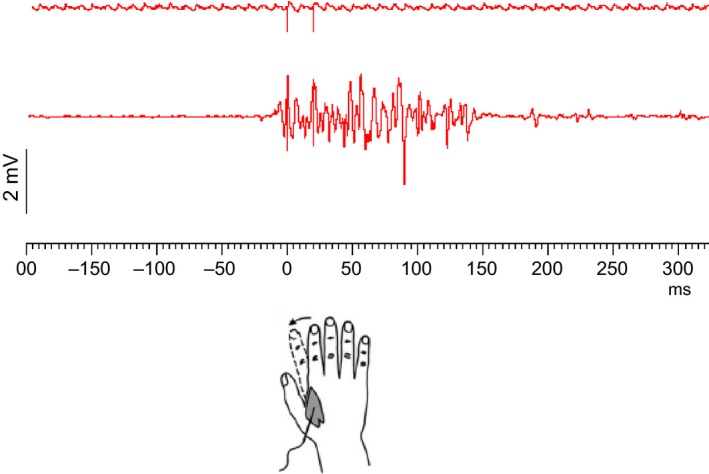
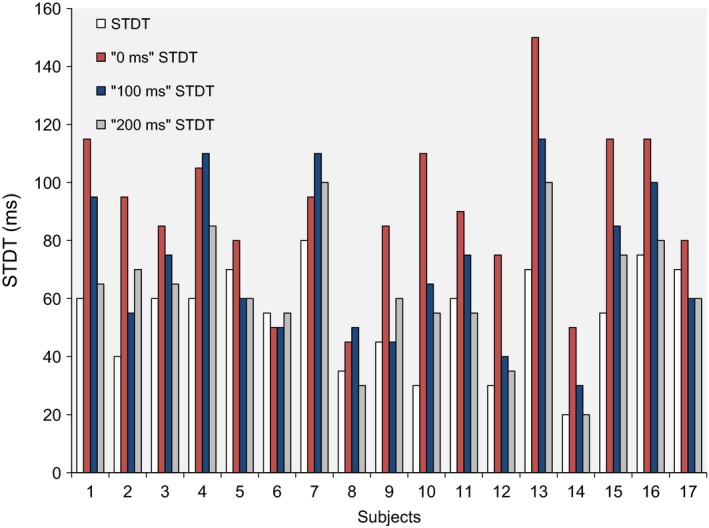
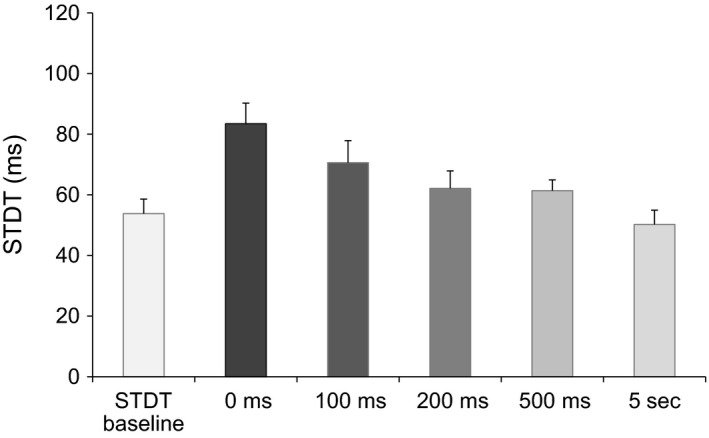
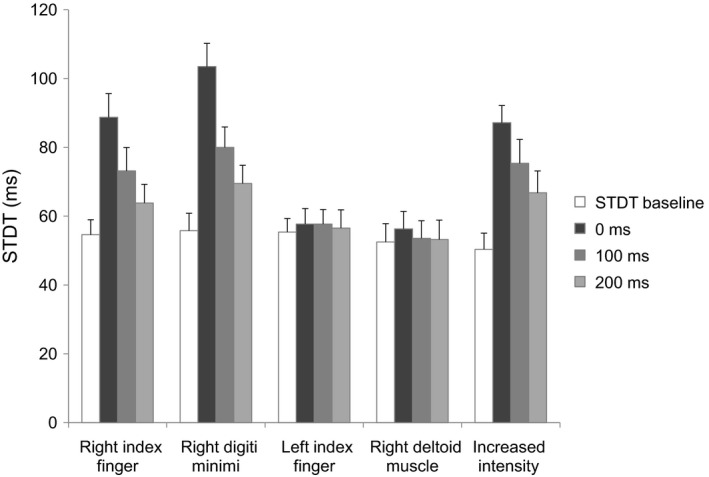
The somatosensory temporal discrimination threshold (STDT) is the shortest interval at which an individual recognizes paired stimuli as separate in time. We investigated whether and how voluntary movement modulates STDT in healthy subjects. In 17 healthy participants, we tested STDT during voluntary index-finger abductions at several time-points after movement onset and during motor preparation. We then tested whether voluntary movement-induced STDT changes were specific for the body segment moved, depended on movement kinematics, on the type of movement or on the intensity for delivering paired electrical stimuli for STDT To understand the mechanisms underlying STDT modulation, we also tested STDT during motor imagery and after delivering repetitive transcranial magnetic stimulation to elicit excitability changes in the primary somatosensory cortex (S1). When tested on the moving hand at movement onset and up to 200 msec thereafter, STDT values increased from baseline, but during motor preparation remained unchanged. STDT values changed significantly during fast and slow index-finger movements and also, though less, during passive index-finger abductions, whereas during tonic index-finger abductions they remained unchanged. STDT also remained unchanged when tested in body parts other than those engaged in movement and during imagined movement. Nor did testing STDT at increased intensity influence movement-induced STDT changes. The cTBS-induced S1 cortical changes left movement-induced STDT changes unaffected. Our findings suggest that movement execution in healthy subjects may alter STDT processing.
躯体感觉时间辨别阈值(STDT)是个体将成对刺激在时间上识别为分开的最短间隔。我们研究了在健康受试者中,自主运动是否以及如何调节STDT。在17名健康参与者中,我们在运动开始后的几个时间点以及运动准备期间,对自主示指外展过程中的STDT进行了测试。然后,我们测试了自主运动引起的STDT变化是否特定于所移动的身体部位,是否取决于运动学、运动类型或用于STDT的成对电刺激的强度。为了理解STDT调节的潜在机制,我们还在运动想象期间以及在给予重复经颅磁刺激以引起初级躯体感觉皮层(S1)兴奋性变化后测试了STDT。当在运动开始时以及此后长达200毫秒对正在移动的手进行测试时,STDT值从基线升高,但在运动准备期间保持不变。在快速和慢速示指运动期间,STDT值发生了显著变化,在被动示指外展期间也有变化,尽管变化较小,而在持续性示指外展期间它们保持不变。当在未参与运动的身体部位以及在想象运动期间测试STDT时,其也保持不变。以增加强度测试STDT也不会影响运动引起的STDT变化。cTBS诱导的S1皮层变化并未影响运动引起的STDT变化。我们的研究结果表明,健康受试者的运动执行可能会改变STDT处理。