Haley Michael J, Lawrence Catherine B
Faculty of Biology, Medicine and Health, University of Manchester, Manchester, UK.
Faculty of Biology, Medicine and Health, University of Manchester, Manchester, UK
J Cereb Blood Flow Metab. 2016 Dec;36(12):2007-2021. doi: 10.1177/0271678X16670411. Epub 2016 Sep 21.
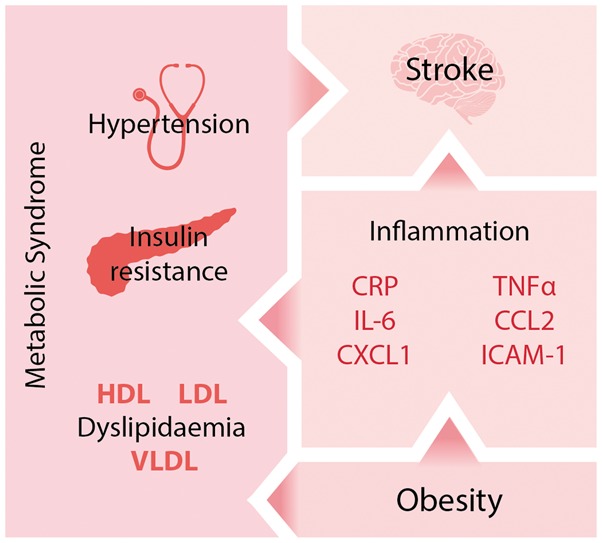
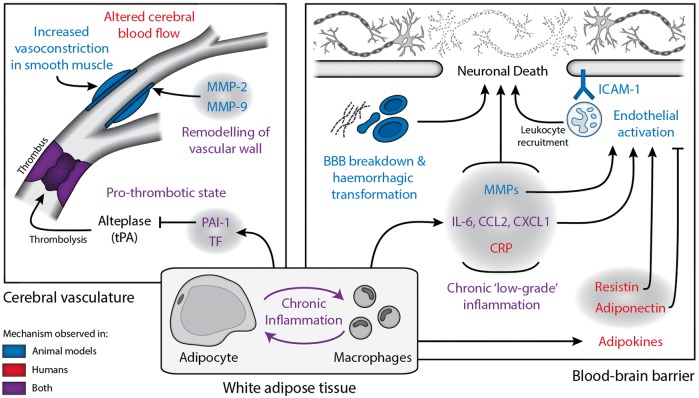
Obesity is a risk factor for stroke and is consequently one of the most common co-morbidities found in patients. There is therefore an identified need to model co-morbidities preclinically to allow better translation from bench to bedside. In preclinical studies, both diet-induced and genetically obese rodents have worse stroke outcome, characterised by increased ischaemic damage and an altered inflammatory response. However, clinical studies have reported an 'obesity paradox' in stroke, characterised by reduced mortality and morbidity in obese patients. We discuss the potential reasons why the preclinical and clinical studies may not agree, and review the mechanisms identified in preclinical studies through which obesity may affects stroke outcome. We suggest inflammation plays a central role in this relationship, as obesity features increases in inflammatory mediators such as C-reactive protein and interleukin-6, and chronic inflammation has been linked to worse stroke risk and outcome.
肥胖是中风的一个风险因素,因此是患者中最常见的合并症之一。因此,明确需要在临床前对合并症进行建模,以便更好地从实验室转化到临床应用。在临床前研究中,饮食诱导和基因肥胖的啮齿动物中风预后都更差,其特征是缺血性损伤增加和炎症反应改变。然而,临床研究报告了中风中的“肥胖悖论”,其特征是肥胖患者的死亡率和发病率降低。我们讨论了临床前和临床研究结果可能不一致的潜在原因,并回顾了临床前研究中确定的肥胖可能影响中风预后的机制。我们认为炎症在这种关系中起核心作用,因为肥胖的特征是炎症介质如C反应蛋白和白细胞介素-6增加,并且慢性炎症与更差的中风风险和预后相关。