Otsuki Shiori, Nishiura Hiroshi
Graduate School of Medicine, The University of Tokyo, Tokyo, Japan.
CREST, Japan Science and Technology Agency, Saitama, Japan.
PLoS One. 2016 Sep 22;11(9):e0163418. doi: 10.1371/journal.pone.0163418. eCollection 2016.
An epidemic of Ebola virus disease (EVD) from 2013-16 posed a serious risk of global spread during its early growth phase. A post-epidemic evaluation of the effectiveness of travel restrictions has yet to be conducted. The present study aimed to estimate the effectiveness of travel restrictions in reducing the risk of importation from mid-August to September, 2014, using a simple hazard-based statistical model.
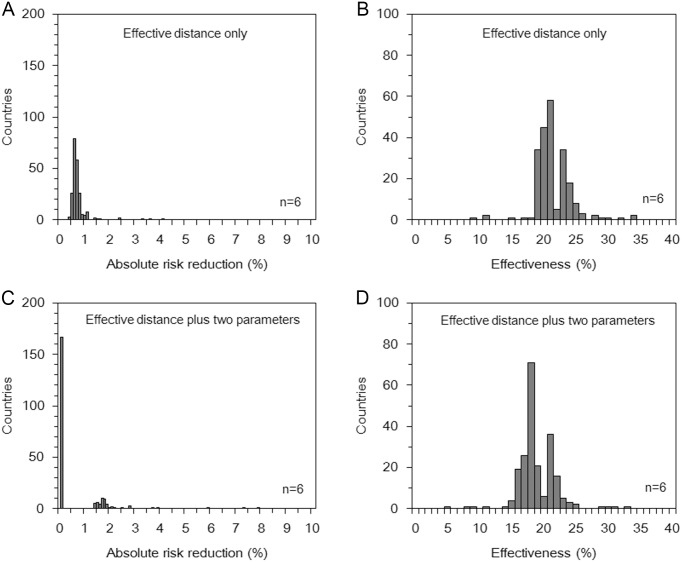
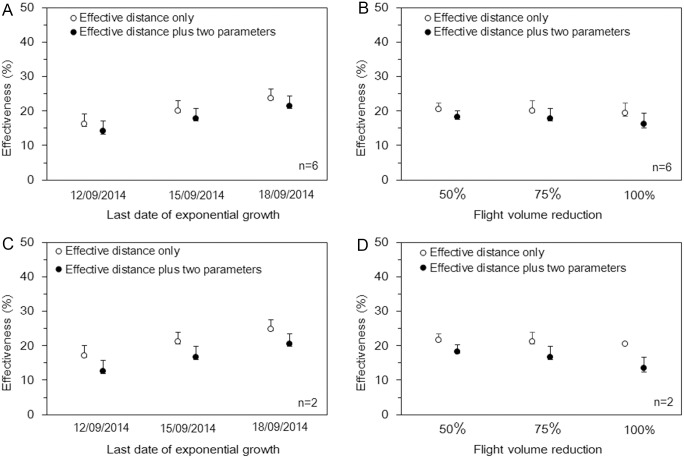
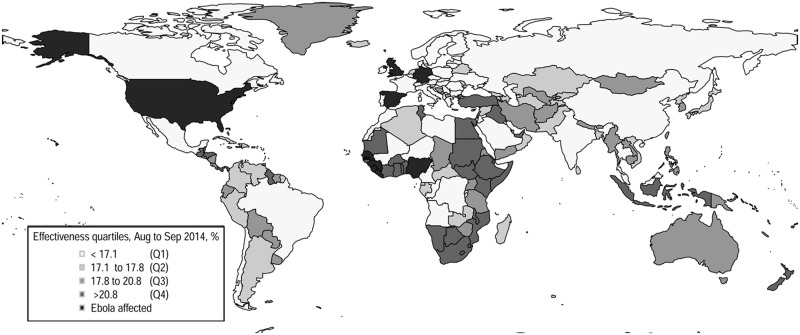
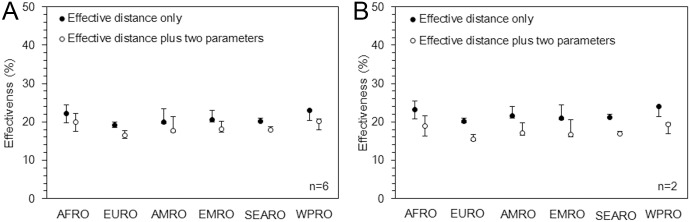
METHODOLOGY/PRINCIPAL FINDINGS: The hazard rate was modeled as an inverse function of the effective distance, an excellent predictor of disease spread, which was calculated from the airline transportation network. By analyzing datasets of the date of EVD case importation from the 15th of July to the 15th of September 2014, and assuming that the network structure changed from the 8th of August 2014 because of travel restrictions, parameters that characterized the hazard rate were estimated. The absolute risk reduction and relative risk reductions due to travel restrictions were estimated to be less than 1% and about 20%, respectively, for all models tested. Effectiveness estimates among African countries were greater than those for other countries outside Africa.
The travel restrictions were not effective enough to expect the prevention of global spread of Ebola virus disease. It is more efficient to control the spread of disease locally during an early phase of an epidemic than to attempt to control the epidemic at international borders. Capacity building for local containment and coordinated and expedited international cooperation are essential to reduce the risk of global transmission.
2013 - 2016年埃博拉病毒病(EVD)疫情在其早期传播阶段对全球传播构成严重风险。疫情后对旅行限制有效性的评估尚未进行。本研究旨在使用一个简单的基于风险的统计模型,估计2014年8月中旬至9月期间旅行限制在降低输入风险方面的有效性。
方法/主要发现:风险率被建模为有效距离的反函数,有效距离是疾病传播的一个极佳预测指标,通过航空运输网络计算得出。通过分析2014年7月15日至9月15日埃博拉病毒病病例输入日期的数据集,并假设由于旅行限制,网络结构于2014年8月8日发生变化,估计了表征风险率的参数。对于所有测试模型,旅行限制导致的绝对风险降低和相对风险降低估计分别小于1%和约20%。非洲国家的有效性估计高于非洲以外的其他国家。
旅行限制在预防埃博拉病毒病全球传播方面的效果不够显著。在疫情早期,在当地控制疾病传播比在国际边境试图控制疫情更为有效。加强当地防控能力建设以及进行协调和快速的国际合作对于降低全球传播风险至关重要。