Kostareva Anna, Kiselev Artem, Gudkova Alexandra, Frishman Goar, Ruepp Andreas, Frishman Dmitrij, Smolina Natalia, Tarnovskaya Svetlana, Nilsson Daniel, Zlotina Anna, Khodyuchenko Tatiana, Vershinina Tatiana, Pervunina Tatiana, Klyushina Alexandra, Kozlenok Andrey, Sjoberg Gunnar, Golovljova Irina, Sejersen Thomas, Shlyakhto Eugeniy
Almazov Federal Medical Research Centre, St. Petersburg, 197341, Russia.
Department of Women's and Children's Health and Centre for Molecular Medicine, Karolinska Institute, Stockholm, 17176, Sweden.
PLoS One. 2016 Sep 23;11(9):e0163362. doi: 10.1371/journal.pone.0163362. eCollection 2016.
Cardiomyopathies represent a rare group of disorders often of genetic origin. While approximately 50% of genetic causes are known for other types of cardiomyopathies, the genetic spectrum of restrictive cardiomyopathy (RCM) is largely unknown. The aim of the present study was to identify the genetic background of idiopathic RCM and to compile the obtained genetic variants to the novel signalling pathways using in silico protein network analysis.
We used Illumina MiSeq setup to screen for 108 cardiomyopathy and arrhythmia-associated genes in 24 patients with idiopathic RCM. Pathogenicity of genetic variants was classified according to American College of Medical Genetics and Genomics classification.
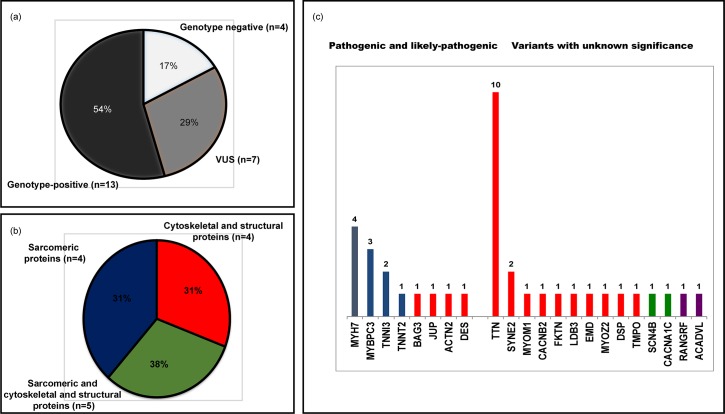
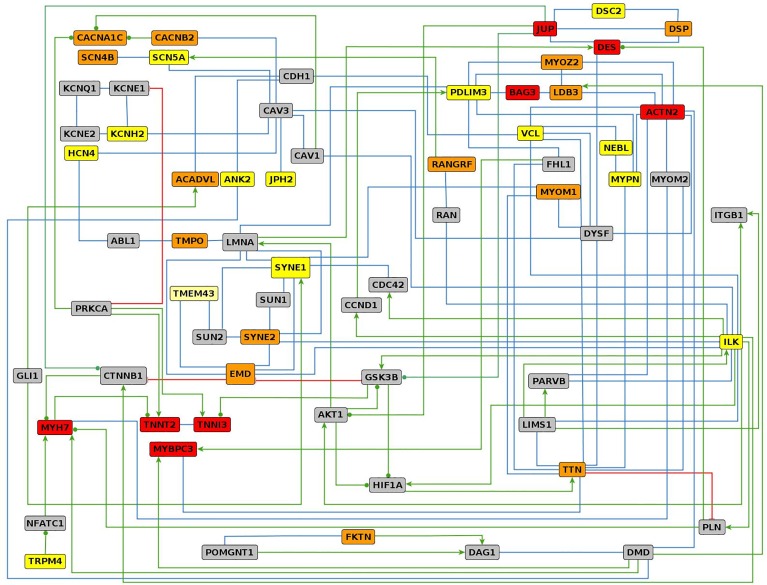
Pathogenic and likely-pathogenic variants were detected in 13 of 24 patients resulting in an overall genotype-positive rate of 54%. Half of the genotype-positive patients carried a combination of pathogenic, likely-pathogenic variants and variants of unknown significance. The most frequent combination included mutations in sarcomeric and cytoskeletal genes (38%). A bioinformatics approach underlined the mechanotransducing protein networks important for RCM pathogenesis.
Multiple gene mutations were detected in half of the RCM cases, with a combination of sarcomeric and cytoskeletal gene mutations being the most common. Mutations of genes encoding sarcomeric, cytoskeletal, and Z-line-associated proteins appear to have a predominant role in the development of RCM.
心肌病是一组罕见的疾病,通常具有遗传起源。虽然其他类型的心肌病约50%的遗传病因已为人所知,但限制型心肌病(RCM)的遗传谱在很大程度上仍不清楚。本研究的目的是确定特发性RCM的遗传背景,并使用计算机蛋白质网络分析将获得的遗传变异整合到新的信号通路中。
我们使用Illumina MiSeq平台对24例特发性RCM患者的108个心肌病和心律失常相关基因进行筛查。根据美国医学遗传学与基因组学学会的分类对遗传变异的致病性进行分类。
24例患者中有13例检测到致病性和可能致病性变异,总体基因型阳性率为54%。一半的基因型阳性患者携带致病性、可能致病性变异和意义未明变异的组合。最常见的组合包括肌节和细胞骨架基因的突变(38%)。一种生物信息学方法强调了对RCM发病机制重要的机械转导蛋白网络。
一半的RCM病例检测到多个基因突变,其中肌节和细胞骨架基因突变的组合最为常见。编码肌节、细胞骨架和Z线相关蛋白的基因突变似乎在RCM的发生发展中起主要作用。