• 文献检索
  • 文档翻译
  • 深度研究
  • 学术资讯
  • Suppr Zotero 插件Zotero 插件
  • 邀请有礼
  • 套餐&价格
  • 历史记录
应用&插件
Suppr Zotero 插件Zotero 插件浏览器插件Mac 客户端Windows 客户端微信小程序
定价
高级版会员购买积分包购买API积分包
服务
文献检索文档翻译深度研究API 文档MCP 服务
关于我们
关于 Suppr公司介绍联系我们用户协议隐私条款
关注我们

Suppr 超能文献

核心技术专利:CN118964589B侵权必究
粤ICP备2023148730 号-1Suppr @ 2026

文献检索

告别复杂PubMed语法,用中文像聊天一样搜索,搜遍4000万医学文献。AI智能推荐,让科研检索更轻松。

立即免费搜索

文件翻译

保留排版,准确专业,支持PDF/Word/PPT等文件格式,支持 12+语言互译。

免费翻译文档

深度研究

AI帮你快速写综述,25分钟生成高质量综述,智能提取关键信息,辅助科研写作。

立即免费体验

利用眼动追踪来理解婴儿对面孔的注意力偏向。

Using Eye Tracking to Understand Infants' Attentional Bias for Faces.

作者信息

Leppänen Jukka M

机构信息

University of Tampere.

出版信息

Child Dev Perspect. 2016 Sep;10(3):161-165. doi: 10.1111/cdep.12180. Epub 2016 Apr 15.

DOI:10.1111/cdep.12180
PMID:27668010
原文链接:https://pmc.ncbi.nlm.nih.gov/articles/PMC5021109/
Abstract

Infants have a natural tendency to look at adults' faces, possibly to help initiate vital interactions with caregivers during sensitive periods of development. Recent studies using eye-tracking technologies have identified the mechanisms that underlie infants' capacity to orient and hold attention on faces. These studies have shown that the bias for faces is weak in young infants, but becomes more robust and resistant to distraction during the second half of the 1st year. This development is apparently related to more general changes in infants' attention and control of eye movement. As a tractable and reproducible aspect of infant behavior, the attention bias for faces can be used to examine the neural correlates of attention and may be a way to monitor early neurodevelopment in infants.

摘要

婴儿天生就有看向成年人面孔的倾向,这可能有助于在发育的敏感时期与照顾者展开重要互动。最近使用眼动追踪技术的研究已经确定了婴儿对面孔进行定向和保持注意力的潜在机制。这些研究表明,小婴儿对面孔的偏好较弱,但在出生后的下半年会变得更强且更能抵抗干扰。这种发展显然与婴儿注意力和眼球运动控制方面更普遍的变化有关。作为婴儿行为中易于处理且可重复的一个方面,对面孔的注意力偏好可用于研究注意力的神经关联,并且可能是监测婴儿早期神经发育的一种方式。
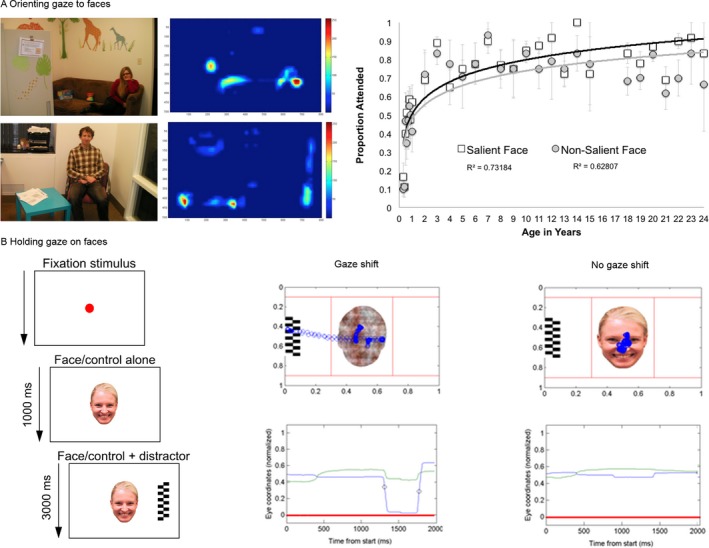
https://cdn.ncbi.nlm.nih.gov/pmc/blobs/5c05/5021109/383242f41c08/CDEP-10-161-g001.jpg

相似文献

1
Using Eye Tracking to Understand Infants' Attentional Bias for Faces.利用眼动追踪来理解婴儿对面孔的注意力偏向。
Child Dev Perspect. 2016 Sep;10(3):161-165. doi: 10.1111/cdep.12180. Epub 2016 Apr 15.
2
What drives the attentional bias for fearful faces? An eye-tracking investigation of 7-month-old infants' visual scanning patterns.是什么导致了对恐惧面孔的注意力偏差?一项对7个月大婴儿视觉扫描模式的眼动追踪研究。
Infancy. 2020 Sep;25(5):658-676. doi: 10.1111/infa.12351. Epub 2020 Jun 21.
3
Endogenous Control and Reward-based Mechanisms Shape Infants' Attention Biases to Caregiver Faces.内源性控制和基于奖励的机制塑造了婴儿对照顾者面孔的注意力偏向。
Dev Psychobiol. 2024 Sep;66(6):e22521. doi: 10.1002/dev.22521.
4
Social touch alters newborn monkey behavior.社会触觉改变新生猴子的行为。
Infant Behav Dev. 2019 Nov;57:101368. doi: 10.1016/j.infbeh.2019.101368. Epub 2019 Sep 12.
5
Infant-directed song potentiates infants' selective attention to adults' mouths over the first year of life.婴儿指向歌曲增强了婴儿在生命的第一年中对成人嘴巴的选择性注意。
Dev Sci. 2023 Sep;26(5):e13359. doi: 10.1111/desc.13359. Epub 2023 Jan 11.
6
Face detection in 2- to 6-month-old infants is influenced by gaze direction and species.2 至 6 个月大的婴儿的面部检测受注视方向和物种的影响。
Dev Sci. 2020 Mar;23(2):e12902. doi: 10.1111/desc.12902. Epub 2019 Oct 1.
7
Still connecting the dots: An investigation into infants' attentional bias to threat using an eye-tracking task.仍在寻找线索:使用眼动追踪任务调查婴儿对威胁的注意力偏向。
Infancy. 2022 Jan;27(1):46-66. doi: 10.1111/infa.12444. Epub 2021 Nov 30.
8
Monolingual and bilingual infants' attention to talking faces: evidence from eye-tracking and Bayesian modeling.单语和双语婴儿对说话面孔的注意力:来自眼动追踪和贝叶斯建模的证据。
Front Psychol. 2024 Mar 14;15:1373191. doi: 10.3389/fpsyg.2024.1373191. eCollection 2024.
9
Development of infants' attention to faces during the first year.婴儿在出生后第一年对面部注意力的发展。
Cognition. 2009 Feb;110(2):160-70. doi: 10.1016/j.cognition.2008.11.010. Epub 2008 Dec 27.
10
Early development of visual attention in infants in rural Malawi.农村马拉维婴儿视觉注意力的早期发展。
Dev Sci. 2019 Sep;22(5):e12761. doi: 10.1111/desc.12761. Epub 2018 Nov 12.

引用本文的文献

1
Figure recognition and visual attention patterns behind the observation of Palaeolithic art.旧石器时代艺术观察背后的图形识别与视觉注意模式。
J Cult Cogn Sci. 2025;9(2):225-241. doi: 10.1007/s41809-025-00170-0. Epub 2025 Jun 8.
2
Paternal adverse childhood experiences and offspring's attentional disengagement from faces at 8 months-Results from the FinnBrain Birth Cohort Study.父亲童年期不良经历与8个月大婴儿从面部的注意力脱离——芬兰大脑出生队列研究结果
PLoS One. 2025 Jul 3;20(7):e0326437. doi: 10.1371/journal.pone.0326437. eCollection 2025.
3
Structure-function coupling in the first month of life: Associations with age and attention.

本文引用的文献

1
Faces Attract Infants' Attention in Complex Displays.在复杂展示中,面孔吸引婴儿的注意力。
Infancy. 2009 Sep 10;14(5):550-562. doi: 10.1080/15250000903144199. Epub 2009 Sep 1.
2
Face Patch Resting State Networks Link Face Processing to Social Cognition.面部贴片静息态网络将面部处理与社会认知联系起来。
PLoS Biol. 2015 Sep 8;13(9):e1002245. doi: 10.1371/journal.pbio.1002245. eCollection 2015.
3
Active vision in passive locomotion: real-world free viewing in infants and adults.被动运动中的主动视觉:婴儿和成人在现实世界中的自由观看
生命第一个月的结构-功能耦合:与年龄和注意力的关联。
Proc Natl Acad Sci U S A. 2025 Jun 10;122(23):e2412729122. doi: 10.1073/pnas.2412729122. Epub 2025 Jun 2.
4
Simultaneous Eye Tracking and Cerebral Hemodynamic Monitoring in Infants: A Guide for Pediatric Outpatient Follow-Up.婴儿同时进行眼动追踪和脑血流动力学监测:儿科门诊随访指南
Brain Sci. 2025 Apr 28;15(5):469. doi: 10.3390/brainsci15050469.
5
A symmetry-based mechanism for perceptual grouping in preverbal infants.一种基于对称性的前语言期婴儿知觉分组机制。
Sci Rep. 2025 Feb 11;15(1):5035. doi: 10.1038/s41598-024-83251-4.
6
Endogenous Control and Reward-based Mechanisms Shape Infants' Attention Biases to Caregiver Faces.内源性控制和基于奖励的机制塑造了婴儿对照顾者面孔的注意力偏向。
Dev Psychobiol. 2024 Sep;66(6):e22521. doi: 10.1002/dev.22521.
7
Exposure to the parents' speech is positively associated with preterm infant's face preference.接触父母的语音与早产儿的面部偏好呈正相关。
Pediatr Res. 2024 Dec;96(7):1803-1811. doi: 10.1038/s41390-024-03239-8. Epub 2024 May 23.
8
Less attention to emotional faces is associated with low empathy and prosociality in 12-to 20-month old infants.12 至 20 个月大的婴儿对情绪面孔的关注度较低,与同理心和亲社会行为较低有关。
Infancy. 2024 Mar-Apr;29(2):113-136. doi: 10.1111/infa.12569. Epub 2024 Jan 3.
9
Eye movements and ERP biomarkers for face processing problems in avoidant attachment-style individuals.回避型依恋风格个体面部加工问题的眼动和事件相关电位生物标志物
Front Behav Neurosci. 2023 May 19;17:1135909. doi: 10.3389/fnbeh.2023.1135909. eCollection 2023.
10
Supernatural explanations across 114 societies are more common for natural than social phenomena.在 114 个社会中,对于自然现象而非社会现象,超自然的解释更为常见。
Nat Hum Behav. 2023 May;7(5):707-717. doi: 10.1038/s41562-023-01558-0. Epub 2023 Apr 3.
Dev Sci. 2015 Sep;18(5):736-50. doi: 10.1111/desc.12251. Epub 2014 Nov 28.
4
Individual differences in infant fixation duration relate to attention and behavioral control in childhood.婴儿注视时间的个体差异与儿童时期的注意力和行为控制有关。
Psychol Sci. 2014 Jul;25(7):1371-9. doi: 10.1177/0956797614531295. Epub 2014 May 8.
5
Widely applicable MATLAB routines for automated analysis of saccadic reaction times.用于自动分析眼跳反应时间的广泛适用的MATLAB程序。
Behav Res Methods. 2015 Jun;47(2):538-48. doi: 10.3758/s13428-014-0473-z.
6
An eye tracking investigation of developmental change in bottom-up attention orienting to faces in cluttered natural scenes.在杂乱自然场景中自下而上的面部注意定向发育变化的眼动追踪研究。
PLoS One. 2014 Jan 22;9(1):e85701. doi: 10.1371/journal.pone.0085701. eCollection 2014.
7
Visual search and attention to faces during early infancy.婴儿期的视觉搜索和对面孔的注意力。
J Exp Child Psychol. 2014 Feb;118:13-26. doi: 10.1016/j.jecp.2013.08.012. Epub 2013 Nov 6.
8
Attention to eyes is present but in decline in 2-6-month-old infants later diagnosed with autism.对眼睛的关注在以后被诊断为自闭症的 2-6 个月大的婴儿中是存在的,但在下降。
Nature. 2013 Dec 19;504(7480):427-31. doi: 10.1038/nature12715. Epub 2013 Nov 6.
9
Attentional capture by social stimuli in young infants.婴儿对社会刺激的注意力捕获。
Front Psychol. 2013 Aug 16;4:527. doi: 10.3389/fpsyg.2013.00527. eCollection 2013.
10
Alpha oscillations serve to protect working memory maintenance against anticipated distracters.阿尔法脑波活动有助于保护工作记忆的维持,防止预期的干扰。
Curr Biol. 2012 Oct 23;22(20):1969-74. doi: 10.1016/j.cub.2012.08.029. Epub 2012 Oct 4.