Amso Dima, Haas Sara, Markant Julie
Department of Cognitive, Linguistic, & Psychological Sciences, Brown University, Providence, Rhode Island, United States of America.
PLoS One. 2014 Jan 22;9(1):e85701. doi: 10.1371/journal.pone.0085701. eCollection 2014.
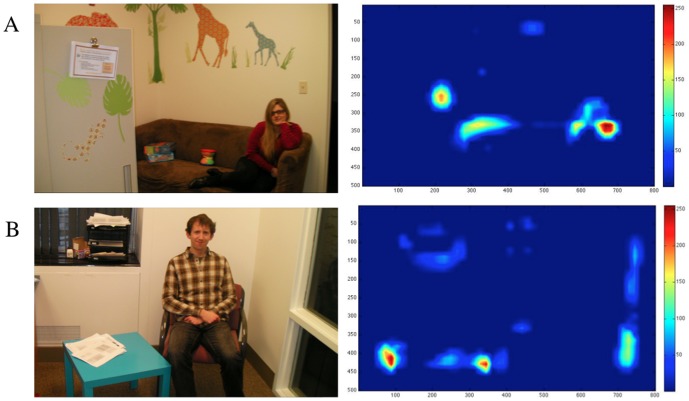
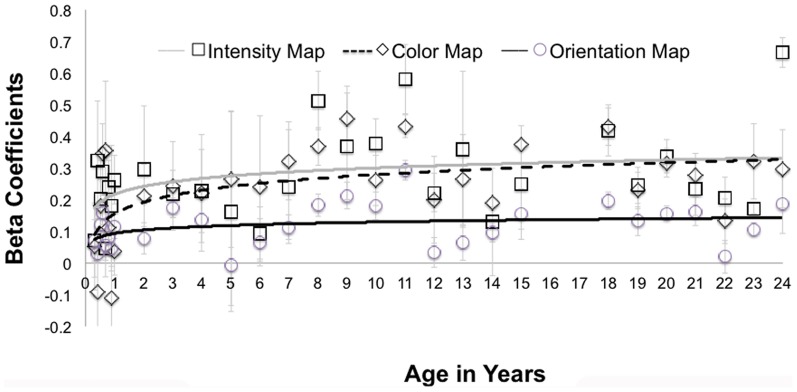
This study examined the contribution of visual salience to bottom-up attention orienting to faces in cluttered natural scenes across development. We eye tracked participants 4 months to 24 years of age as they freely viewed 16 natural scenes, all of which had faces in them. In half, the face was also the winner-take-all salient area in the display as determined by the MATLAB SaliencyToolbox. In the other half, a random location was the winner-take-all salient area in the display and the face was visually non-salient. We found that proportion of attended faces, in the first second of scene viewing, improved after the first year. Visually salient faces attracted bottom-up attention orienting more than non-salient faces reliably and robustly only after infancy. Preliminary data indicate that this shift to use of visual salience to guide bottom-up attention orienting after infancy may be a function of stabilization of visual skills. Moreover, sociodemographic factors including number of siblings in the home and family income were agents of developmental change in orienting to faces in cluttered natural scenes in infancy.
本研究考察了视觉显著性在整个发育过程中对杂乱自然场景中自下而上的面部注意力定向的贡献。我们对4个月至24岁的参与者进行了眼动追踪,他们自由观看了16个自然场景,所有场景中都有面部。其中一半场景中,面部也是由MATLAB显著性工具箱确定的显示中的胜者通吃显著区域。在另一半场景中,随机位置是显示中的胜者通吃显著区域,而面部在视觉上不显著。我们发现,在场景观看的第一秒内,被注视面部的比例在一岁后有所提高。只有在婴儿期之后,视觉上显著的面部比不显著的面部更可靠、更有力地吸引自下而上的注意力定向。初步数据表明,婴儿期后转向使用视觉显著性来引导自下而上的注意力定向可能是视觉技能稳定的一个作用。此外,社会人口统计学因素,包括家中兄弟姐妹的数量和家庭收入,是婴儿期在杂乱自然场景中对面部定向发育变化的影响因素。