Chow Dominic, Shikuma Cecilia, Ritchings Corey, Guo Muxing, Rosenblatt Lisa
Hawaii Center for AIDS, John A. Burns School of Medicine, University of Hawaii Mānoa, Honolulu, HI, USA.
Bristol-Myers Squibb, Plainsboro, NJ, USA.
Infect Dis Ther. 2016 Dec;5(4):473-489. doi: 10.1007/s40121-016-0132-z. Epub 2016 Sep 27.
Patients with human immunodeficiency virus (HIV) infection have an increased risk of cardiovascular disease (CVD). While viral suppression with antiretroviral therapy decreases CVD risk overall, several studies have suggested that certain antiretrovirals, particularly certain protease inhibitors, may be associated with an increased relative risk of CVD. In AIDS Clinical Trials Group 5260 s, ritonavir-boosted atazanavir (ATV) was associated with slower atherosclerosis progression compared to ritonavir-boosted darunavir and raltegravir, potentially due to hyperbilirubinemia. Although hyperbilirubinemia may lead to increased rates of treatment discontinuation, it may also contribute to a favorable cardiovascular (CV) profile for ATV. To fully elucidate the effect of ATV on CVD risk among HIV-infected patients, a systematic review of the literature was performed.
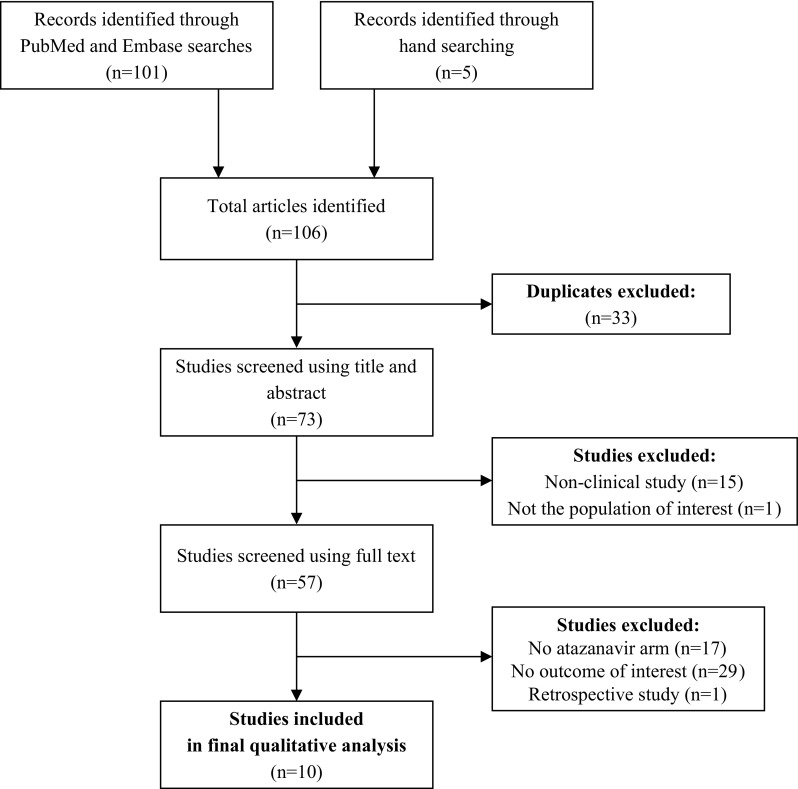
A systematic search of the PubMed and Embase databases was conducted on August 26, 2015, using terms to identify papers that discuss ATV, HIV, and CVD. Articles were limited to English-language publications of randomized-controlled or observational studies investigating adult humans. The primary outcome was the incidence of CVD. Articles describing surrogate markers of CVD were also included.
Ten studies were included in this qualitative analysis: six reported CVD outcomes, two reported data on atherosclerosis as assessed by carotid intima-media thickness (cIMT), and two reported outcomes related to endothelial function. The studies reporting the incidence of myocardial infarction (MI) among HIV-infected patients showed that ATV (boosted and unboosted) was not associated with an increased risk of acute MI. Other CV endpoints were similarly unaffected by treatment with ATV. Compared with non-ATV-based regimens, ATV had beneficial effects on cIMT progression in the publications identified, with no apparent impact on endothelial function.
This analysis showed that there was no increased risk or occurrence of adverse CV events among HIV-infected patients receiving ATV. Markers of atherosclerosis were improved, suggesting a possible antioxidant effect of ATV, and endothelial function was not affected.
Bristol-Myers Squibb (article processing charges and medical writing support).
感染人类免疫缺陷病毒(HIV)的患者患心血管疾病(CVD)的风险增加。虽然抗逆转录病毒疗法实现病毒抑制总体上可降低CVD风险,但多项研究表明,某些抗逆转录病毒药物,尤其是某些蛋白酶抑制剂,可能与CVD相对风险增加有关。在艾滋病临床试验组5260研究中,与利托那韦增强的达芦那韦和拉替拉韦相比,利托那韦增强的阿扎那韦(ATV)与动脉粥样硬化进展较慢有关,这可能归因于高胆红素血症。虽然高胆红素血症可能导致治疗中断率增加,但它也可能有助于ATV呈现良好的心血管(CV)特征。为了全面阐明ATV对HIV感染患者CVD风险的影响,我们对文献进行了系统评价。
2015年8月26日,我们在PubMed和Embase数据库中进行了系统检索,使用相关术语来识别讨论ATV、HIV和CVD的论文。文章仅限于调查成年人类的随机对照或观察性研究的英文出版物。主要结局是CVD的发病率。还纳入了描述CVD替代标志物的文章。
本定性分析纳入了10项研究:6项报告了CVD结局,2项报告了通过颈动脉内膜中层厚度(cIMT)评估的动脉粥样硬化数据,2项报告了与内皮功能相关的结局。报告HIV感染患者心肌梗死(MI)发病率的研究表明,ATV(增强和未增强)与急性MI风险增加无关。其他CV终点同样未受ATV治疗的影响。与非基于ATV的治疗方案相比,在已识别的出版物中,ATV对cIMT进展有有益影响,对内皮功能无明显影响。
该分析表明,接受ATV治疗的HIV感染患者发生不良CV事件的风险或发生率没有增加。动脉粥样硬化标志物得到改善,提示ATV可能具有抗氧化作用,且内皮功能未受影响。
百时美施贵宝公司(文章处理费和医学写作支持)。