Zhang Jiaming, Norris Kate J, Gibson Gary, Zhao Dongxue, Samuels Katy, Zhang Minxian Max, Yang J Joshua, Park Joonsuk, Sinclair Robert, Jeon Yoocharn, Li Zhiyong, Williams R Stanley
Hewlett Packard Labs, 1501 Page Mill Rd, Palo Alto, CA 94304, USA.
Department of Electrical and Computer Engineering, University of Massachusetts, Amherst, Massachusetts 01003, USA.
Sci Rep. 2016 Sep 29;6:34294. doi: 10.1038/srep34294.
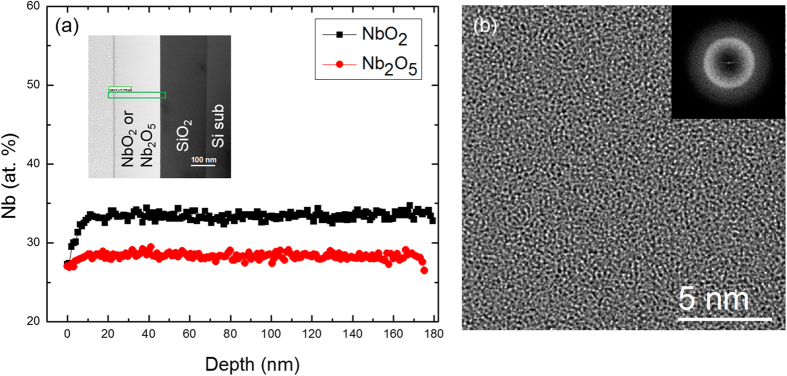
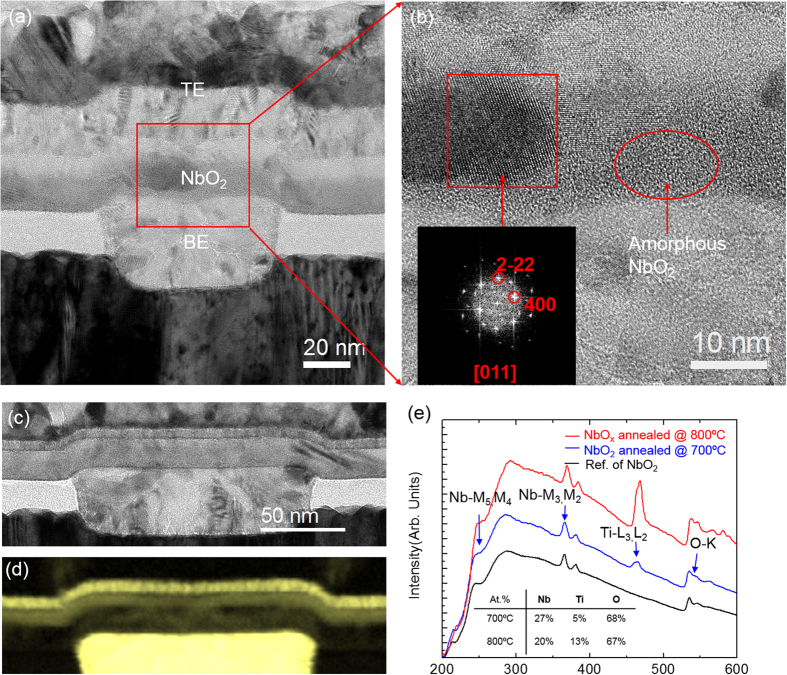
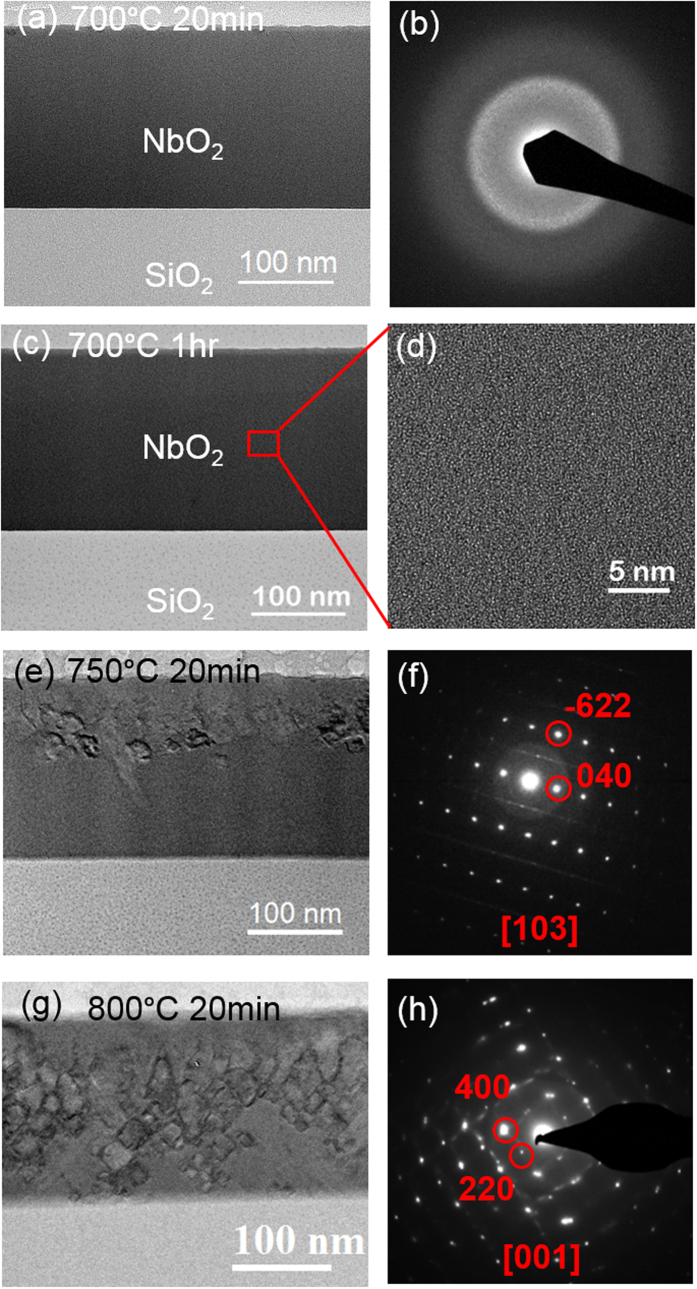
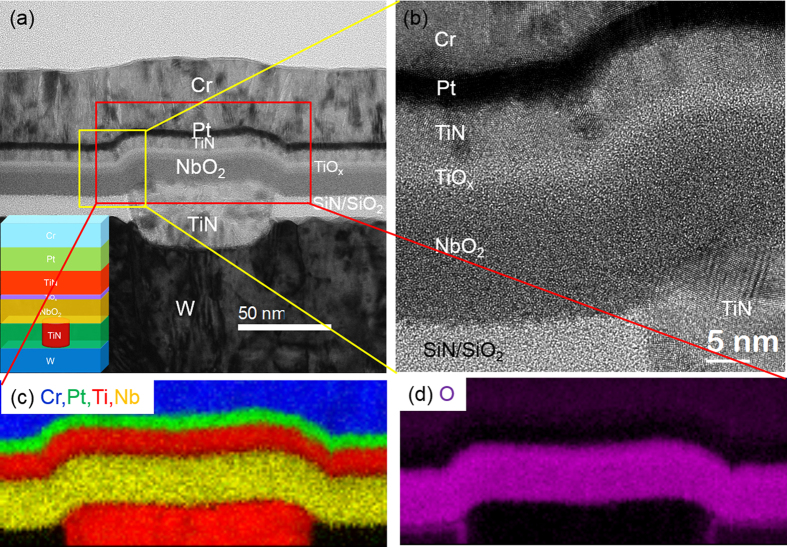
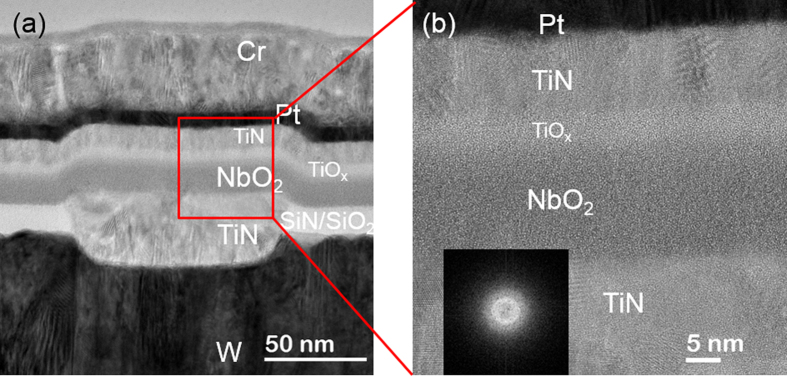
Niobium dioxide can exhibit negative differential resistance (NDR) in metal-insulator-metal (MIM) devices, which has recently attracted significant interest for its potential applications as a highly non-linear selector element in emerging nonvolatile memory (NVM) and as a locally-active element in neuromorphic circuits. In order to further understand the processing of this material system, we studied the effect of thermal annealing on a 15 nm thick NbO thin film sandwiched inside a nanoscale MIM device and compared it with 180 nm thick blanket NbO (x = 2 and 2.5) films deposited on a silicon dioxide surface as references. A systematic transmission electron microscope (TEM) study revealed a similar structural transition from amorphous to a distorted rutile structure in both cases, with a transition temperature of 700 °C for the NbO inside the MIM device and a slightly higher transition temperature of 750 °C for the reference NbO film. Quantitative composition analysis from electron energy loss spectroscopy (EELS) showed the stoichiometry of the nominal 15 nm NbO layer in the as-fabricated MIM device deviated from the target 1:2 ratio because of an interaction with the electrode materials, which was more prominent at elevated annealing temperature.
二氧化铌在金属-绝缘体-金属(MIM)器件中可表现出负微分电阻(NDR),最近它因其在新兴非易失性存储器(NVM)中作为高度非线性选择元件以及在神经形态电路中作为局部有源元件的潜在应用而备受关注。为了进一步了解这种材料体系的工艺,我们研究了热退火对夹在纳米级MIM器件内部的15纳米厚NbO薄膜的影响,并将其与沉积在二氧化硅表面作为参考的180纳米厚的NbO(x = 2和2.5)覆盖膜进行了比较。系统的透射电子显微镜(TEM)研究表明,在这两种情况下都发生了从非晶态到扭曲金红石结构的类似结构转变,MIM器件内部的NbO转变温度为700°C,参考NbO薄膜的转变温度略高,为750°C。电子能量损失谱(EELS)的定量成分分析表明,由于与电极材料的相互作用,所制备的MIM器件中名义上15纳米厚的NbO层的化学计量比偏离了目标1:2的比例,这种相互作用在较高的退火温度下更为明显。