Sun Pengxiao, Lu Nianduan, Li Ling, Li Yingtao, Wang Hong, Lv Hangbing, Liu Qi, Long Shibing, Liu Su, Liu Ming
Key Laboratory of Microelectronics Devices and Integrated Technology, Institute of Microelectronics, Chinese Academy of Sciences, Beijing 100029 China.
Lab of Nanofabrication and Novel Devices Integration Technology, Institute of Microelectronics, Chinese Academy of Sciences, Beijing 100029 China.
Sci Rep. 2015 Aug 27;5:13504. doi: 10.1038/srep13504.
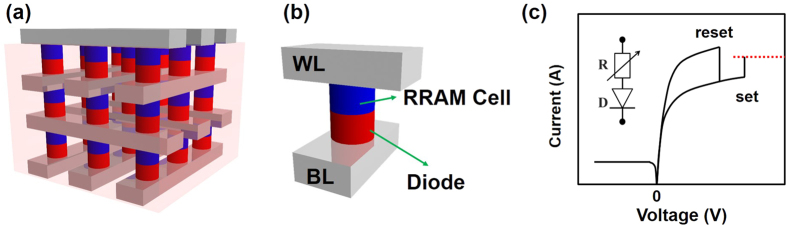
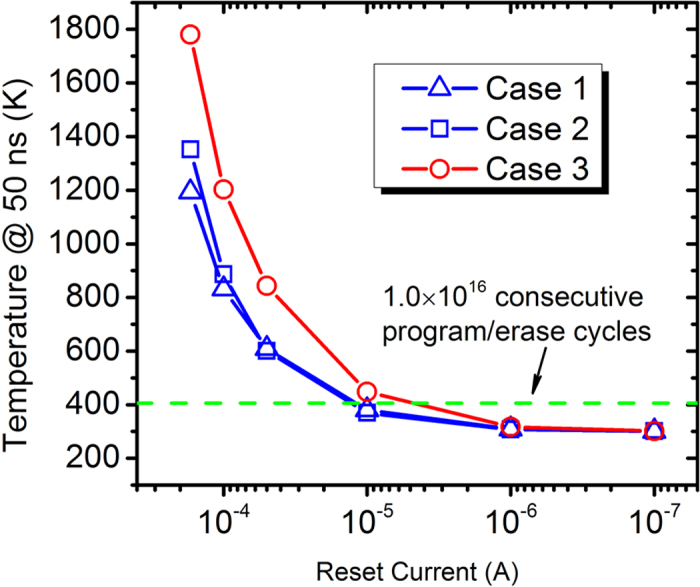
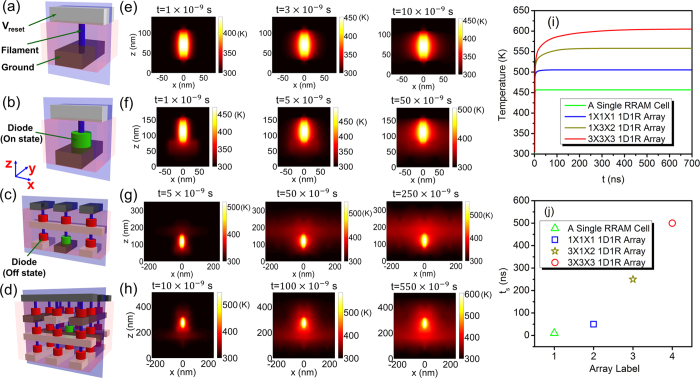
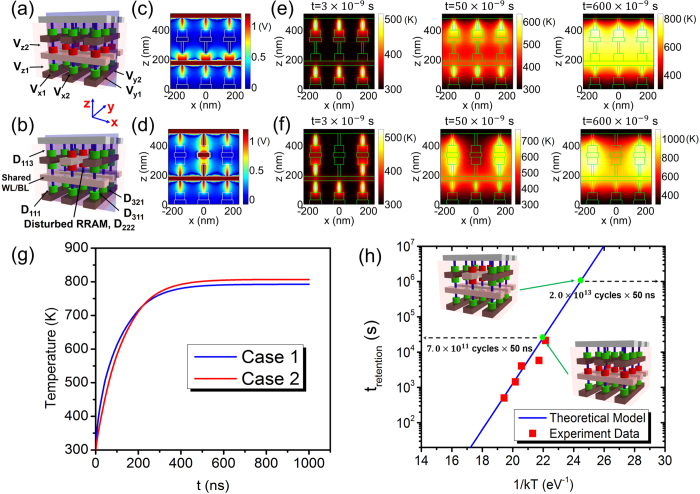
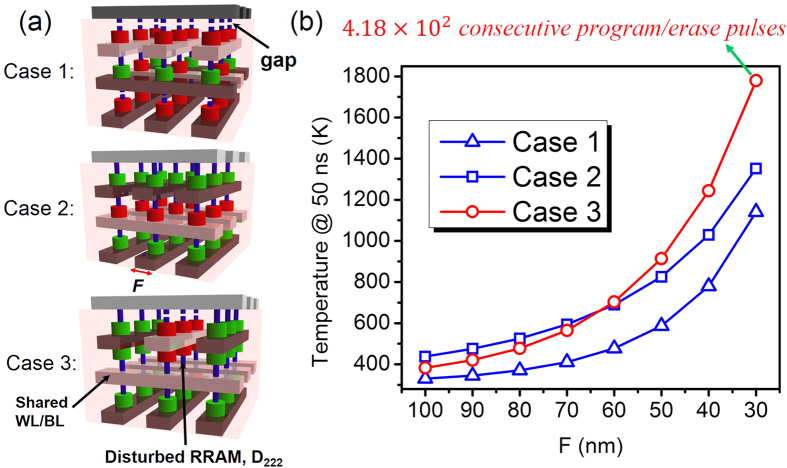
High density 3-dimensional (3D) crossbar resistive random access memory (RRAM) is one of the major focus of the new age technologies. To compete with the ultra-high density NAND and NOR memories, understanding of reliability mechanisms and scaling potential of 3D RRAM crossbar array is needed. Thermal crosstalk is one of the most critical effects that should be considered in 3D crossbar array application. The Joule heat generated inside the RRAM device will determine the switching behavior itself, and for dense memory arrays, the temperature surrounding may lead to a consequent resistance degradation of neighboring devices. In this work, thermal crosstalk effect and scaling potential under thermal effect in 3D RRAM crossbar array are systematically investigated. It is revealed that the reset process is dominated by transient thermal effect in 3D RRAM array. More importantly, thermal crosstalk phenomena could deteriorate device retention performance and even lead to data storage state failure from LRS (low resistance state) to HRS (high resistance state) of the disturbed RRAM cell. In addition, the resistance state degradation will be more serious with continuously scaling down the feature size. Possible methods for alleviating thermal crosstalk effect while further advancing the scaling potential are also provided and verified by numerical simulation.
高密度三维(3D)交叉阵列电阻式随机存取存储器(RRAM)是新时代技术的主要研究热点之一。为了与超高密度的NAND和NOR存储器竞争,需要了解3D RRAM交叉阵列的可靠性机制和缩放潜力。热串扰是3D交叉阵列应用中应考虑的最关键效应之一。RRAM器件内部产生的焦耳热将决定其自身的开关行为,而对于密集的存储器阵列,周围温度可能会导致相邻器件的电阻随之降低。在这项工作中,系统地研究了3D RRAM交叉阵列中的热串扰效应和热效应下的缩放潜力。结果表明,在3D RRAM阵列中,复位过程由瞬态热效应主导。更重要的是,热串扰现象会恶化器件的保持性能,甚至导致受干扰的RRAM单元从低电阻状态(LRS)到高电阻状态(HRS)的数据存储状态失效。此外,随着特征尺寸的不断缩小,电阻状态退化将更加严重。还提供了在进一步提高缩放潜力的同时减轻热串扰效应的可能方法,并通过数值模拟进行了验证。