Obrist Dominik, Nienhaus Andrea, Zamaro Ewa, Kalla Roger, Mantokoudis Georgios, Strupp Michael
ARTORG Center for Biomedical Engineering Research, University of Bern , Bern , Switzerland.
Department of Otorhinolaryngology, Head and Neck Surgery, University Hospital Bern, Inselspital , Bern , Switzerland.
Front Neurol. 2016 Sep 16;7:150. doi: 10.3389/fneur.2016.00150. eCollection 2016.
To evaluate the effect of time between the movements/steps, angle of body movements as well as the angular velocity of the maneuvers in an model of a semicircular canal (SCC) to improve the efficacy of the Sémont maneuver (SM) in benign paroxysmal positional vertigo.
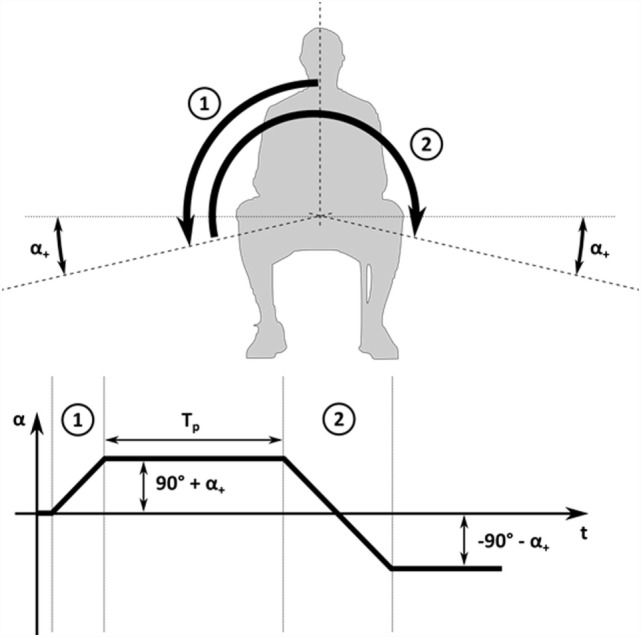
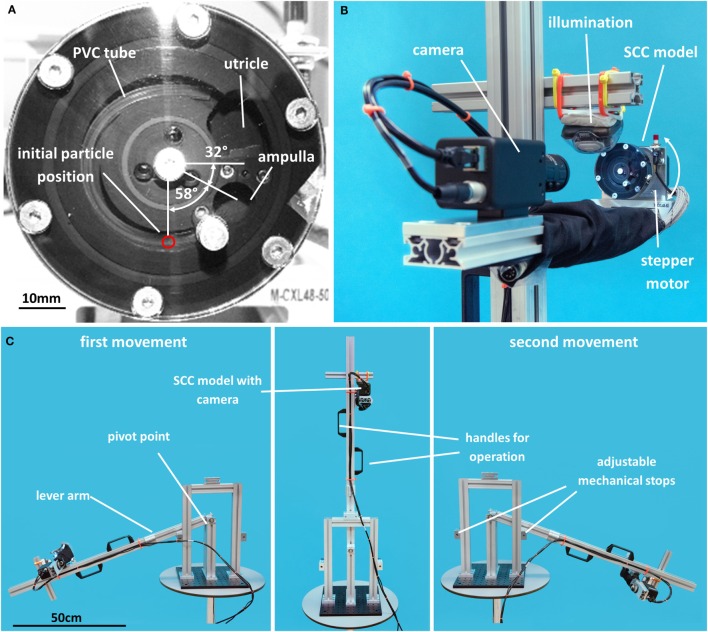
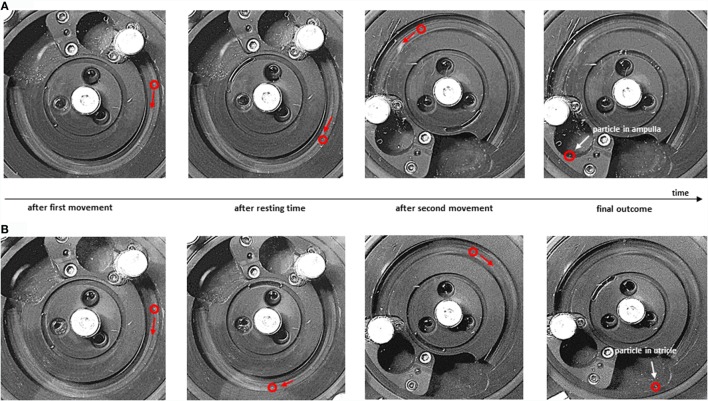
Sémont maneuvers were performed on an SCC model. Otoconia trajectories were captured by a video camera. The effects of time between the movements, angles of motion (0°, 10°, 20°, and 30° below the horizontal line), different angular velocities (90, 135, 180°/s), and otoconia size (36 and 50 μm) on the final position of the otoconia in the SCC were tested.
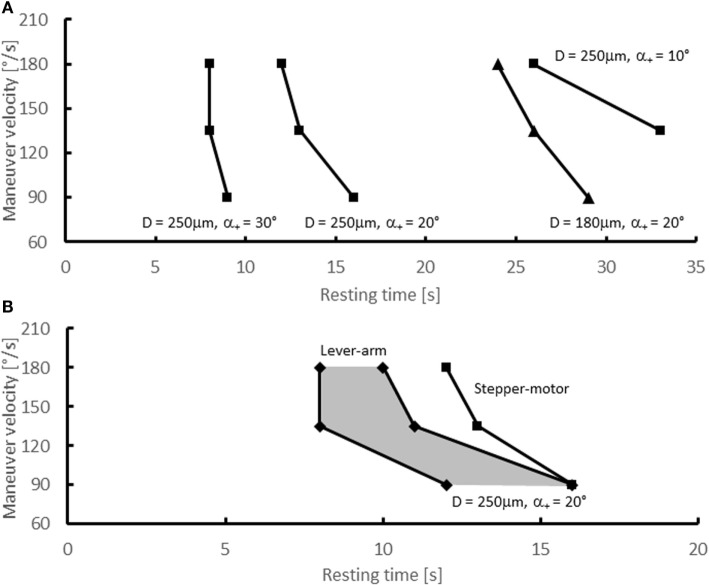
Without extension of the movements beyond the horizontal, the experiments (with particles corresponding to 50 μm diameter) did not yield successful canalith repositioning. If the movements were extended by 20° beyond the horizontal position, SM were successful with resting times of at least 16 s. For larger extension angles, the required time decreased. However, for smaller particles (36 μm), the required time doubled. The angular maneuver velocity (tested between 90 and 180°/s) did not have a major impact on the final position of the otoconia.
The two primary determinants for success of the SM are the time between the movements and the extension of the movements beyond the horizontal. The time between the movements should be at least 45 s. Angles of 20° or more below horizontal line (so-called Sémont+) should increase the success rate of SM.
在半规管(SCC)模型中评估运动/步骤之间的时间、身体运动角度以及动作的角速度对改善良性阵发性位置性眩晕的Sémont手法(SM)疗效的影响。
在SCC模型上进行Sémont手法操作。通过摄像机捕捉耳石轨迹。测试运动之间的时间、运动角度(低于水平线0°、10°、20°和30°)、不同角速度(90、135、180°/秒)以及耳石大小(36和50μm)对SCC中耳石最终位置的影响。
在运动不超过水平线的情况下,实验(使用直径对应50μm的颗粒)未成功实现耳石复位。如果运动超出水平位置20°,SM手法在休息时间至少为16秒时成功。对于更大的伸展角度,所需时间减少。然而,对于较小的颗粒(36μm),所需时间翻倍。角动作速度(在90至180°/秒之间测试)对耳石的最终位置没有重大影响。
SM手法成功的两个主要决定因素是运动之间的时间以及运动超出水平线的程度。运动之间的时间应至少为45秒。低于水平线20°或更大的角度(所谓的Sémont+)应提高SM手法的成功率。