State Key Laboratory of Cognitive Neuroscience and Learning and IDG/McGovern Institute for Brain Research, Beijing Normal University, Beijing, China.
Center for Collaboration and Innovation in Brain and Learning Sciences, Beijing Normal University, Beijing, China.
Addict Biol. 2018 Jan;23(1):337-346. doi: 10.1111/adb.12474. Epub 2016 Nov 28.
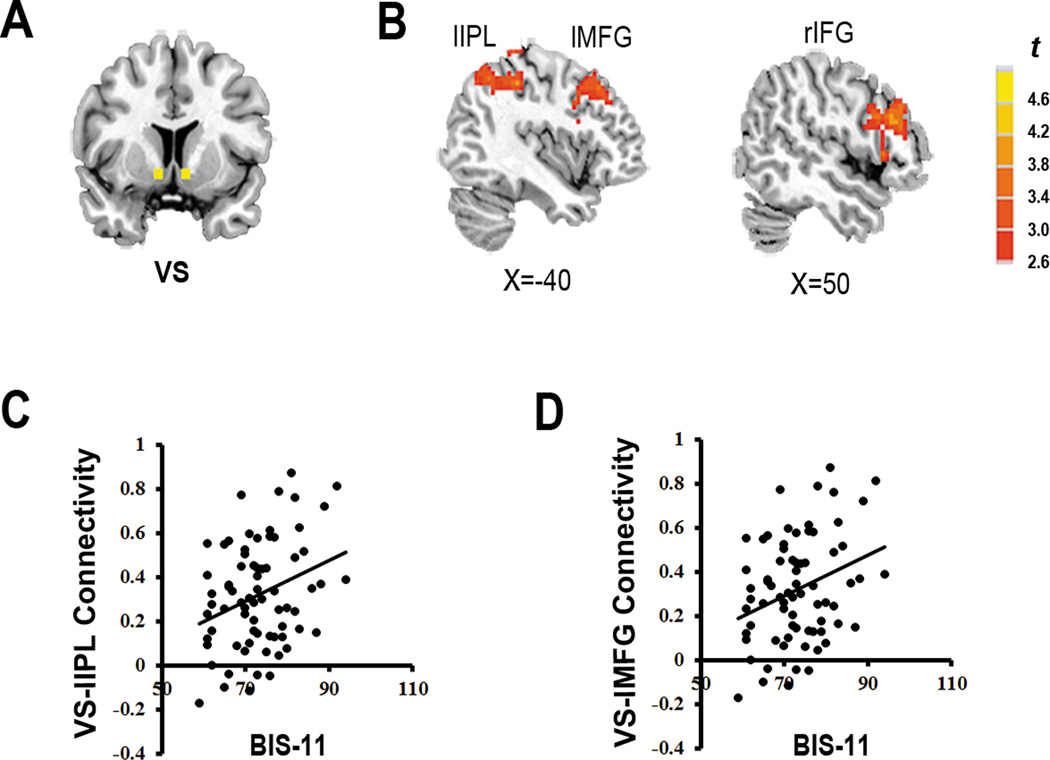
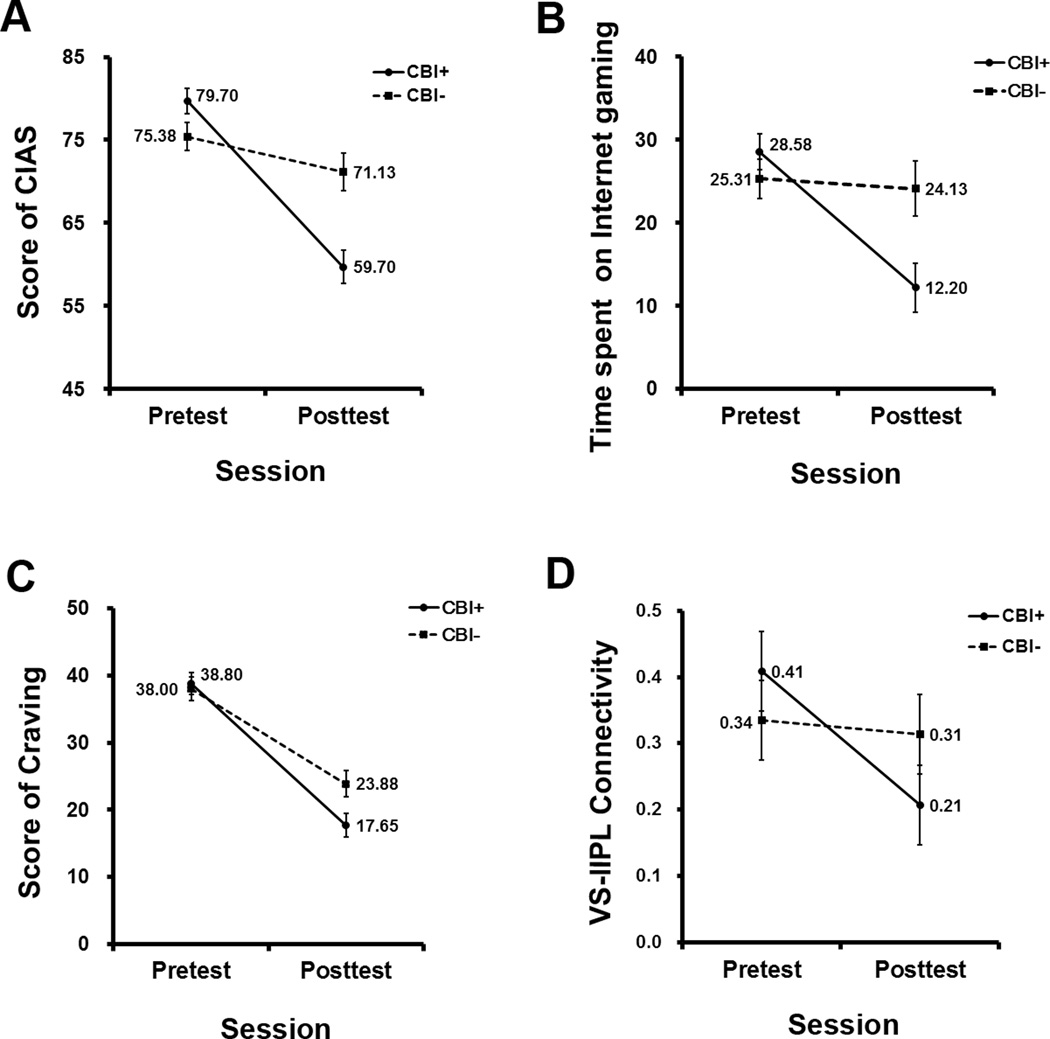
Psychobehavioral intervention is an effective treatment of Internet addiction, including Internet gaming disorder (IGD). However, the neural mechanisms underlying its efficacy remain unclear. Cortical-ventral striatum (VS) circuitry is a common target of psychobehavioral interventions in drug addiction, and cortical-VS dysfunction has been reported in IGD; hence, the primary aim of the study was to investigate how the VS circuitry responds to psychobehavioral interventions in IGD. In a cross-sectional study, we examined resting-state functional connectivity of the VS in 74 IGD subjects (IGDs) and 41 healthy controls (HCs). In a follow-up craving behavioral intervention (CBI) study, of the 74 IGD subjects, 20 IGD subjects received CBI (CBI+) and 16 IGD subjects did not (CBI-). All participants were scanned twice with similar time interval to assess the effects of CBI. IGD subjects showed greater resting-state functional connectivity of the VS to left inferior parietal lobule (lIPL), right inferior frontal gyrus and left middle frontal gyrus, in positive association with the severity of IGD. Moreover, compared with CBI-, CBI+ showed significantly greater decrease in VS-lIPL connectivity, along with amelioration in addiction severity following the intervention. These findings demonstrated that functional connectivity between VS and lIPL, each presumably mediating gaming craving and attentional bias, may be a potential biomarker of the efficacy of psychobehavioral intervention. These results also suggested that non-invasive techniques such as transcranial magnetic or direct current stimulation targeting the VS-IPL circuitry may be used in the treatment of Internet gaming disorders.
心理行为干预是治疗网络成瘾(包括网络游戏障碍)的有效方法。然而,其疗效的神经机制仍不清楚。皮质腹侧纹状体(VS)回路是药物成瘾心理行为干预的共同靶点,并且已经报道了网络游戏障碍中的皮质 VS 功能障碍;因此,该研究的主要目的是研究 VS 回路如何对网络游戏障碍的心理行为干预做出反应。在一项横断面研究中,我们检查了 74 名网络游戏障碍患者(IGD)和 41 名健康对照者(HC)的 VS 静息状态功能连接。在后续的渴求行为干预(CBI)研究中,在 74 名 IGD 患者中,20 名 IGD 患者接受了 CBI(CBI+),16 名 IGD 患者未接受 CBI(CBI-)。所有参与者均在相似的时间间隔内进行两次扫描,以评估 CBI 的效果。IGD 患者的 VS 与左侧顶下小叶(lIPL)、右侧额下回和左侧额中回之间的静息状态功能连接更强,与 IGD 的严重程度呈正相关。此外,与 CBI-相比,CBI+显示 VS-lIPL 连接显著降低,并且在干预后成瘾严重程度得到改善。这些发现表明,VS 与 IPL 之间的功能连接,可能分别介导游戏渴求与注意力偏向,可能是心理行为干预疗效的潜在生物标志物。这些结果还表明,针对 VS-IPL 回路的非侵入性技术,如经颅磁刺激或直流电刺激,可能用于治疗网络游戏障碍。