IBM Research-Almaden, San Jose, CA 95120, USA.; Department of Materials Science Engineering, Stanford University, Stanford, CA 94305, USA.
IBM Research-Almaden, San Jose, CA 95120, USA.; International Center for Quantum Materials, School of Physics, Peking University, Beijing 100871, China.
Sci Adv. 2016 Sep 30;2(9):e1600759. doi: 10.1126/sciadv.1600759. eCollection 2016 Sep.
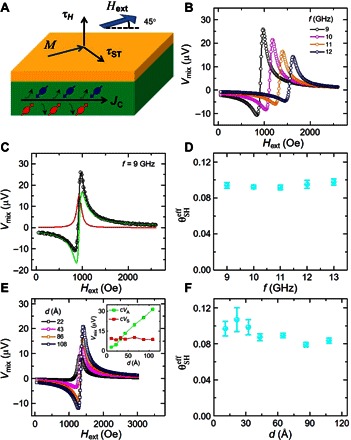
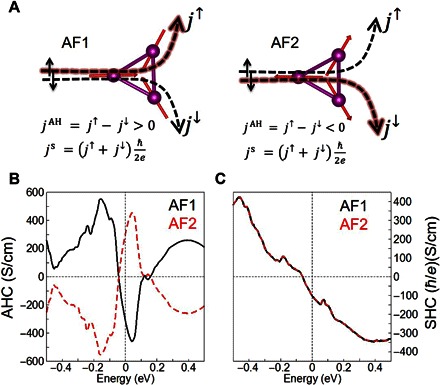
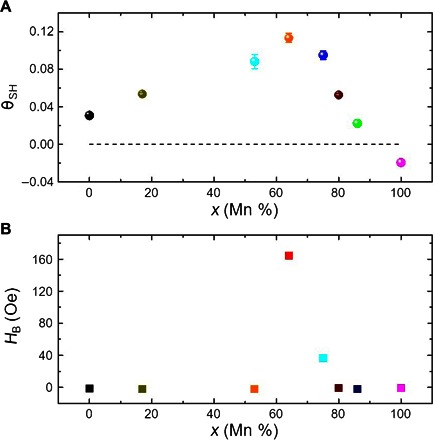
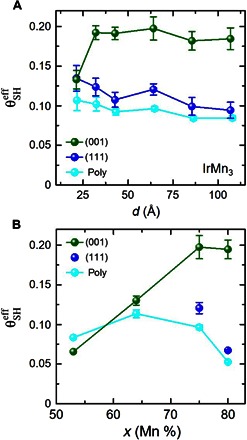
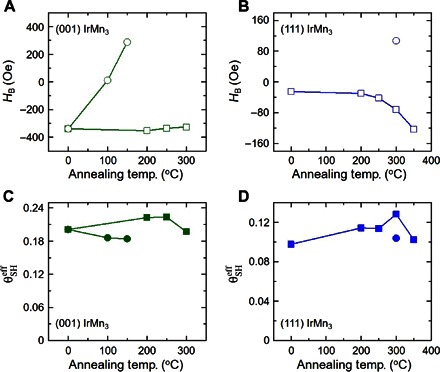
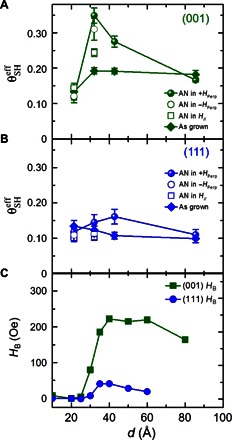
There has been considerable interest in spin-orbit torques for the purpose of manipulating the magnetization of ferromagnetic elements for spintronic technologies. Spin-orbit torques are derived from spin currents created from charge currents in materials with significant spin-orbit coupling that propagate into an adjacent ferromagnetic material. A key challenge is to identify materials that exhibit large spin Hall angles, that is, efficient charge-to-spin current conversion. Using spin torque ferromagnetic resonance, we report the observation of a giant spin Hall angle [Formula: see text] of up to ~0.35 in (001)-oriented single-crystalline antiferromagnetic IrMn thin films, coupled to ferromagnetic permalloy layers, and a [Formula: see text] that is about three times smaller in (111)-oriented films. For (001)-oriented samples, we show that the magnitude of [Formula: see text] can be significantly changed by manipulating the populations of various antiferromagnetic domains through perpendicular field annealing. We identify two distinct mechanisms that contribute to [Formula: see text]: the first mechanism, which is facet-independent, arises from conventional bulk spin-dependent scattering within the IrMn layer, and the second intrinsic mechanism is derived from the unconventional antiferromagnetic structure of IrMn. Using ab initio calculations, we show that the triangular magnetic structure of IrMn gives rise to a substantial intrinsic spin Hall conductivity that is much larger for the (001) than for the (111) orientation, consistent with our experimental findings.
人们对自旋轨道扭矩产生了浓厚的兴趣,因为它可以用于操控铁磁元件的磁化,从而应用于自旋电子技术。自旋轨道扭矩源自于具有显著自旋轨道耦合的材料中由电荷电流产生的自旋电流,这些自旋电流会传播到相邻的铁磁材料中。一个关键的挑战是要确定具有较大自旋霍尔角的材料,也就是说,要有高效的电荷到自旋电流转换效率。我们利用自旋扭矩铁磁共振,观察到了在(001)取向的单晶反铁磁 IrMn 薄膜中,高达~0.35 的巨大自旋霍尔角[Formula: see text],这些薄膜与铁磁坡莫合金层耦合,而在(111)取向的薄膜中,[Formula: see text]则小了约三倍。对于(001)取向的样品,我们通过在外加垂直磁场退火过程中操控不同反铁磁畴的分布,表明[Formula: see text]的大小可以显著改变。我们确定了两种不同的机制导致了[Formula: see text]:第一种机制与晶面无关,它源自于 IrMn 层内的常规体相自旋相关散射;第二种内在机制源自于 IrMn 的非常规反铁磁结构。通过第一性原理计算,我们表明 IrMn 的三角磁性结构导致了可观的固有自旋霍尔电导率,对于(001)取向,该电导率比(111)取向大得多,这与我们的实验结果一致。