Isaac Sandrine, Scher Jose U, Djukovic Ana, Jiménez Nuria, Littman Dan R, Abramson Steven B, Pamer Eric G, Ubeda Carles
Departamento de Genómica y Salud, Centro Superior de Investigación en Salud Pública - FISABIO, Valencia, Spain.
Department of Medicine, New York University School of Medicine and Hospital for Joint Diseases, New York, NY, USA.
J Antimicrob Chemother. 2017 Jan;72(1):128-136. doi: 10.1093/jac/dkw383. Epub 2016 Oct 5.
Oral vancomycin remains the mainstay of therapy for severe infections produced by Clostridium difficile, the most prevalent cause of healthcare-associated infectious diarrhoea in developed countries. However, its short- and long-term effects on the human intestinal microbiota remain largely unknown.
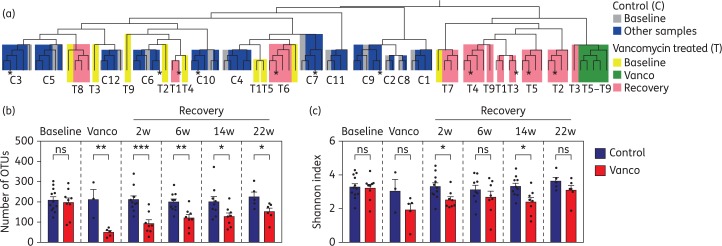
We utilized high-throughput sequencing to analyse the effects of vancomycin on the faecal human microbiota up to 22 weeks post-antibiotic cessation. The clinical relevance of the observed microbiota perturbations was studied in mice.
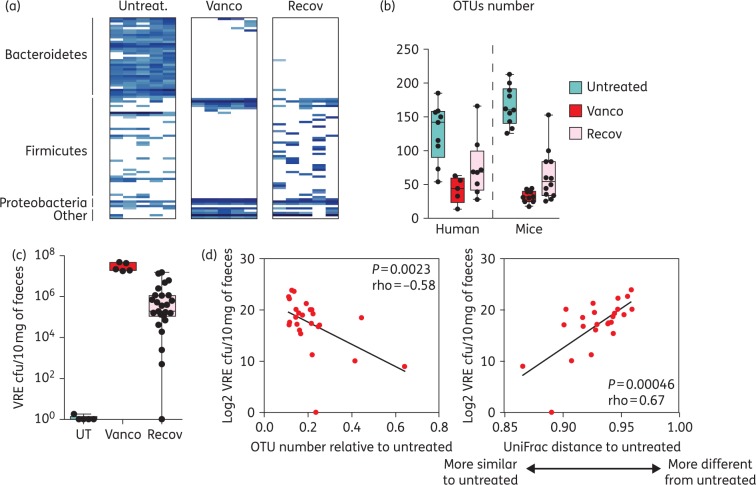
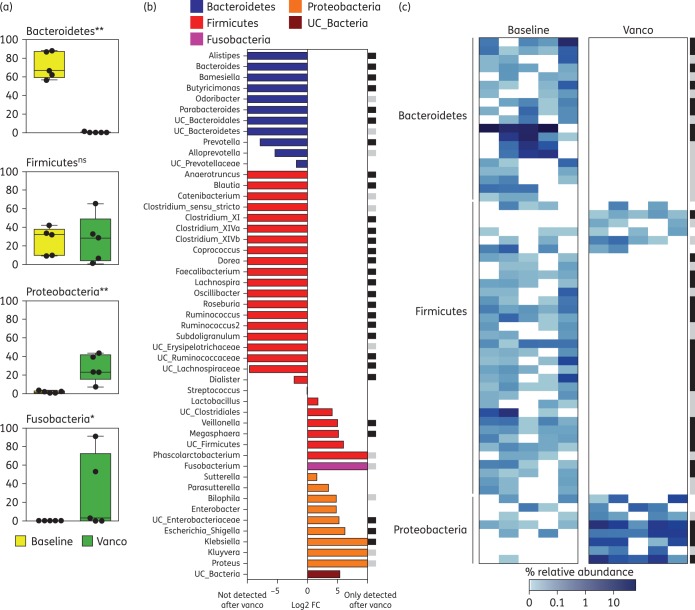
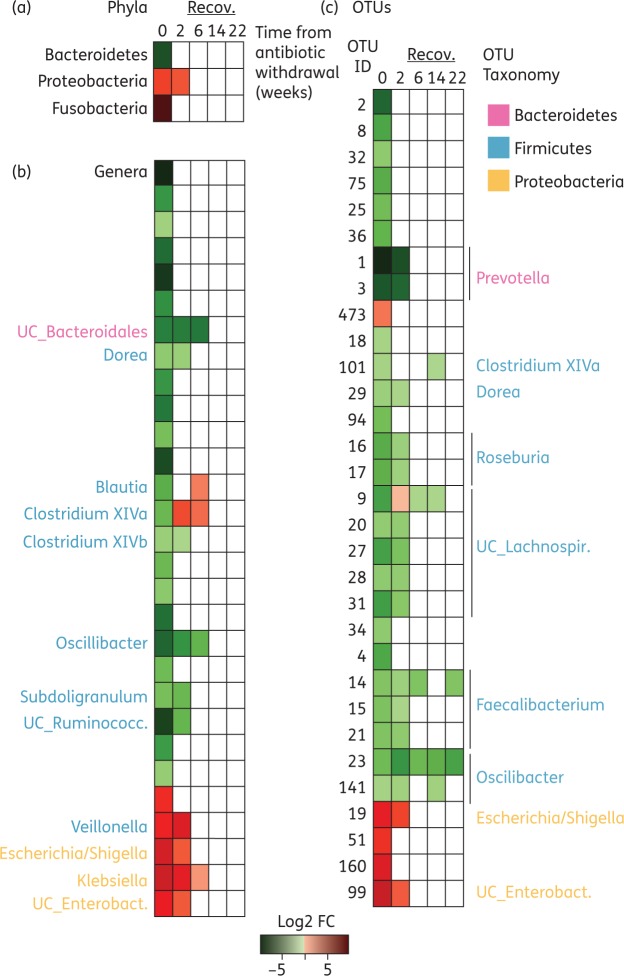
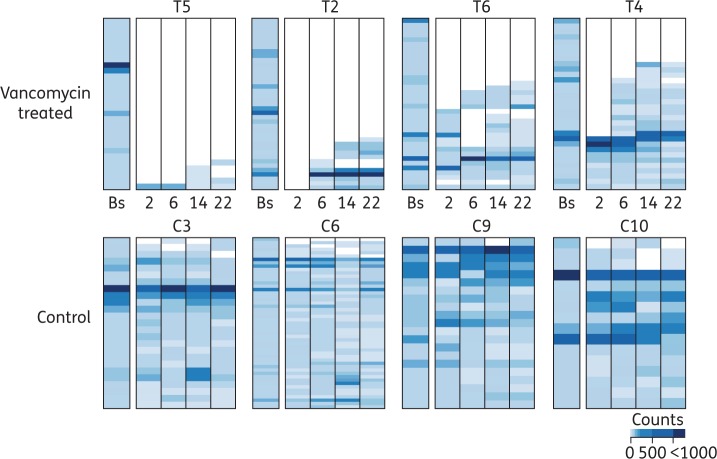
During vancomycin therapy, most intestinal microbiota genera and operational taxonomic units (OTUs) were depleted in all analysed subjects, including all baseline OTUs from the phylum Bacteroidetes. This was accompanied by a vast expansion of genera associated with infections, including Klebsiella and Escherichia/Shigella. Following antibiotic cessation, marked differences in microbiota resilience were observed among subjects. While some individuals recovered a microbiota close to baseline composition, in others, up to 89% of abundant OTUs could no longer be detected. The clinical relevance of the observed microbiota changes was further demonstrated in mice, which developed analogous microbiota alterations. During vancomycin treatment, mice were highly susceptible to intestinal colonization by an antibiotic-resistant pathogen and, upon antibiotic cessation, a less-resilient microbiota allowed higher levels of pathogen colonization.
Oral vancomycin induces drastic and consistent changes in the human intestinal microbiota. Upon vancomycin cessation, the microbiota recovery rate varied considerably among subjects, which could influence, as validated in mice, the level of susceptibility to pathogen intestinal colonization. Our results demonstrate the negative long-term effects of vancomycin, which should be considered as a fundamental aspect of the cost-benefit equation for antibiotic prescription.
口服万古霉素仍然是治疗艰难梭菌所致严重感染的主要手段,艰难梭菌是发达国家医疗保健相关感染性腹泻最常见的病因。然而,其对人类肠道微生物群的短期和长期影响仍 largely 未知。
我们利用高通量测序分析了万古霉素在抗生素停用后长达22周对人类粪便微生物群的影响。在小鼠中研究了观察到的微生物群扰动的临床相关性。
在万古霉素治疗期间,所有分析对象的大多数肠道微生物群属和操作分类单元(OTU)均减少,包括拟杆菌门的所有基线OTU。这伴随着与感染相关的属的大量扩增,包括克雷伯菌属和大肠埃希菌/志贺菌属。抗生素停用后,各受试者之间观察到微生物群恢复力存在显著差异。虽然一些个体恢复了接近基线组成的微生物群,但在其他个体中,高达89%的丰富OTU再也检测不到。在小鼠中进一步证明了观察到的微生物群变化的临床相关性,小鼠出现了类似的微生物群改变。在万古霉素治疗期间,小鼠极易被耐抗生素病原体肠道定植,抗生素停用后,恢复力较低的微生物群允许更高水平的病原体定植。
口服万古霉素会引起人类肠道微生物群剧烈且一致的变化。万古霉素停用后,各受试者之间微生物群的恢复率差异很大,正如在小鼠中验证的那样,这可能会影响对病原体肠道定植的易感性水平。我们的结果证明了万古霉素的负面长期影响,这应被视为抗生素处方成本效益方程的一个基本方面。