Le Weidong, Wu Junjiao, Tang Yu
Center for Clinical Research on Neurological Diseases, First Affiliated Hospital, Dalian Medical University, Dalian China.
Department of Rheumatology and Immunology, Xiangya Hospital of Central South University, ChangshaChina; Department of Molecular Biology, University of Texas Southwestern Medical Center, Dallas, TXUSA.
Front Mol Neurosci. 2016 Sep 21;9:89. doi: 10.3389/fnmol.2016.00089. eCollection 2016.
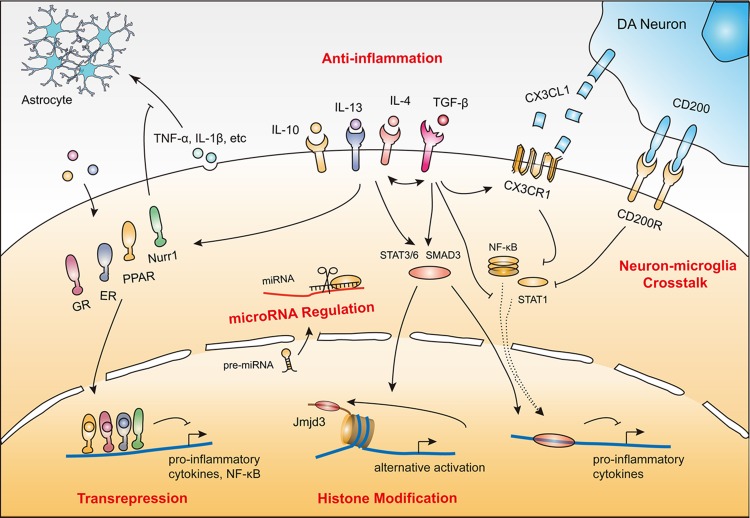
Microglia-mediated neuroinflammation is a hallmark of Parkinson's disease (PD). In the brains of patients with PD, microglia have both neurotoxic and neuroprotective effects, depending on their activation state. In this review, we focus on recent research demonstrating the neuroprotective role of microglia in PD. Accumulating evidence indicates that the protective mechanisms of microglia may result from their regulation of transrepression pathways via nuclear receptors, anti-inflammatory responses, neuron-microglia crosstalk, histone modification, and microRNA regulation. All of these mechanisms work together to suppress the production of neurotoxic inflammatory components. However, during the progression of PD, the detrimental effects of inflammation overpower the protective actions of microglia. Therefore, an in-depth exploration of the mechanisms underlying microglial neuroprotection, and a means of promoting the transformation of microglia to the protective phenotype, are urgently needed for the treatment of PD.
小胶质细胞介导的神经炎症是帕金森病(PD)的一个标志。在帕金森病患者的大脑中,小胶质细胞根据其激活状态具有神经毒性和神经保护两种作用。在这篇综述中,我们重点关注了近期证明小胶质细胞在帕金森病中具有神经保护作用的研究。越来越多的证据表明,小胶质细胞的保护机制可能源于它们通过核受体对反式抑制途径的调节、抗炎反应、神经元与小胶质细胞的相互作用、组蛋白修饰以及微小RNA调节。所有这些机制共同作用以抑制神经毒性炎症成分的产生。然而,在帕金森病的进展过程中,炎症的有害作用超过了小胶质细胞的保护作用。因此,深入探究小胶质细胞神经保护的潜在机制以及促进小胶质细胞向保护表型转化的方法,对于帕金森病的治疗至关重要。