Nödl Marie-Therese, Kerbl Alexandra, Walzl Manfred G, Müller Gerd B, de Couet Heinz Gert
Department of Theoretical Biology, University of Vienna, Althanstrasse 14, 1090 Vienna, Austria ; Department of Biology, University of Hawaii at Manoa, 2538 McCarthy Mall, Edmondson Hall 413, Honolulu, HI 96822 USA.
Marine Biology Section - Department of Biology, University of Copenhagen, Universitetsparken 4, 2100 Copenhagen, Denmark.
Front Zool. 2016 Sep 29;13:44. doi: 10.1186/s12983-016-0175-8. eCollection 2016.
Cephalopods are a highly derived class of molluscs that adapted their body plan to a more active and predatory lifestyle. One intriguing adaptation is the modification of the ventral foot to form a bilaterally symmetric arm crown, which constitutes a true morphological novelty in evolution. In addition, this structure shows many diversifications within the class of cephalopods and therefore offers an interesting opportunity to study the molecular underpinnings of the emergence of phenotypic novelties and their diversification. Here we use the sepiolid as a model to study the formation and differentiation of the decabrachian arm crown, which consists of four pairs of sessile arms and one pair of retractile tentacles. We provide a detailed description of arm crown formation in order to understand the basic morphology and the developmental dynamics of this structure.
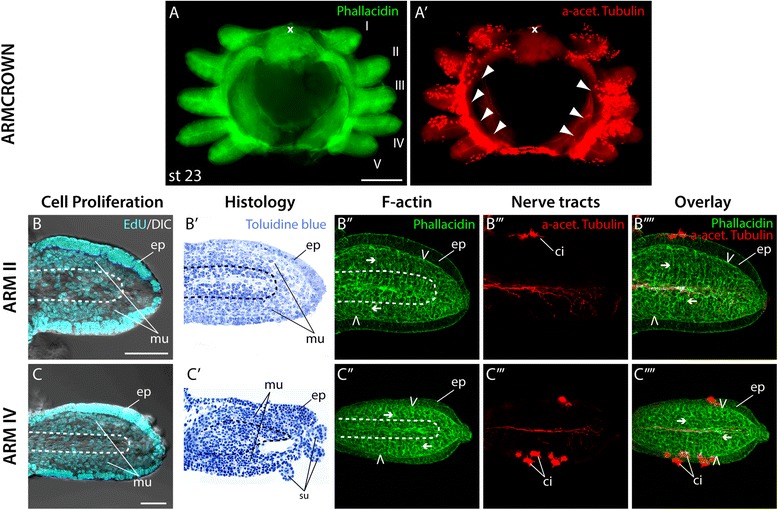
We show that the morphological formation of the cephalopod appendages occurs during distinct phases, including outgrowth, elongation, and tissue differentiation. Early outgrowth is characterized by uniform cell proliferation, while the elongation of the appendages initiates tissue differentiation. The latter progresses in a gradient from proximal to distal, whereas cell proliferation becomes restricted to the distal-most end of the arm. Differences in the formation of arms and tentacles exist, with the tentacles showing an expedite growth rate and higher complexity at younger stages.
The early outgrowth and differentiation of the arm crown shows similarities to the related, yet derived cephalopod . Parallels in the growth and differentiation of appendages seem to exist throughout the animal kingdom, raising the question of whether these similarities reflect a recruitment of similar molecular patterning pathways.
头足类动物是一类高度特化的软体动物,它们调整了身体结构以适应更活跃的捕食性生活方式。一个有趣的适应性变化是腹足演变成双侧对称的腕冠,这在进化过程中构成了真正的形态学新特征。此外,这种结构在头足类动物类群中表现出许多多样性,因此为研究表型新特征的出现及其多样化的分子基础提供了一个有趣的机会。在这里,我们以乌贼科动物为模型来研究十腕总目腕冠的形成和分化,腕冠由四对固定的腕和一对可伸缩的触须组成。我们详细描述了腕冠的形成过程,以便了解这种结构的基本形态和发育动态。
我们表明,头足类附肢的形态形成发生在不同阶段,包括生长、伸长和组织分化。早期生长的特征是细胞均匀增殖,而附肢的伸长则启动组织分化。后者从近端到远端呈梯度进行,而细胞增殖则局限于腕的最远端。腕和触须的形成存在差异,触须在较年轻阶段显示出更快的生长速度和更高的复杂性。
腕冠的早期生长和分化与相关但已分化的头足类动物相似。整个动物界的附肢在生长和分化方面似乎存在相似之处,这就提出了一个问题,即这些相似性是否反映了相似分子模式通路的重新利用。