Bond Mary, Crathorne Louise, Peters Jaime, Coelho Helen, Haasova Marcela, Cooper Chris, Milner Quentin, Shawyer Vicki, Hyde Christopher, Powell Roy
University of Exeter Medical School, University of Exeter, Veysey Building, Salmon Pool Lane, Exeter, EX2 4SG, UK.
Department of Anaesthesia, Royal Devon and Exeter Foundation Trust, Exeter, UK.
BMC Anesthesiol. 2016 Oct 1;16(1):81. doi: 10.1186/s12871-016-0252-8.
Peripheral venous cannulation is an everyday practice in hospitals, which many adults find painful. However, anaesthesia for cannulation is usually only offered to children. Inadequate pain relief is not only unpleasant for patients but may cause anxiety about further treatment and deter patients from seeking medical care in the future. The aim of this study is to discover the most effective local anaesthetic for adult peripheral venous cannulation and to find out how the pain of local anaesthetic application compares with that of unattenuated cannulation.
These aims are addressed through a systematic review, network meta-analysis and random-effects meta-analysis. Searching covered 12 databases including MEDLINE and EMBASE from 1990 to August 2015. The main included study design was RCTs. The primary outcome measure is self-reported pain, measured on a 100 mm visual analogue scale.
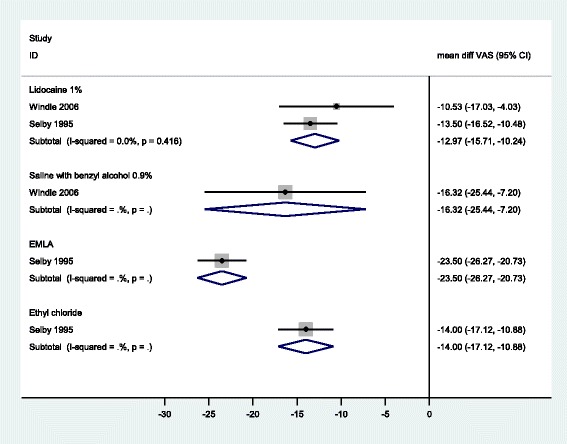
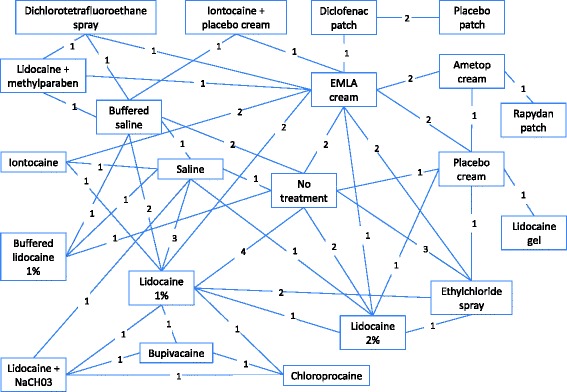
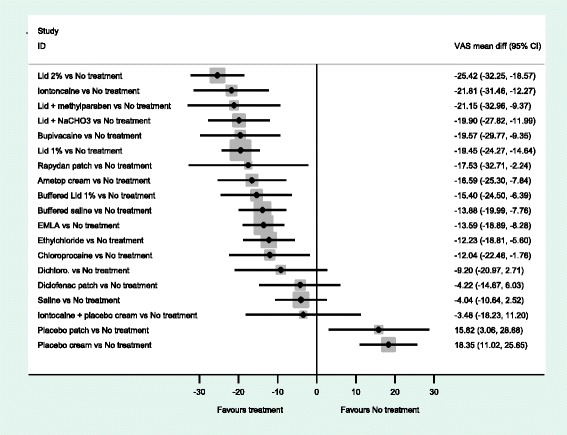
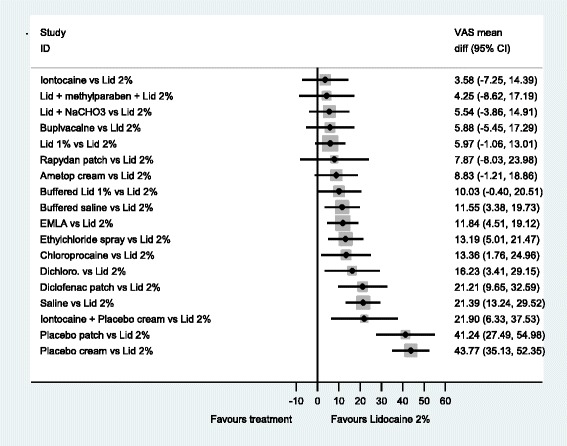
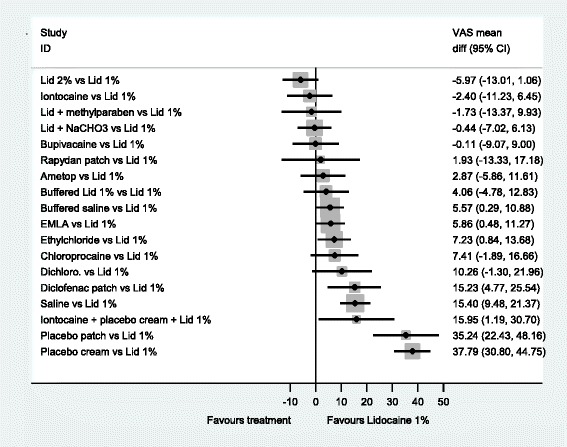
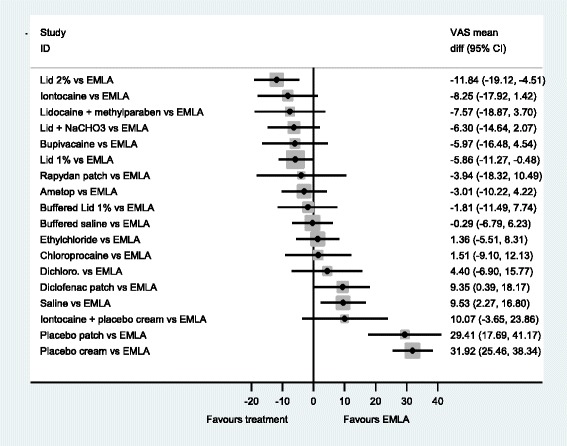
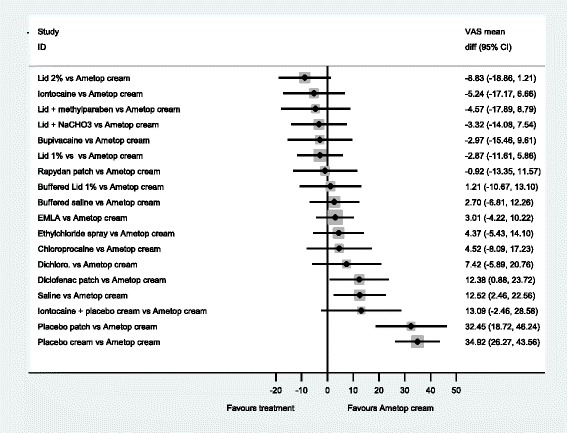
The systematic review found 37 includable studies, 27 of which were suitable for network meta-analysis and two for random-effects meta-analysis. The results of the network meta-analysis indicate that none of the 17 anaesthetic considered had a very high probability of being the most effective when compared to each other; 2 % lidocaine had the highest probability (44 %). When the anaesthetics were compared to no treatment, the network meta-analysis showed that again 2 % lidocaine was estimated to be the most effective (mean difference -25.42 (95 % CI -32.25, -18.57). Other members of the 'caine' family were also estimated to be more effective than no treatment as were Ametop, EMLA and Rapydan patch. The meta-analysis compared the pain of anaesthetic application with the unattenuated pain of cannulation. This found that all applications of local anaesthetic were less painful than cannulation without local anaesthetic. In particular a 1 % lidocaine injection was estimated to be -12.97 (95 % CI -15.71, -10.24) points (100 mm VAS) less painful than unattenuated cannulation.
The pain of peripheral venous cannulation in adults can be successfully treated. The pain of application of any local anaesthetic is less than that of unattenuated cannulation. Local anaesthetic prior to cannulation should become normal practice and a marker of high quality care.
The protocol for the larger study was registered with PROSPERO no. CRD42012002093 .
外周静脉置管是医院日常操作,许多成年人觉得很疼。然而,置管麻醉通常仅用于儿童。疼痛缓解不足不仅让患者不适,还可能导致对进一步治疗的焦虑,并使患者未来不愿寻求医疗护理。本研究的目的是找出用于成人外周静脉置管最有效的局部麻醉剂,并了解局部麻醉剂应用时的疼痛与未减轻的置管疼痛相比如何。
通过系统评价、网状Meta分析和随机效应Meta分析来实现这些目标。检索涵盖了12个数据库,包括1990年至2015年8月的MEDLINE和EMBASE。主要纳入的研究设计为随机对照试验(RCTs)。主要结局指标是自我报告的疼痛,采用100毫米视觉模拟量表进行测量。
系统评价发现37项可纳入研究,其中27项适合进行网状Meta分析,2项适合进行随机效应Meta分析。网状Meta分析结果表明,所考虑的17种麻醉剂中,相互比较时没有一种有很高概率成为最有效的;2%利多卡因概率最高(44%)。当将麻醉剂与不治疗进行比较时,网状Meta分析表明,同样2%利多卡因估计是最有效的(平均差值-25.42(95%CI -32.25,-18.57))。“卡因”家族的其他成员以及Ametop、EMLA和Rapydan贴剂估计也比不治疗更有效。Meta分析比较了麻醉剂应用时的疼痛与未减轻的置管疼痛。结果发现,所有局部麻醉剂的应用都比不使用局部麻醉剂的置管疼痛轻。特别是,估计1%利多卡因注射比未减轻的置管疼痛轻-12.97(95%CI -15.71,-10.24)分(100毫米视觉模拟量表)。
成人外周静脉置管的疼痛可以得到成功治疗。任何局部麻醉剂应用时的疼痛都比未减轻的置管疼痛轻。置管前使用局部麻醉剂应成为常规操作和高质量护理的标志。
更大规模研究的方案已在PROSPERO注册,注册号为CRD42012002093 。