Knight Anna K, Craig Jeffrey M, Theda Christiane, Bækvad-Hansen Marie, Bybjerg-Grauholm Jonas, Hansen Christine S, Hollegaard Mads V, Hougaard David M, Mortensen Preben B, Weinsheimer Shantel M, Werge Thomas M, Brennan Patricia A, Cubells Joseph F, Newport D Jeffrey, Stowe Zachary N, Cheong Jeanie L Y, Dalach Philippa, Doyle Lex W, Loke Yuk J, Baccarelli Andrea A, Just Allan C, Wright Robert O, Téllez-Rojo Mara M, Svensson Katherine, Trevisi Letizia, Kennedy Elizabeth M, Binder Elisabeth B, Iurato Stella, Czamara Darina, Räikkönen Katri, Lahti Jari M T, Pesonen Anu-Katriina, Kajantie Eero, Villa Pia M, Laivuori Hannele, Hämäläinen Esa, Park Hea Jin, Bailey Lynn B, Parets Sasha E, Kilaru Varun, Menon Ramkumar, Horvath Steve, Bush Nicole R, LeWinn Kaja Z, Tylavsky Frances A, Conneely Karen N, Smith Alicia K
Genetics and Molecular Biology Program, Emory University, Atlanta, GA, USA.
Murdoch Childrens Research Institute and Department of Paediatrics, University of Melbourne, Parkville, Victoria, 3052, Australia.
Genome Biol. 2016 Oct 7;17(1):206. doi: 10.1186/s13059-016-1068-z.
Gestational age is often used as a proxy for developmental maturity by clinicians and researchers alike. DNA methylation has previously been shown to be associated with age and has been used to accurately estimate chronological age in children and adults. In the current study, we examine whether DNA methylation in cord blood can be used to estimate gestational age at birth.
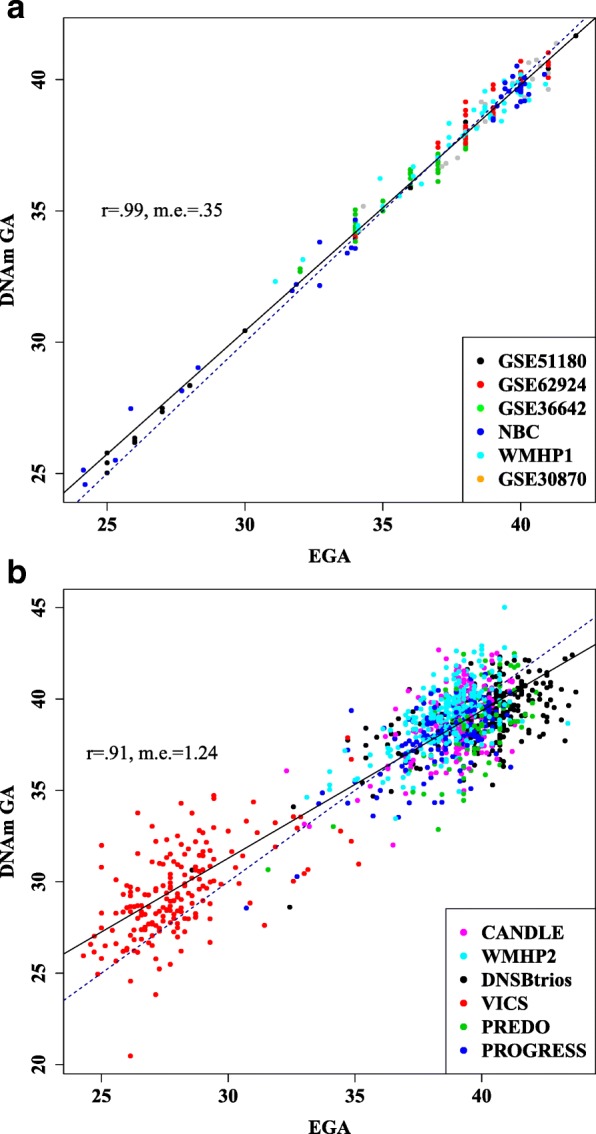
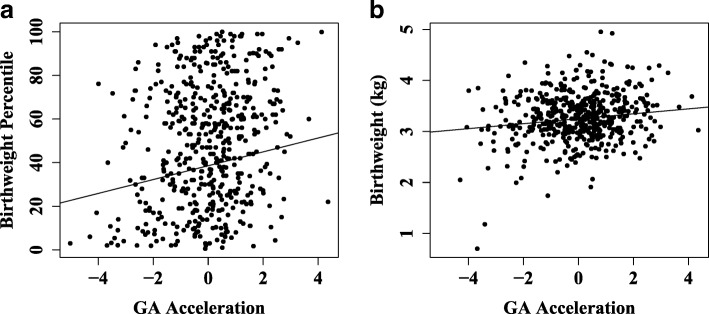
We find that gestational age can be accurately estimated from DNA methylation of neonatal cord blood and blood spot samples. We calculate a DNA methylation gestational age using 148 CpG sites selected through elastic net regression in six training datasets. We evaluate predictive accuracy in nine testing datasets and find that the accuracy of the DNA methylation gestational age is consistent with that of gestational age estimates based on established methods, such as ultrasound. We also find that an increased DNA methylation gestational age relative to clinical gestational age is associated with birthweight independent of gestational age, sex, and ancestry.
DNA methylation can be used to accurately estimate gestational age at or near birth and may provide additional information relevant to developmental stage. Further studies of this predictor are warranted to determine its utility in clinical settings and for research purposes. When clinical estimates are available this measure may increase accuracy in the testing of hypotheses related to developmental age and other early life circumstances.
临床医生和研究人员常常将胎龄作为发育成熟度的一个替代指标。此前已有研究表明,DNA甲基化与年龄相关,并且已被用于准确估计儿童和成人的实际年龄。在本研究中,我们探究脐带血中的DNA甲基化是否可用于估计出生时的胎龄。
我们发现,可根据新生儿脐带血和血斑样本的DNA甲基化准确估计胎龄。我们在六个训练数据集中通过弹性网络回归选择了148个CpG位点,计算出一个DNA甲基化胎龄。我们在九个测试数据集中评估预测准确性,发现DNA甲基化胎龄的准确性与基于超声等既定方法的胎龄估计准确性一致。我们还发现,相对于临床胎龄,DNA甲基化胎龄增加与出生体重相关,且不受胎龄、性别和血统的影响。
DNA甲基化可用于准确估计出生时或接近出生时的胎龄,并可能提供与发育阶段相关的额外信息。有必要对这一预测指标进行进一步研究,以确定其在临床环境和研究目的中的效用。当有临床估计值时,这一指标可能会提高与发育年龄及其他早期生活情况相关假设检验的准确性。