Berg Christina, Strandhagen Elisabeth, Mehlig Kirsten, Subramoney Sreevidya, Lissner Lauren, Björck Lena
Department of Food and Nutrition, and Sport Science University of Gothenburg Gothenburg Sweden.
Department of Public Health and Community Medicine, Institute of Medicine, Sahlgrenska Academy University of Gothenburg Gothenburg Sweden.
Obes Sci Pract. 2015 Oct;1(1):50-58. doi: 10.1002/osp4.4. Epub 2015 Sep 15.
The aim of this study was to examine how well body mass index (BMI) reflects cardiovascular risk associated with excess adiposity in a Swedish population by examining the association between body fat, BMI and cardiovascular risk factors.
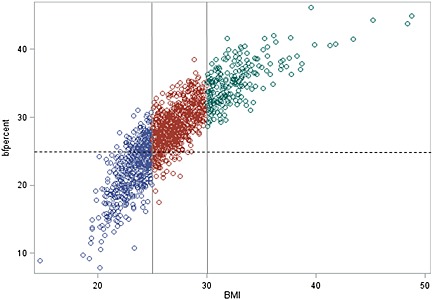
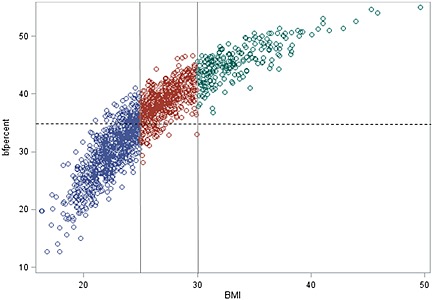
A total of 3,010 adults participated. Normal weight adiposity was defined as the combination of BMI < 25 kg/m and percentage body fat ≥35% for women and ≥25% for men. Associations with blood pressure, blood lipids, apolipoproteins and C-reactive protein were analysed in age-adjusted regression models.
The majority of the individuals with overweight and obesity were correctly classified to adiposity, while a wide range of body fat was observed among the normal weight subjects. In total, 9% of the participants were categorised as normal weight with adiposity. Compared with the normal weight leanness group, participants with normal weight adiposity had higher levels of serum triglycerides, low-density lipoprotein cholesterol, C-reactive protein, apolipoptotein B and the apolipoprotein B/A-I ratio. In normal weight men, adiposity was also associated with higher blood pressure and lower high-density lipoprotein cholesterol.
Higher percentage of body fat was associated with less favourable risk factor profile even in subjects who were normal weight. Thus, it might be relevant to screen for metabolic risk factors in the upper end of the normal weight category.
本研究旨在通过研究体脂、体重指数(BMI)与心血管危险因素之间的关联,探讨BMI在瑞典人群中反映与肥胖相关的心血管风险的程度。
共有3010名成年人参与。正常体重肥胖定义为BMI<25kg/m²且女性体脂百分比≥35%、男性体脂百分比≥25%的组合。在年龄调整回归模型中分析与血压、血脂、载脂蛋白和C反应蛋白的关联。
大多数超重和肥胖个体被正确归类为肥胖,而在正常体重受试者中观察到广泛的体脂范围。总体而言,9%的参与者被归类为正常体重但肥胖。与正常体重消瘦组相比,正常体重肥胖参与者的血清甘油三酯、低密度脂蛋白胆固醇、C反应蛋白、载脂蛋白B和载脂蛋白B/A-I比值水平更高。在正常体重男性中,肥胖还与更高的血压和更低的高密度脂蛋白胆固醇相关。
即使在正常体重的受试者中,较高的体脂百分比也与更不利的危险因素谱相关。因此,在正常体重范围上限筛查代谢危险因素可能是有意义的。