Takemae Nobuhiro, Shobugawa Yugo, Nguyen Phuong Thanh, Nguyen Tung, Nguyen Tien Ngoc, To Thanh Long, Thai Phuong Duy, Nguyen Tho Dang, Nguyen Duy Thanh, Nguyen Dung Kim, Do Hoa Thi, Le Thi Quynh Anh, Hua Phan Truong, Van Vo Hung, Nguyen Diep Thi, Nguyen Dang Hoang, Uchida Yuko, Saito Reiko, Saito Takehiko
Influenza and Prion Diseases Research Center, National Institute of Animal Health, NARO, Ibaraki, Japan.
Thailand-Japan Zoonotic Diseases Collaboration Center, Bangkok, Thailand.
BMC Vet Res. 2016 Oct 10;12(1):227. doi: 10.1186/s12917-016-0844-z.
Influenza A viruses of swine (IAV-S) cause acute and subclinical respiratory disease. To increase our understanding of the etiology of the subclinical form and thus help prevent the persistence of IAV-S in pig populations, we conducted active virologic surveillance in Vietnam, the second-largest pig-producing country in Asia, from February 2010 to December 2013.
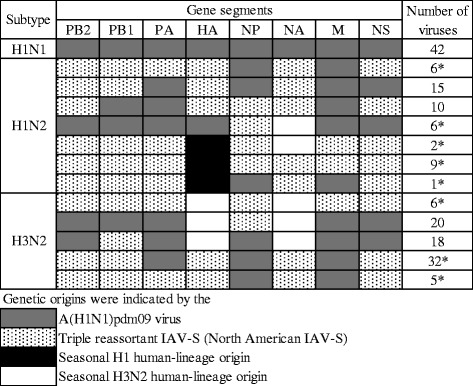
From a total of 7034 nasal swabs collected from clinically healthy pigs at 250 farms and 10 slaughterhouses, we isolated 172 IAV-S from swine at the weaning and early-fattening stages. The isolation rate of IAV-S was significantly higher among pigs aged 3 weeks to 4.5 months than in older and younger animals. IAV-S were isolated from 16 large, corporate farms and 6 family-operated farms from among the 250 farms evaluated. Multivariate logistic regression analysis revealed that "having more than 1,000 pigs" was the most influential risk factor for IAV-S positivity. Farms affected by reassortant IAV-S had significantly larger pig populations than did those where A(H1N1)pdm09 viruses were isolated, thus suggesting that large, corporate farms serve as sites of reassortment events.
We demonstrate the asymptomatic circulation of IAV-S in the Vietnamese pig population. Raising a large number of pigs on a farm has the strongest impact on the incidence of subclinical IAV-S infection. Given that only some of the corporate farms surveyed were IAV-S positive, further active monitoring is necessary to identify additional risk factors important in subclinical infection of pigs with IAV-S in Vietnam.
猪甲型流感病毒(IAV-S)可引发急性和亚临床呼吸道疾病。为加深对亚临床形式病因的了解,从而有助于防止IAV-S在猪群中持续存在,我们于2010年2月至2013年12月在亚洲第二大生猪生产国越南开展了主动病毒学监测。
从250个农场和10个屠宰场的临床健康猪采集的总共7034份鼻拭子中,我们在断奶和育肥早期阶段的猪中分离出172株IAV-S。3周龄至4.5月龄猪的IAV-S分离率显著高于年龄较大和较小的动物。在评估的250个农场中,从16个大型企业农场和6个家庭经营农场分离出了IAV-S。多变量逻辑回归分析显示,“猪只数量超过1000头”是IAV-S阳性的最具影响力的风险因素。受重组IAV-S影响的农场猪群数量显著大于分离出A(H1N1)pdm09病毒的农场,这表明大型企业农场是重组事件的发生场所。
我们证明了IAV-S在越南猪群中无症状传播。在农场饲养大量猪对亚临床IAV-S感染发生率的影响最大。鉴于仅部分接受调查的企业农场IAV-S呈阳性,有必要进一步进行主动监测,以确定对越南猪亚临床感染IAV-S重要的其他风险因素。