Division of Transboundary Diseases, National Institute of Animal Health, National Agriculture and Food Research Organization (NARO), Tsukuba, Ibaraki, Japan.
Division of Transboundary Diseases, National Institute of Animal Health, National Agriculture and Food Research Organization (NARO), Tsukuba, Ibaraki, Japan
J Virol. 2020 Jul 1;94(14). doi: 10.1128/JVI.02169-19.
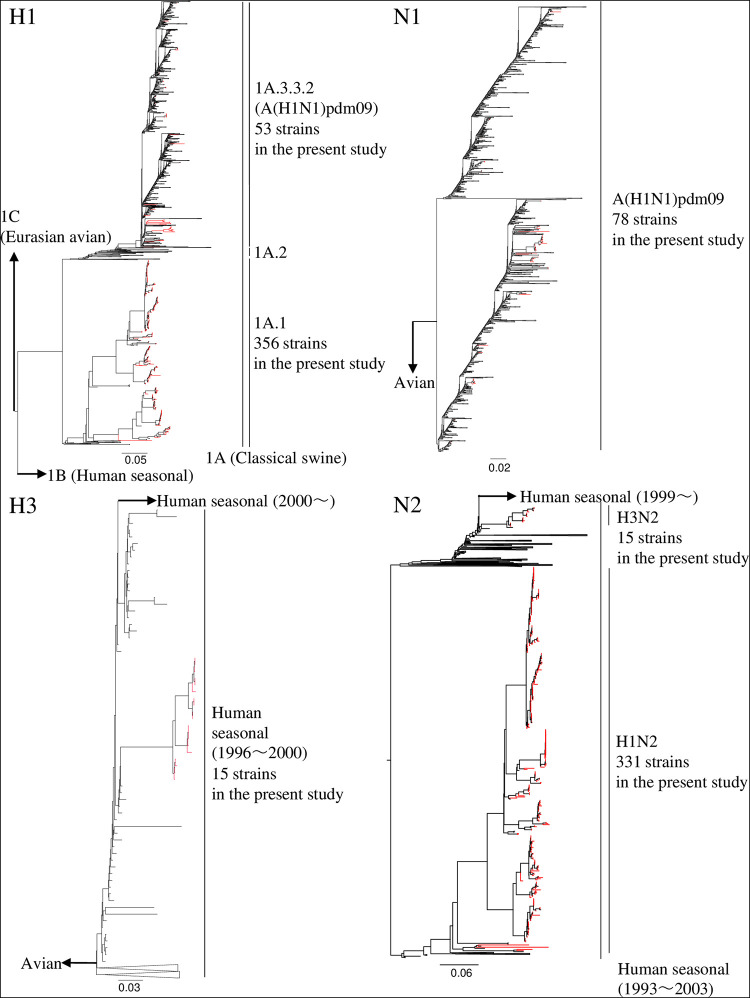
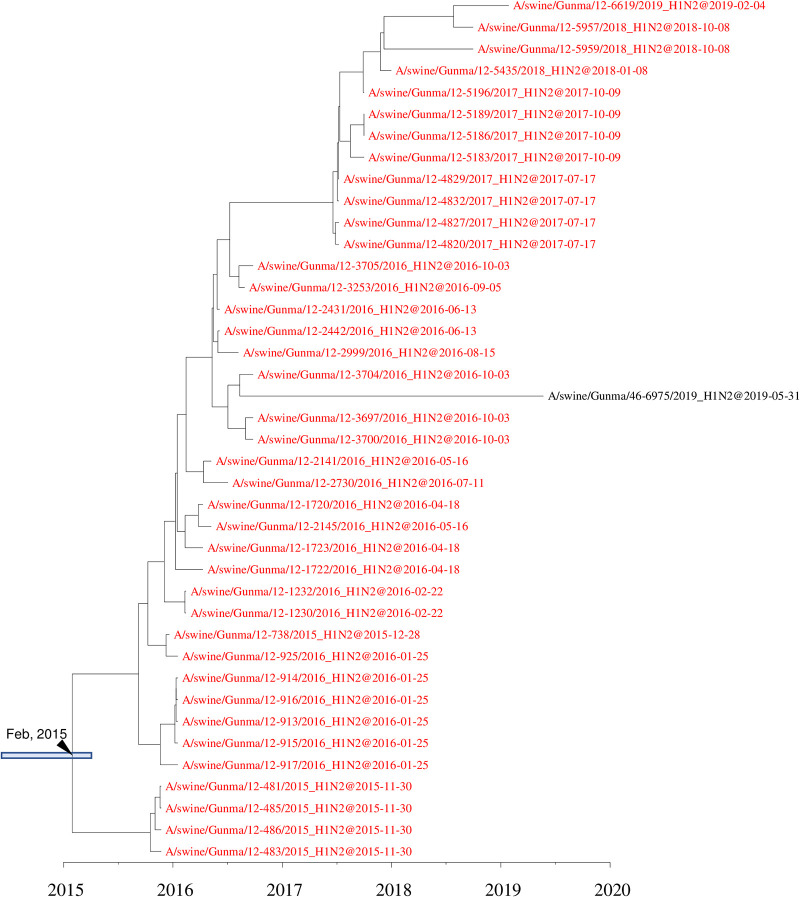
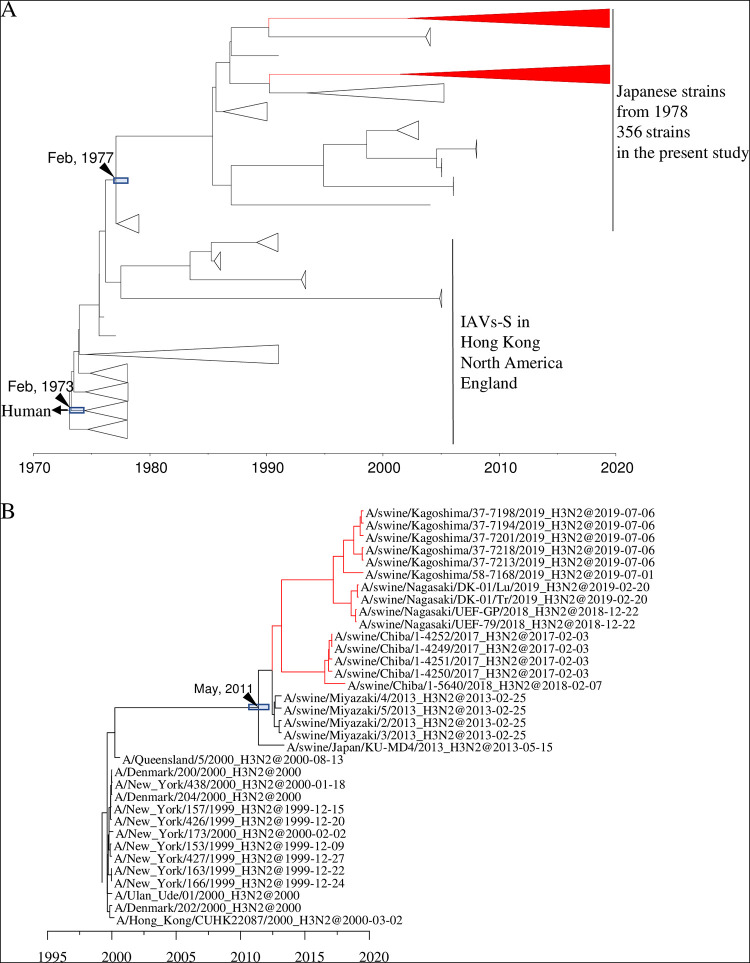
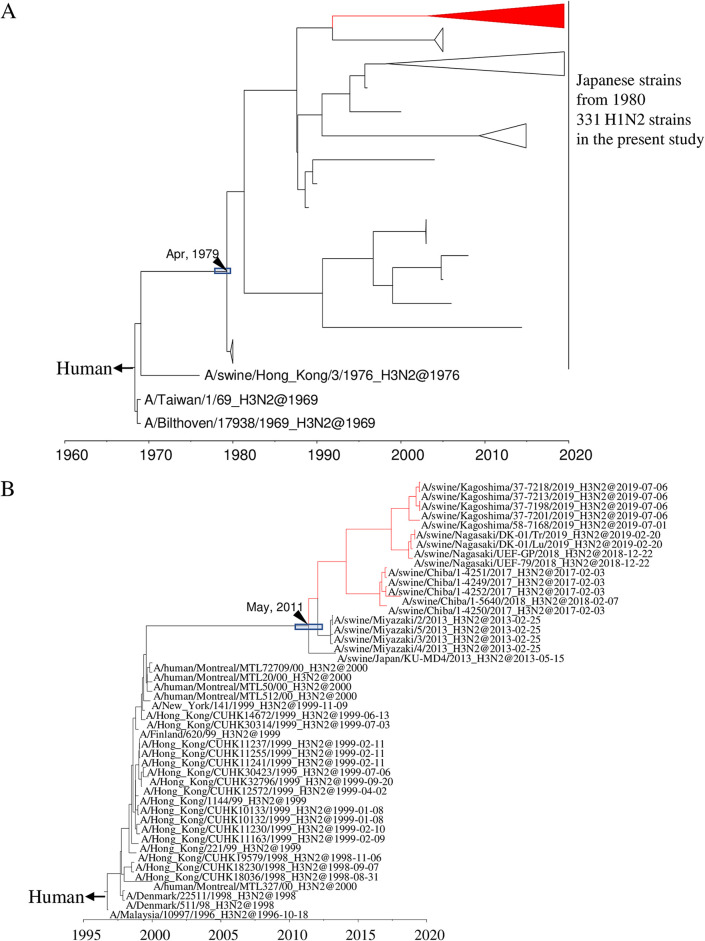
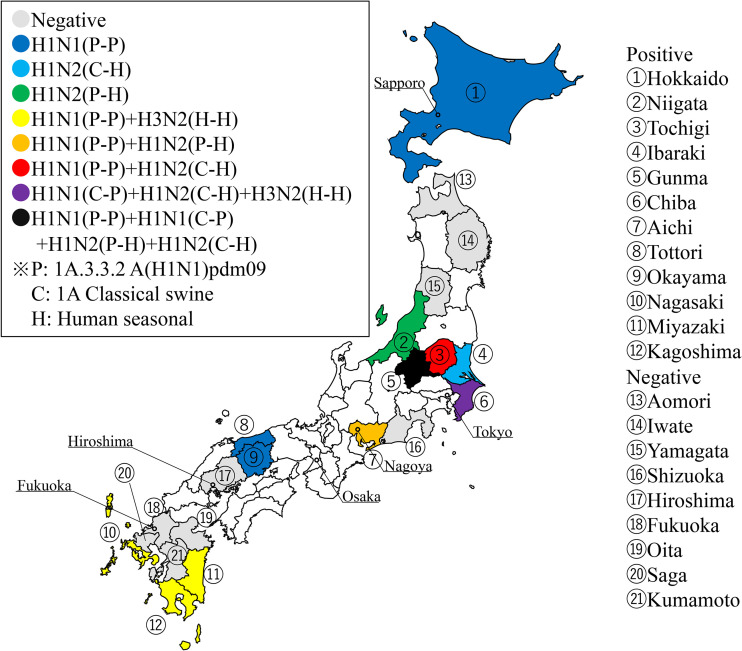
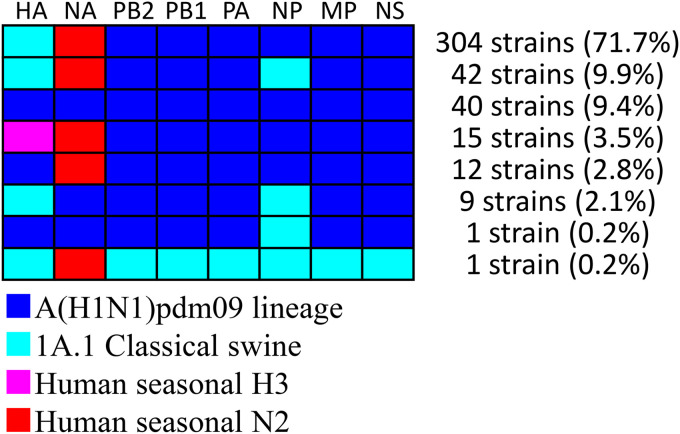
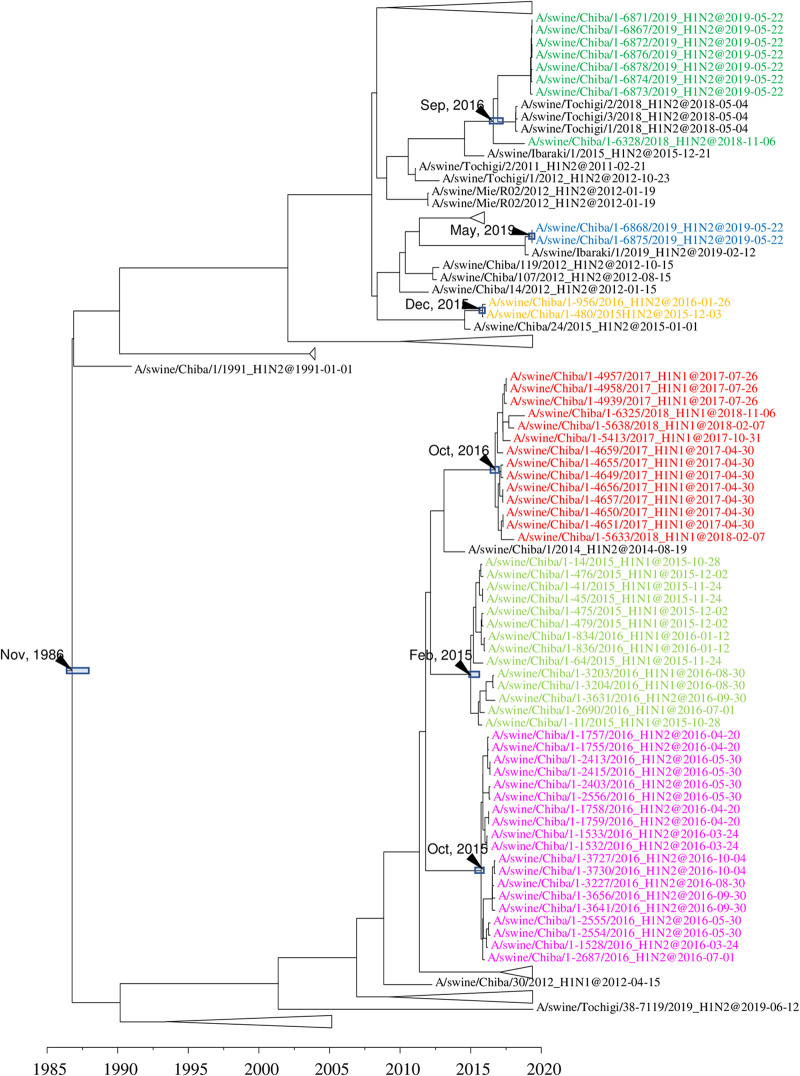
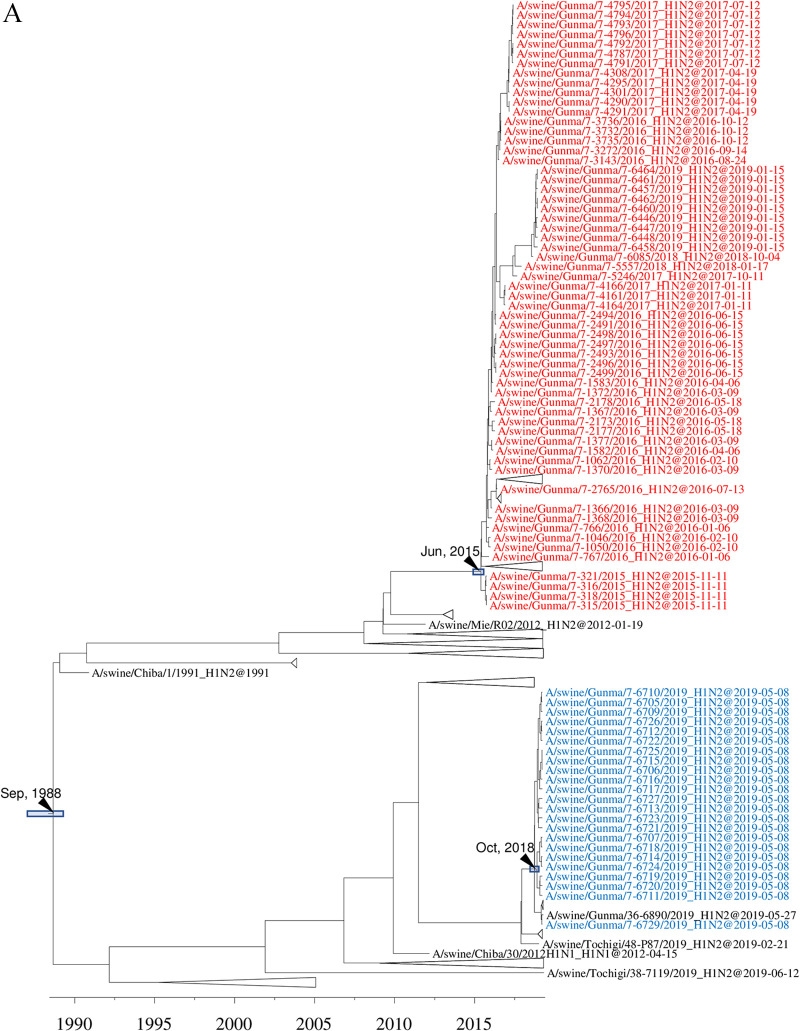
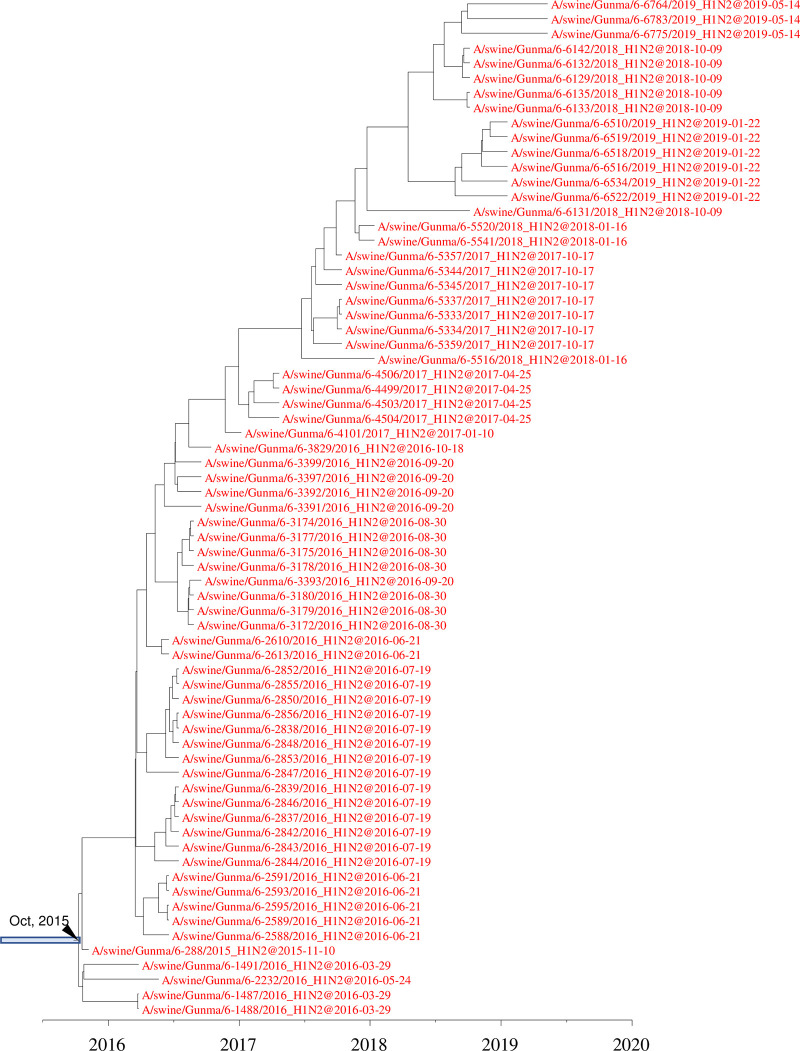
To assess the current status of influenza A viruses of swine (IAVs-S) throughout Japan and to investigate how these viruses persisted and evolve on pig farms, we genetically characterized IAVs-S isolated during 2015 to 2019. Nasal swab samples collected through active surveillance and lung tissue samples collected for diagnosis yielded 424 IAVs-S, comprising 78 H1N1, 331 H1N2, and 15 H3N2 viruses, from farms in 21 sampled prefectures in Japan. Phylogenetic analyses of surface genes revealed that the 1A.1 classical swine H1 lineage has evolved uniquely since the late 1970s among pig populations in Japan. During 2015 to 2019, A(H1N1)pdm09 viruses repeatedly became introduced into farms and reassorted with endemic H1N2 and H3N2 IAVs-S. H3N2 IAVs-S isolated during 2015 to 2019 formed a clade that originated from 1999-2000 human seasonal influenza viruses; this situation differs from previous reports, in which H3N2 IAVs-S derived from human seasonal influenza viruses were transmitted sporadically from humans to swine but then disappeared without becoming established within the pig population. At farms where IAVs-S were frequently isolated for at least 3 years, multiple introductions of IAVs-S with phylogenetically distinct hemagglutinin (HA) genes occurred. In addition, at one farm, IAVs-S derived from a single introduction persisted for at least 3 years and carried no mutations at the deduced antigenic sites of the hemagglutinin protein, except for one at the antigenic site (Sa). Our results extend our understanding regarding the status of IAVs-S currently circulating in Japan and how they genetically evolve at the farm level. Understanding the current status of influenza A viruses of swine (IAVs-S) and their evolution at the farm level is important for controlling these pathogens. Efforts to monitor IAVs-S during 2015 to 2019 yielded H1N1, H1N2, and H3N2 viruses. H1 genes in Japanese swine formed a unique clade in the classical swine H1 lineage of 1A.1, and H3 genes originating from 1999-2000 human seasonal influenza viruses appear to have become established among Japanese swine. A(H1N1)pdm09-derived H1 genes became introduced repeatedly and reassorted with endemic IAVs-S, resulting in various combinations of surface and internal genes among pig populations in Japan. At the farm level, multiple introductions of IAVs-S with phylogenetically distinct HA sequences occurred, or IAVs-S derived from a single introduction have persisted for at least 3 years with only a single mutation at the antigenic site of the HA protein. Continued monitoring of IAVs-S is necessary to update and maximize control strategies.
为了评估日本各地猪流感病毒(IAVs-S)的现状,并研究这些病毒如何在养猪场中持续存在和进化,我们对 2015 年至 2019 年分离的 IAVs-S 进行了遗传特征分析。通过主动监测采集的鼻拭子样本和用于诊断的肺组织样本,从日本 21 个采样县的农场中获得了 424 株 IAVs-S,包括 78 株 H1N1、331 株 H1N2 和 15 株 H3N2 病毒。表面基因的系统进化分析表明,自 20 世纪 70 年代末以来,1A.1 经典猪 H1 谱系在日本猪群中独特进化。在 2015 年至 2019 年期间,A(H1N1)pdm09 病毒反复传入农场,并与地方性 H1N2 和 H3N2 IAVs-S 重组。2015 年至 2019 年分离的 H3N2 IAVs-S 形成了一个起源于 1999-2000 年人类季节性流感病毒的分支;这种情况与之前的报告不同,之前的报告表明,源自人类季节性流感病毒的 H3N2 IAVs-S 从人类零星传播到猪,但随后在猪群中消失,没有建立起来。在至少连续 3 年频繁分离到 IAVs-S 的农场中,出现了具有不同遗传进化的血凝素(HA)基因的多次引入。此外,在一个农场中,源自单次引入的 IAVs-S 至少持续了 3 年,并且除了在抗原位点(Sa)处的一个位点外,血凝蛋白的推断抗原位点没有发生突变。我们的研究结果扩展了我们对当前在日本流行的 IAVs-S 状况以及它们在农场水平上的遗传进化的理解。了解猪流感病毒(IAVs-S)的现状及其在农场水平上的进化对于控制这些病原体非常重要。在 2015 年至 2019 年期间,监测 IAVs-S 的工作产生了 H1N1、H1N2 和 H3N2 病毒。日本猪的 H1 基因在 1A.1 的经典猪 H1 谱系中形成了一个独特的分支,起源于 1999-2000 年人类季节性流感病毒的 H3 基因似乎已在日本猪群中建立起来。源自 A(H1N1)pdm09 的 H1 基因反复传入并与地方性 IAVs-S 重组,导致日本猪群中出现了各种表面和内部基因组合。在农场水平上,具有不同遗传进化的 HA 序列的 IAVs-S 多次引入,或者源自单次引入的 IAVs-S 至少持续 3 年,仅在 HA 蛋白的抗原位点发生单个突变。需要继续监测 IAVs-S,以更新和最大限度地发挥控制策略的作用。