Dunn Erin C, Nishimi Kristen, Powers Abigail, Bradley Bekh
Psychiatric and Neurodevelopmental Genetics Unit, Massachusetts General Hospital, 185 Cambridge St, Simches Research Building, Boston, MA 02114, USA; Department of Psychiatry, Harvard Medical School, 401 Park Drive, 2 West, Room 305, Boston, MA 02215, USA; Stanley Center for Psychiatric Research, The Broad Institute of Harvard and MIT, The Ted and Vada Stanley Building, 75 Ames Street, Cambridge, MA 02142, USA. Electronic address: http://www.thedunnlab.com.
Psychiatric and Neurodevelopmental Genetics Unit, Massachusetts General Hospital, 185 Cambridge St, Simches Research Building, Boston, MA 02114, USA; Harvard T.H. Chan School of Public Health, 677 Huntington Avenue, Boston, MA 02115, USA.
J Psychiatr Res. 2017 Jan;84:119-127. doi: 10.1016/j.jpsychires.2016.09.004. Epub 2016 Sep 13.
Trauma exposure is a known risk factor for psychopathology. However, the impact of the developmental timing of exposure remains unclear. This study examined the effect of age at first trauma exposure on levels of adult depressive and posttraumatic stress disorder (PTSD) symptoms.
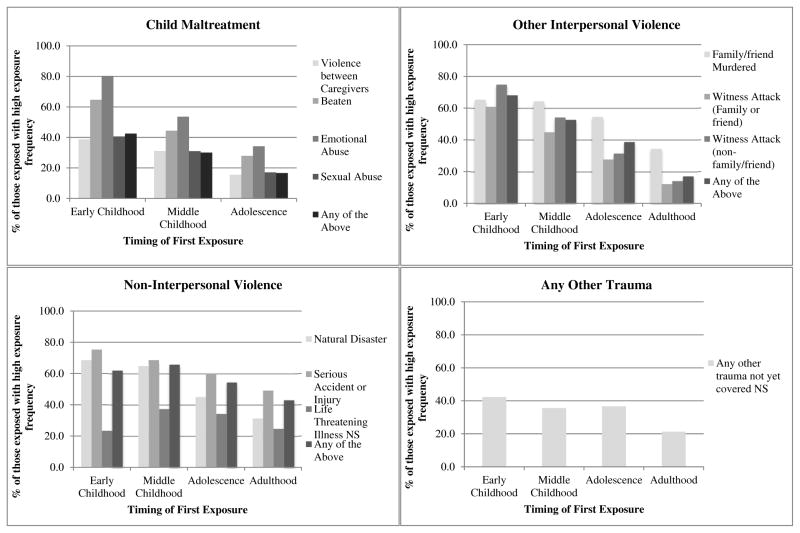
Lifetime trauma exposure (including age at first exposure and frequency), current psychiatric symptoms, and sociodemographic information were collected during interviews with adults participating in a study at a public urban hospital in Atlanta, GA. Multiple linear regression models assessed the association between timing of first trauma exposure, classified as early childhood (ages 0-5), middle childhood (ages 6-10), adolescence (ages 11-18), and adulthood (ages 19+), on adult psychopathology in 2892 individuals.
Participants exposed to trauma (i.e., child maltreatment, other interpersonal violence, non-interpersonal violence, and other events) at any age had higher depressive and PTSD symptoms compared to their unexposed peers. However, participants first exposed to child maltreatment during early childhood had depression and PTSD symptoms that were about twice as high as those exposed during later developmental stages. This association was detected even after controlling for sociodemographic characteristics, exposure to other trauma types, and frequency of exposure. Participants first exposed during middle childhood to other interpersonal violence also had depressive symptoms scores that were about twice as high as those first exposed during adulthood.
Trauma exposure at different ages may differentially impact depressive and PTSD symptoms in adulthood. More detailed examination of timing of trauma exposure is warranted to aid in identifying sensitive periods in development.
创伤暴露是已知的精神病理学风险因素。然而,暴露的发育时机的影响仍不明确。本研究考察了首次创伤暴露时的年龄对成人抑郁和创伤后应激障碍(PTSD)症状水平的影响。
在对佐治亚州亚特兰大市一家城市公立医院参与一项研究的成年人进行访谈期间,收集了终生创伤暴露情况(包括首次暴露年龄和频率)、当前精神症状以及社会人口统计学信息。多元线性回归模型评估了2892名个体中首次创伤暴露时机(分为幼儿期(0至5岁)、童年中期(6至10岁)、青春期(11至18岁)和成年期(19岁及以上))与成人精神病理学之间的关联。
与未暴露的同龄人相比,在任何年龄暴露于创伤(即儿童虐待、其他人际暴力、非人际暴力和其他事件)的参与者有更高的抑郁和PTSD症状。然而,在幼儿期首次暴露于儿童虐待的参与者的抑郁和PTSD症状比在后期发育阶段暴露的参与者高出约两倍。即使在控制了社会人口统计学特征、其他创伤类型的暴露情况和暴露频率之后,这种关联仍然存在。在童年中期首次暴露于其他人际暴力的参与者的抑郁症状得分也比在成年期首次暴露的参与者高出约两倍。
不同年龄的创伤暴露可能对成年期的抑郁和PTSD症状产生不同的影响。有必要对创伤暴露的时机进行更详细的检查,以帮助确定发育中的敏感期。