Mayr Agnes, Kitterer Daniel, Latus Joerg, Steubing Hannah, Henes Joerg, Vecchio Francesco, Kaesemann Philipp, Patrascu Alexandru, Greiser Andreas, Groeninger Stefan, Braun Niko, Alscher M Dominik, Sechtem Udo, Mahrholdt Heiko, Greulich Simon
Division of Radiology, University Hospital Innsbruck, Innsbruck, Austria.
Division of Nephrology, Department of Internal Medicine, Robert-Bosch-Medical Center Stuttgart, Stuttgart, Germany.
J Cardiovasc Magn Reson. 2016 Oct 13;18(1):67. doi: 10.1186/s12968-016-0288-4.
Severe arrhythmias or heart failure may be surrogates of myocardial involvement in patients with connective tissue disorders (CTD). However, most patients present with unspecific symptoms, normal ECG, and preserved left ventricular ejection fraction (LV-EF). Therefore, timely diagnosis by an accurate technique is crucial. Late gadolinium enhancement (LGE) cardiovascular magnetic resonance (CMR) has proven value for the detection of focal processes, but due to the often diffuse character of fibrosis/inflammation in CTD patients, CMR mapping techniques might be of incremental value for the assessment of myocardial involvement. Purpose of this study was to evaluate a multi-parametric CMR protocol as a screening tool for myocardial involvement in CTD patients.
Forty CTD patients were prospectively enrolled and underwent CMR, twenty healthy volunteers served as control group.
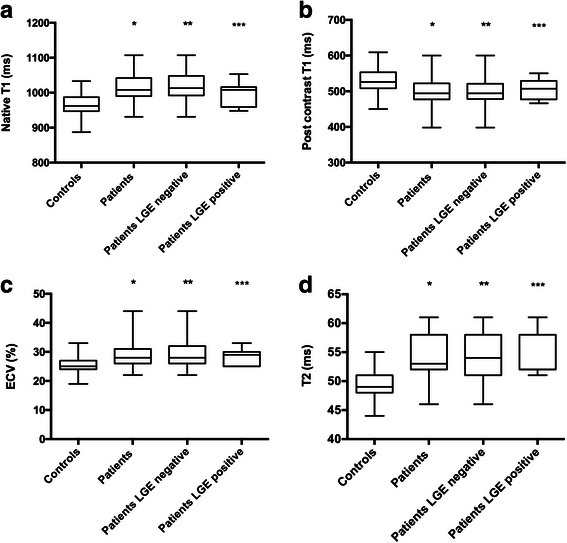
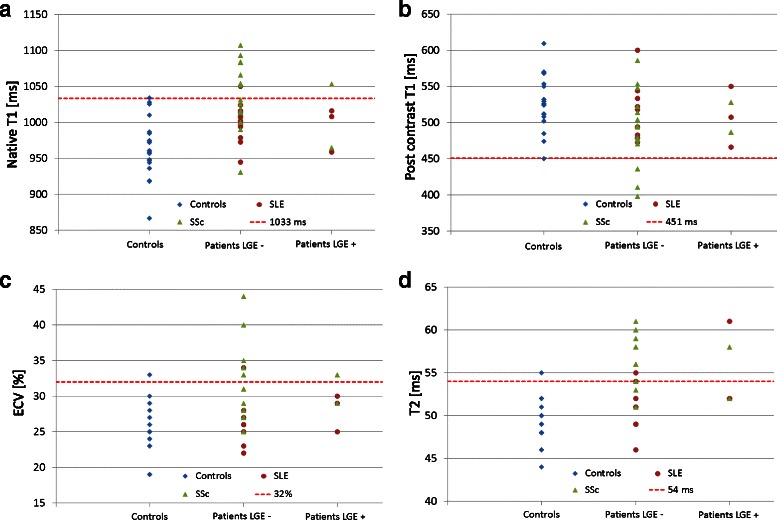
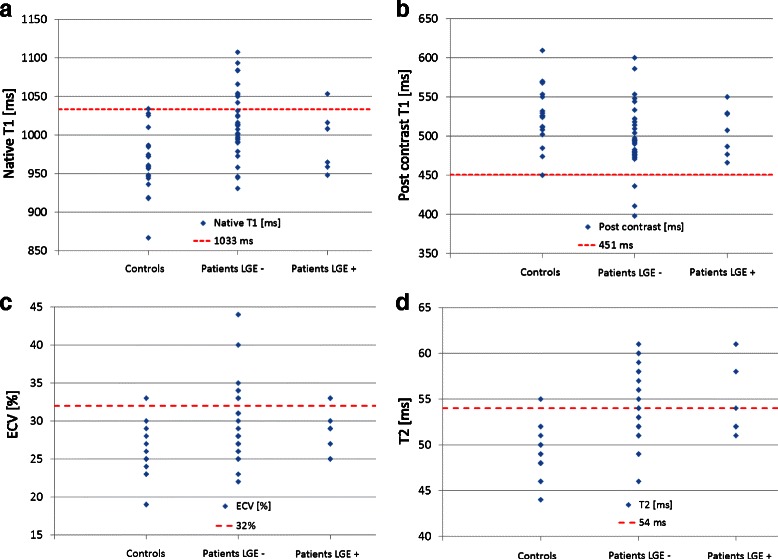
Mean LV-EF was 62 %; LGE prevalence was low (18 %). CTD patients had higher native T1 (1008 vs. 962 ms, p = 0.001), lower post contrast T1 (494 vs. 526 ms, p = 0.008), expanded extracellular volume (ECV) (28 vs. 25 %, p = 0.001), and higher T2 values (53 vs. 49 ms, p < 0.001) compared to controls. Among patients with values higher than the 95 % percentile of healthy controls, native T1 and T2 values seem to be the most promising discriminators.
CTD patients showed higher T1, ECV, and T2 values compared to controls, with most significant differences for native T1 and T2, which seem to be independent of the presence of LGE. Our data suggest that CMR mapping techniques are of incremental value in the detection of myocardial involvement in CTD patients.
严重心律失常或心力衰竭可能是结缔组织病(CTD)患者心肌受累的替代指标。然而,大多数患者表现为非特异性症状、心电图正常且左心室射血分数(LV-EF)保留。因此,采用准确技术进行及时诊断至关重要。延迟钆增强(LGE)心血管磁共振(CMR)已被证明在检测局灶性病变方面具有价值,但由于CTD患者的纤维化/炎症通常具有弥漫性,CMR成像技术可能在评估心肌受累方面具有更大价值。本研究的目的是评估一种多参数CMR方案作为CTD患者心肌受累的筛查工具。
前瞻性纳入40例CTD患者并进行CMR检查,20名健康志愿者作为对照组。
平均LV-EF为62%;LGE患病率较低(18%)。与对照组相比,CTD患者的固有T1值更高(1008对962毫秒,p = 0.001),钆增强后T1值更低(494对526毫秒,p = 0.008),细胞外容积(ECV)扩大(28%对25%,p = 0.001),T2值更高(53对49毫秒,p < 0.001)。在数值高于健康对照者第95百分位数的患者中,固有T1和T2值似乎是最有前景的鉴别指标。
与对照组相比,CTD患者的T1、ECV和T2值更高,固有T1和T2的差异最为显著,且这些差异似乎与LGE的存在无关。我们的数据表明,CMR成像技术在检测CTD患者心肌受累方面具有更大价值。