Patra Jayanta Kumar, Das Gitishree, Paramithiotis Spiros, Shin Han-Seung
Research Institute of Biotechnology and Medical Converged Science, Dongguk University-Seoul Goyang, South Korea.
Department of Food Science and Human Nutrition, Agricultural University of Athens Athens, Greece.
Front Microbiol. 2016 Sep 28;7:1493. doi: 10.3389/fmicb.2016.01493. eCollection 2016.
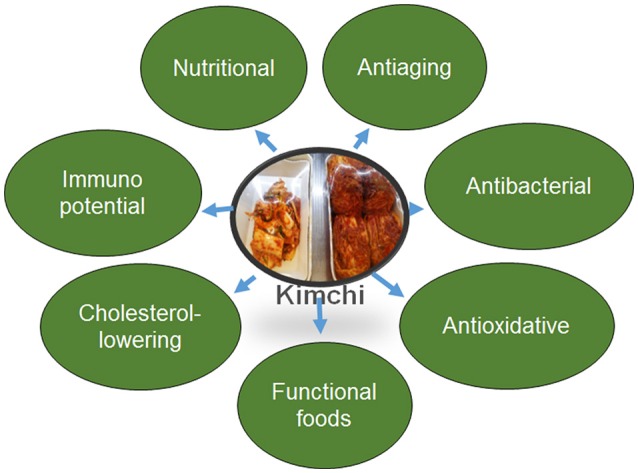
Different types of fermented foods such as chongkukjang, doenjang, ganjang, gochujang, and kimchi are plentifully available and widely consumed in north eastern Asian countries including Korea. Among them, kimchi is one of the most popular Korean traditional food. It is prepared by fermenting the baechu cabbage together with other vegetables and lactic acid bacteria (LAB) with functional potential. Many types of ingredients are added to kimchi to enhance its taste, flavor, nutritional value, texture etc. A number of bacteria are involved in the fermentation of kimchi, but LAB are the dominant species in the fermentation process. The addition of other sub ingredients and formation of different by-products during fermentation eventually leads to eradication of putrefactive and pathogenic bacteria, and also increase the functionalities, nutritional and nutraceutical potential of kimchi. Kimchi possesses anti-inflammatory, antibacterial, antioxidant, anticancer, antiobesity, probiotic properties, cholesterol reduction, and antiaging properties. In the present review an attempt has been made to review the different types of fermented foods found in the Korean peninsula with detailed scientific research regarding preparation, processing, structure of the microecosystem, and health benefits of kimchi.
不同类型的发酵食品,如清曲酱、大酱、酱油、辣椒酱和泡菜,在包括韩国在内的东北亚国家大量供应且广泛食用。其中,泡菜是最受欢迎的韩国传统食品之一。它是通过将白菜与其他蔬菜以及具有功能潜力的乳酸菌一起发酵制成的。许多种类的配料被添加到泡菜中以提升其口感、风味、营养价值、质地等。泡菜发酵过程涉及多种细菌,但乳酸菌是发酵过程中的主要菌种。在发酵过程中添加其他辅助成分以及形成不同的副产物最终导致腐败菌和病原菌被根除,同时还增加了泡菜的功能、营养和保健潜力。泡菜具有抗炎、抗菌、抗氧化、抗癌、抗肥胖、益生菌特性、降低胆固醇和抗衰老特性。在本综述中,我们尝试回顾朝鲜半岛发现的不同类型的发酵食品,并对泡菜的制备、加工、微生态系统结构以及健康益处进行详细的科学研究。