Huang Chun-Ming, Huang Ming-Yii, Tsai Hsiang-Lin, Huang Ching-Wen, Ma Cheng-Jen, Lin Chih-Hung, Huang Chih-Jen, Wang Jaw-Yuan
Department of Radiation Oncology, Kaohsiung Medical University Hospital, Kaohsiung Medical University, No. 100 Tzyou 1st Road, Kaohsiung 807, Taiwan.
Graduate Institute of Medicine, College of Medicine, Kaohsiung Medical University, No. 100 Tzyou 1st Road, Kaohsiung 807, Taiwan.
J Radiat Res. 2017 Mar 1;58(2):247-259. doi: 10.1093/jrr/rrw098.
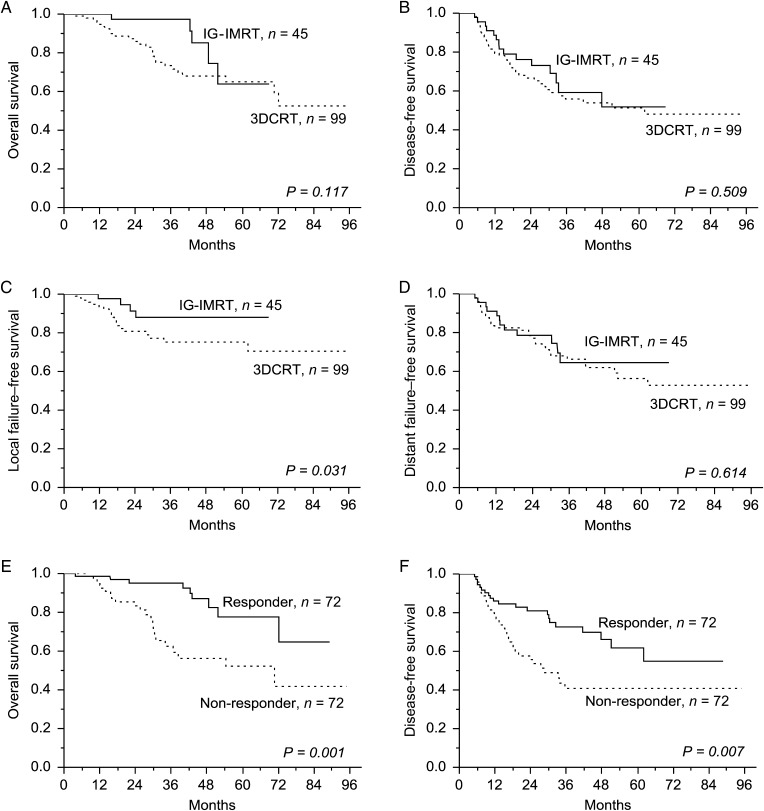
The aim of the study was to compare clinical outcomes and toxicity between 3D conformal radiotherapy (3DCRT) and image-guided intensity-modulated radiotherapy (IG-IMRT) administered through helical tomotherapy in locally advanced rectal cancer (LARC) patients receiving preoperative chemoradiotherapy. We reviewed 144 patients with Stage II-III rectal cancer receiving preoperative fluoropyrimidine-based chemoradiotherapy followed by radical resection. Tumor responses following chemoradiotherapy were evaluated using the Dworak tumor regression grade (TRG). Of the 144 patients, 45 received IG-IMRT and 99 received 3DCRT. A significant reduction in Grade 3 or 4 acute gastrointestinal toxicity (IG-IMRT, 6.7%; 3DCRT, 15.1%; P = 0.039) was observed by IG-IMRT. The pathologic complete response (pCR) rate did not differ between the IG-IMRT and the 3DCRT group (17.8% vs 15.1%, P = 0.52). Patients in the IG-IMRT group had the trend of favorable tumor regressions (TRG 3 or 4) compared with those in the 3DCRT group (66.7% vs 43.5%, P = 0.071). The median follow-up was 53 months (range, 18-95 months) in the 3DCRT group and 43 months (range, 17-69 months) in the IG-IMRT group. Four-year overall, disease-free, and local failure-free survival rates of the IG-IMRT and 3DCRT groups were 81.6% and 67.9% (P = 0.12), 53.8% and 51.8% (P = 0.51), and 88% and 75.1% (P = 0.031), respectively. LARC patients treated with preoperative IG-IMRT achieved lower acute gastrointestinal adverse effects and a higher local control rate than those treated with 3DCRT, but there was no prominent difference in distant metastasis rate and overall survival between two treatment modalities.
本研究旨在比较在接受术前放化疗的局部晚期直肠癌(LARC)患者中,三维适形放疗(3DCRT)与通过螺旋断层放疗实施的图像引导调强放疗(IG-IMRT)的临床疗效和毒性。我们回顾了144例接受术前基于氟嘧啶的放化疗并随后进行根治性切除的II-III期直肠癌患者。使用德沃拉克肿瘤消退分级(TRG)评估放化疗后的肿瘤反应。在这144例患者中,45例接受了IG-IMRT,99例接受了3DCRT。IG-IMRT组观察到3级或4级急性胃肠道毒性显著降低(IG-IMRT组为6.7%;3DCRT组为15.1%;P = 0.039)。IG-IMRT组和3DCRT组的病理完全缓解(pCR)率无差异(分别为17.8%和15.1%,P = 0.52)。与3DCRT组相比,IG-IMRT组患者有肿瘤消退良好(TRG 3或4)的趋势(分别为66.7%和43.5%,P = 0.071)。3DCRT组的中位随访时间为53个月(范围18 - 95个月),IG-IMRT组为43个月(范围17 - 69个月)。IG-IMRT组和3DCRT组的4年总生存率、无病生存率和局部无复发生存率分别为81.6%和67.9%(P = 0.12)、53.8%和51.8%(P = 0.51)、88%和75.1%(P = 0.031)。接受术前IG-IMRT治疗的LARC患者比接受3DCRT治疗的患者急性胃肠道不良反应更低,局部控制率更高,但两种治疗方式在远处转移率和总生存率方面无显著差异。