Bi Chun, Wang Qiugen, Nagelli Christopher, Wu Jianhong, Wang Qian, Wang Jiandong
Trauma Center, Shanghai General Hospital, School of Medicine, Shanghai Jiaotong University, Shanghai, China (mainland).
Department of Orthopedic Surgery and Sports Medicine Center, Mayo Clinic, Rochester, MN, USA.
Med Sci Monit. 2016 Oct 17;22:3764-3770. doi: 10.12659/msm.900673.
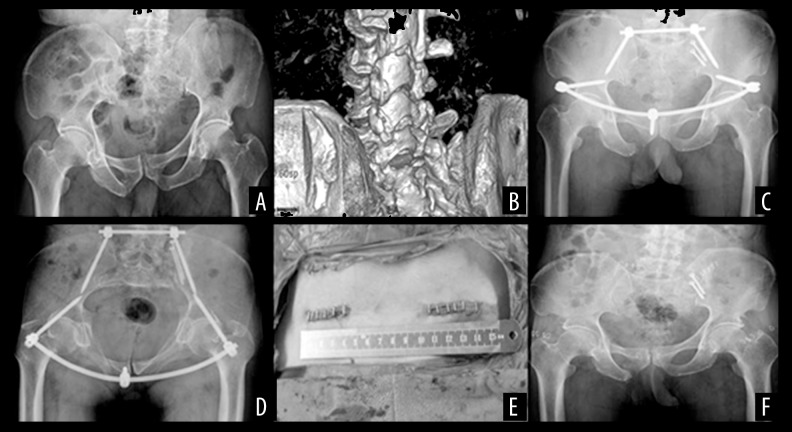
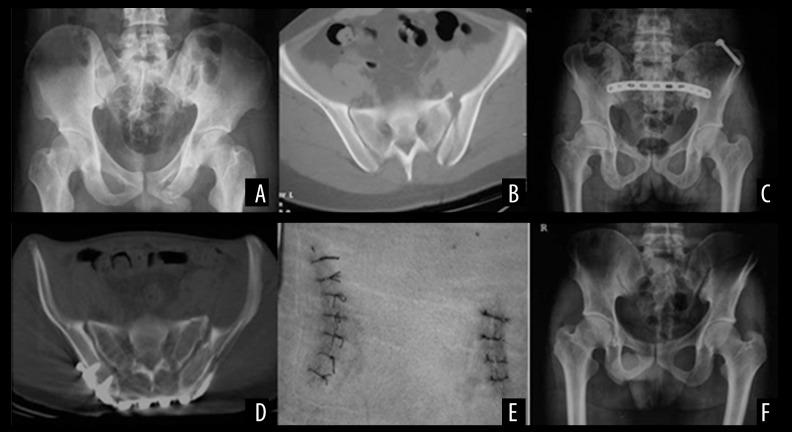
BACKGROUND The aim of this study was to assess the clinical results of treatment for unstable posterior pelvic fractures using a pedicle screw-rod fixator compared to use of a locking compression plate. MATERIAL AND METHODS A retrospective study was performed between June 2010 and May 2014 and the data were collected from 46 patients with unstable posterior pelvic ring fractures. All patients were treated using either a pedicle screw-rod fixator (study group, 24 patients) or locking compression plate (control group, 22 patients). In these patients, causes of injury included traffic accidents (n=27), fall from height (n=12), and crushing accidents (n=7). The quality of reduction and radiological grading were assessed. Clinical assessments included the operation time, times of X-ray exposures, bleeding volume during operation, incision length, and Majeed postoperative functional evaluation. RESULTS No iatrogenic neurovascular injuries occurred during the operations in these 2 groups. The average follow-up time was 24.5 months. All fractures were healed. The significant differences (P<0.05) between the 2 groups were operation duration, size of incision, and intraoperative bleeding volume. Statistically significant differences in the Majeed postoperative functional evaluation and times of X-ray exposures were not found between the 2 groups. CONCLUSIONS Similar clinical effects were achieved in treating the posterior pelvic ring fractures using the pedicle screw-rod fixator and the locking compression plate. However, the pedicle screw-rod fixator has the advantages of smaller incision, shorter duration of the operation, and less bleeding volume compared to using the locking compression plate.
背景 本研究旨在评估与使用锁定加压钢板相比,采用椎弓根螺钉-棒固定器治疗不稳定型骨盆后环骨折的临床效果。
材料与方法 于2010年6月至2014年5月进行一项回顾性研究,收集了46例不稳定型骨盆环骨折患者的数据。所有患者均采用椎弓根螺钉-棒固定器(研究组,24例患者)或锁定加压钢板(对照组,22例患者)进行治疗。在这些患者中,受伤原因包括交通事故(n = 27)、高处坠落(n = 12)和挤压伤(n = 7)。评估了复位质量和放射学分级。临床评估包括手术时间、X线曝光次数、术中出血量、切口长度以及Majeed术后功能评估。
结果 这两组手术过程中均未发生医源性神经血管损伤。平均随访时间为24.5个月。所有骨折均愈合。两组之间的显著差异(P < 0.05)在于手术持续时间、切口大小和术中出血量。两组在Majeed术后功能评估和X线曝光次数方面未发现统计学上的显著差异。
结论 使用椎弓根螺钉-棒固定器和锁定加压钢板治疗骨盆后环骨折取得了相似的临床效果。然而,与使用锁定加压钢板相比,椎弓根螺钉-棒固定器具有切口更小、手术时间更短和出血量更少的优点。