Australian Centre for Ancient DNA, School of Biological Sciences, University of Adelaide, Adelaide, South Australia 5005, Australia.
School of Biological Sciences, University of Sydney, Sydney, New South Wales 2006, Australia.
Nat Commun. 2016 Oct 18;7:13158. doi: 10.1038/ncomms13158.
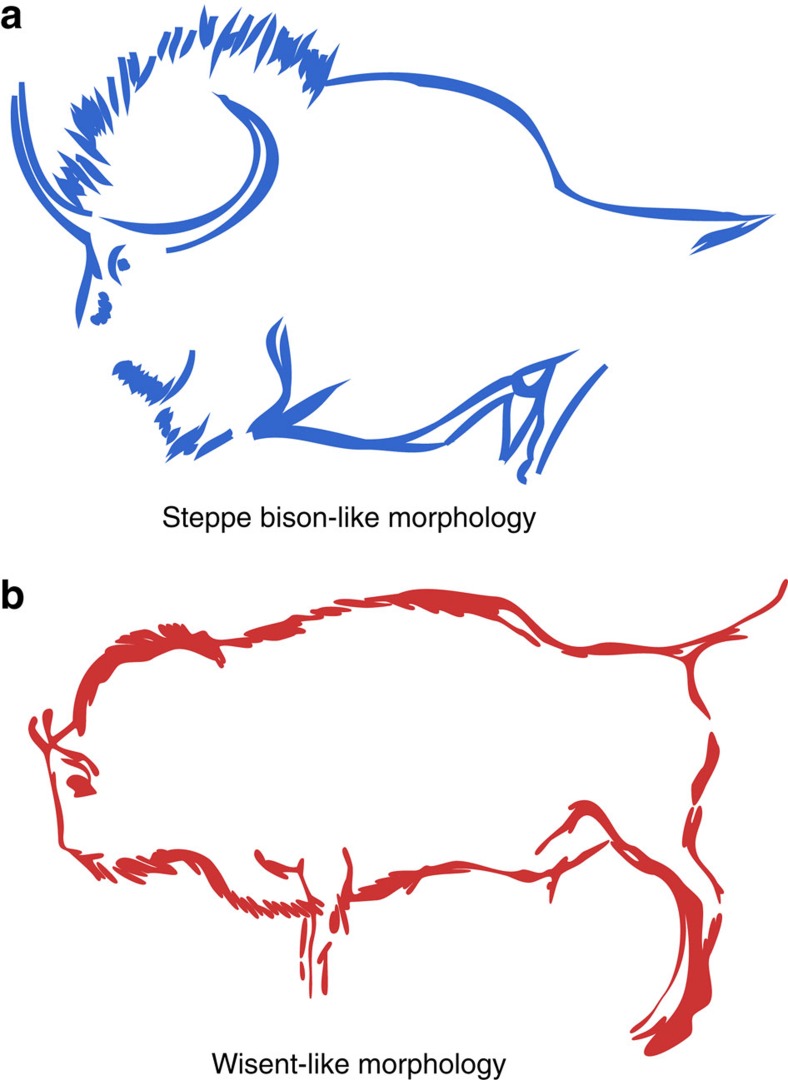
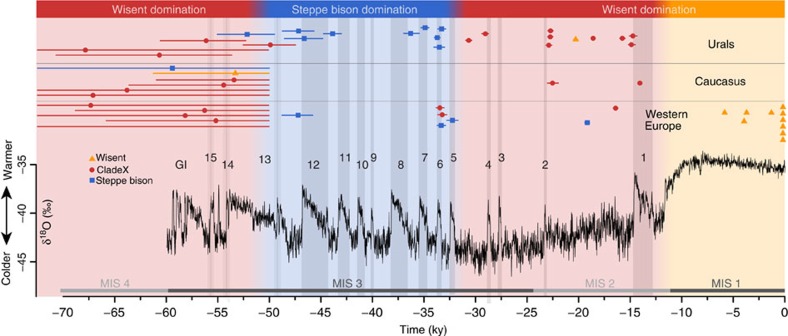
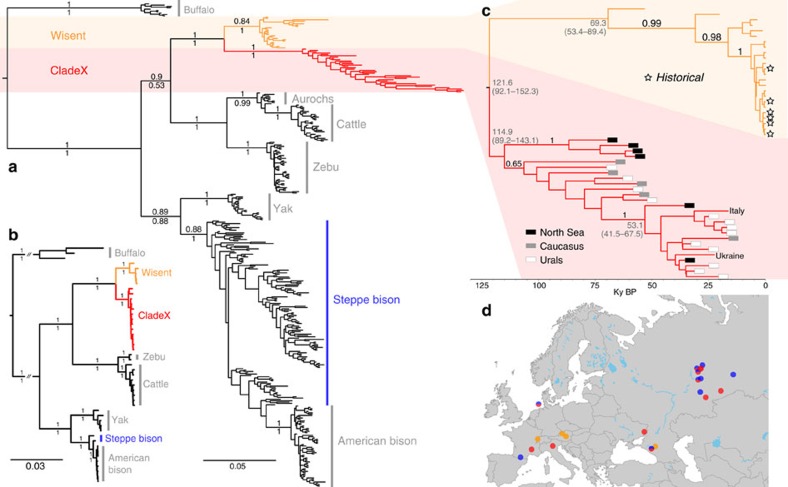
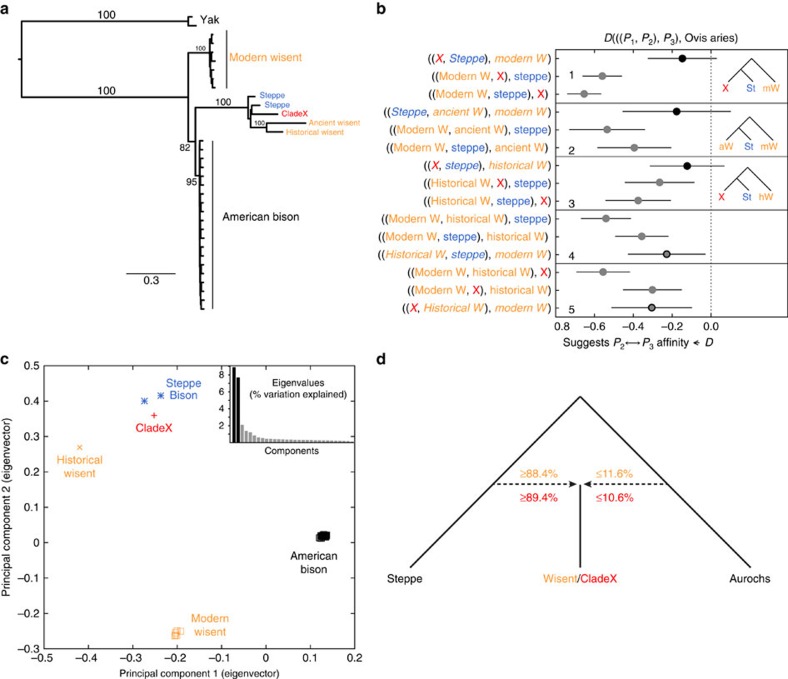
The two living species of bison (European and American) are among the few terrestrial megafauna to have survived the late Pleistocene extinctions. Despite the extensive bovid fossil record in Eurasia, the evolutionary history of the European bison (or wisent, Bison bonasus) before the Holocene (<11.7 thousand years ago (kya)) remains a mystery. We use complete ancient mitochondrial genomes and genome-wide nuclear DNA surveys to reveal that the wisent is the product of hybridization between the extinct steppe bison (Bison priscus) and ancestors of modern cattle (aurochs, Bos primigenius) before 120 kya, and contains up to 10% aurochs genomic ancestry. Although undetected within the fossil record, ancestors of the wisent have alternated ecological dominance with steppe bison in association with major environmental shifts since at least 55 kya. Early cave artists recorded distinct morphological forms consistent with these replacement events, around the Last Glacial Maximum (LGM, ∼21-18 kya).
两种现生的野牛(欧洲野牛和美洲野牛)是少数幸存于更新世末期灭绝事件的陆地巨型动物之一。尽管欧亚大陆有大量的牛科化石记录,但在全新世(<11700 年前)之前,欧洲野牛(或欧洲野牛,Bison bonasus)的进化历史仍然是一个谜。我们利用完整的古代线粒体基因组和全基因组核 DNA 调查揭示,在 12 万年前之前,欧洲野牛是已灭绝的草原野牛(Bison priscus)和现代牛(欧洲野牛,Bos primigenius)祖先之间杂交的产物,并且含有高达 10%的欧洲野牛基因组祖先。尽管在化石记录中没有被发现,但自至少 55000 年前以来,野牛的祖先与草原野牛一起,随着主要环境变化交替占据生态优势。早期的洞穴艺术家记录了与这些更替事件一致的独特形态,大约在末次冰盛期(LGM,约 21-18 千年前)。