Maaoui Houcem, Teodoresu Florina, Wang Qian, Pan Guo-Hui, Addad Ahmed, Chtourou Radhouane, Szunerits Sabine, Boukherroub Rabah
Institut d'Electronique, de Microélectronique et de Nanotechnologie (IEMN), UMR CNRS8520, Université Lille 1, Avenue Poincaré-BP 60069, 59652 Villeneuve d'Ascq, France.
Département de Physique, Faculté des Sciences de Tunis, Université Tunis-El Manar, 2092 Tunis, Tunisia.
Sensors (Basel). 2016 Oct 18;16(10):1720. doi: 10.3390/s16101720.
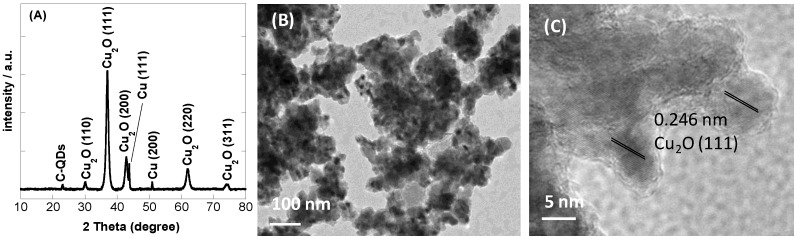
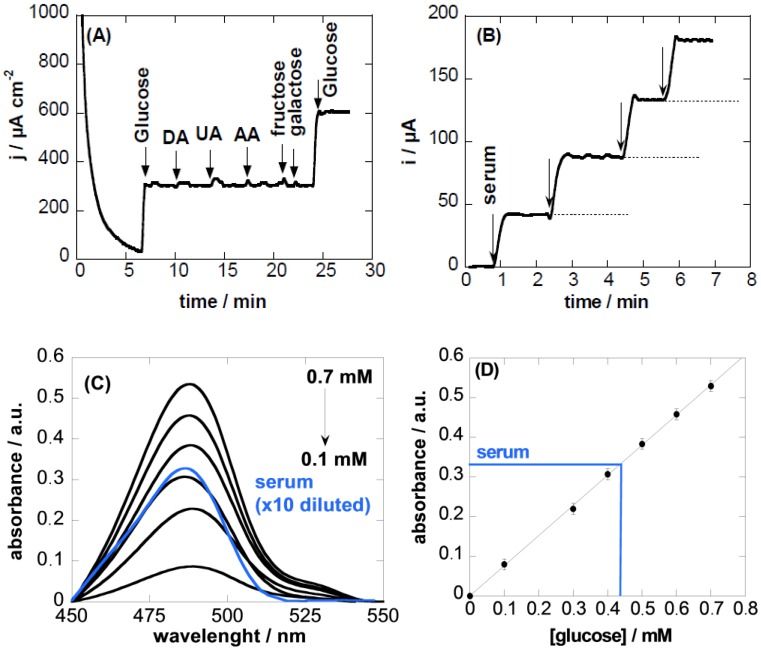
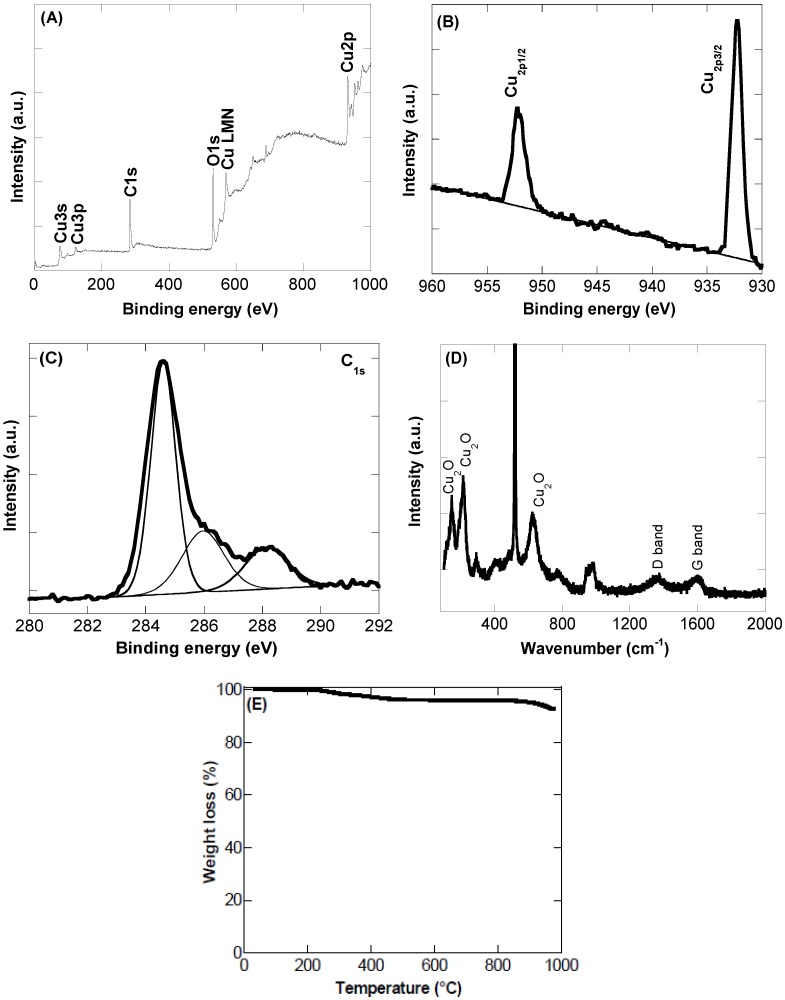
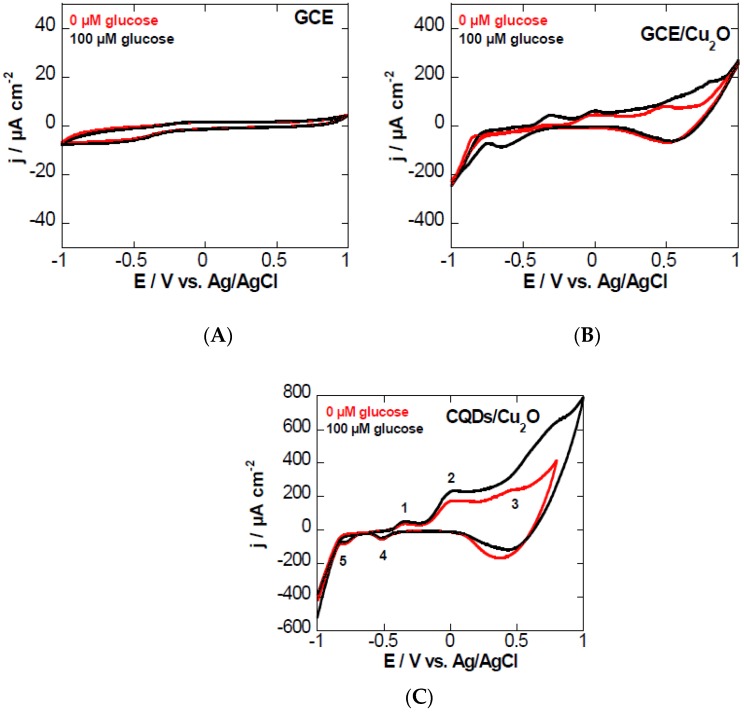
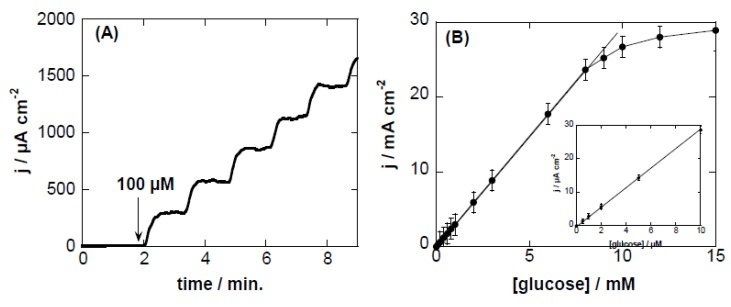
Perturbations in glucose homeostasis is critical for human health, as hyperglycemia (defining diabetes) leads to premature death caused by macrovascular and microvascular complications. However, the simple and accurate detection of glucose in the blood at low cost remains a challenging task, although it is of great importance for the diagnosis and therapy of diabetic patients. In this work, carbon quantum dots decorated with copper oxide nanostructures (CQDs/Cu₂O) are prepared by a simple hydrothermal approach, and their potential for electrochemical non-enzymatic glucose sensing is evaluated. The proposed sensor exhibits excellent electrocatalytic activity towards glucose oxidation in alkaline solutions. The glucose sensor is characterized by a wide concentration range from 6 µM to 6 mM, a sensitivity of 2.9 ± 0.2 µA·µM·cm, and a detection limit of 6 µM at a signal-to-noise ratio S/N = 3. The sensors are successfully applied for glucose determination in human serum samples, demonstrating that the CQDs/Cu₂O-based glucose sensor satisfies the requirements of complex sample detection with adapted potential for therapeutic diagnostics.
葡萄糖稳态的紊乱对人类健康至关重要,因为高血糖(定义为糖尿病)会导致由大血管和微血管并发症引起的过早死亡。然而,尽管低成本、简单且准确地检测血液中的葡萄糖对糖尿病患者的诊断和治疗非常重要,但这仍然是一项具有挑战性的任务。在这项工作中,通过简单的水热法制备了用氧化铜纳米结构修饰的碳量子点(CQDs/Cu₂O),并评估了它们用于电化学非酶葡萄糖传感的潜力。所提出的传感器在碱性溶液中对葡萄糖氧化表现出优异的电催化活性。该葡萄糖传感器的特征在于浓度范围宽,从6 μM到6 mM,灵敏度为2.9±0.2 μA·μM⁻¹·cm⁻²,在信噪比S/N = 3时检测限为6 μM。这些传感器已成功应用于人体血清样品中的葡萄糖测定,表明基于CQDs/Cu₂O的葡萄糖传感器满足复杂样品检测的要求,具有适用于治疗诊断的潜力。