Wiley Joshua F, Bei Bei, Bower Julienne E, Stanton Annette L
From the Department of Psychology (Wiley, Bower, Stanton), University of California, Los Angeles, Los Angeles, California; Centre for Primary Care and Prevention (Wiley), Mary MacKillop Institute for Health Research, Australian Catholic University, Victoria, Australia; School of Psychological Sciences and Monash Institute of Cognitive and Clinical Neurosciences (Bei), Faculty of Biomedical and Psychological Sciences, Monash University, Victoria, Australia; Centre for Women's Mental Health, (Bei), Royal Women's Hospital, Department of Psychiatry, University of Melbourne, Victoria, Australia; Department of Psychiatry and Biobehavioral Sciences (Bower, Stanton), University of California, Los Angeles; and Jonsson Comprehensive Cancer Center (Bower, Stanton), University of California, Los Angeles.
Psychosom Med. 2017 Apr;79(3):283-292. doi: 10.1097/PSY.0000000000000395.
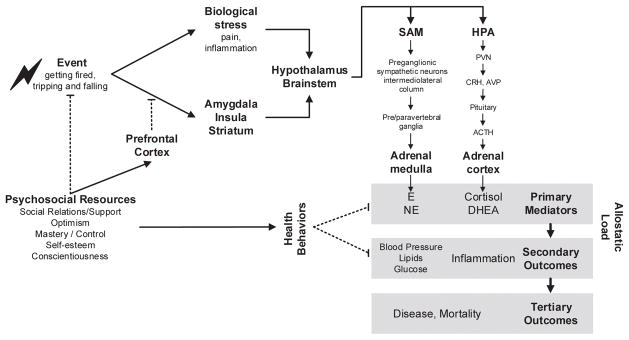
Allostatic load (AL) represents cumulative wear-and-tear on the body and is operationalized as a multisystem index of biomarkers. Allostatic load is associated with morbidities and mortality, leading to a growing body of literature that uses AL as an outcome in its own right. Psychosocial resources (PSRs), such as mastery and social support, may influence health outcomes in part via AL, and the current review seeks to characterize the relations between PSRs and AL.
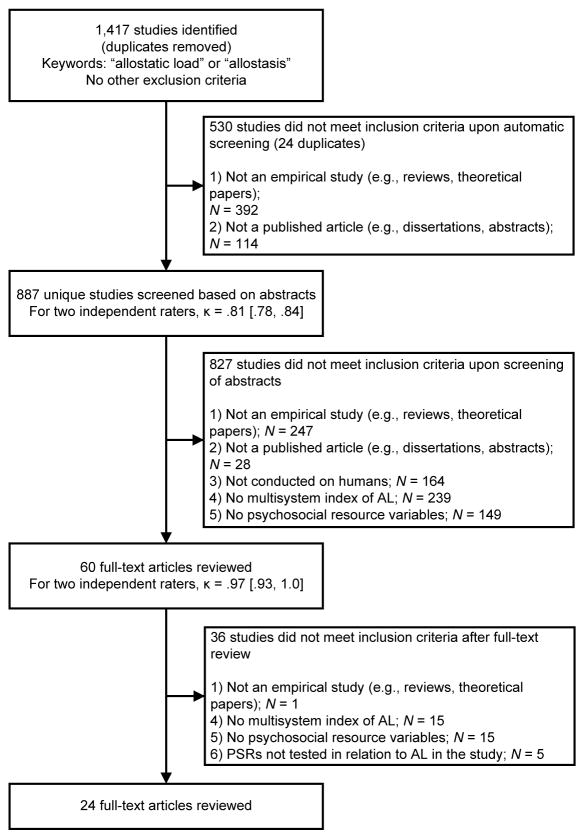
A systematic review was conducted by searching PubMed, CINAHL Plus, PsycINFO, Scopus, and Embase for studies examining the relation between PSR(s) and AL in humans. From 1,417 abstracts screened, 60 full-text articles were reviewed, and 24 studies met inclusion criteria.
Mixed evidence exists for a relationship between PSRs and AL. Most (14/24) studies used a cross-sectional design, and only one study investigated whether a PSR predicted change in AL. Compared to cross-sectional studies, longitudinal studies were more likely to report a significant relationship (8/14 versus 8/10, respectively). Studies with statistically significant main or moderated effects had larger sample sizes than those reporting null effects. Whether a study reported a significant main or moderated relationship did not differ by whether psychological (8/11) or social (10/16) resources were assessed.
Evidence for a relationship between PSRs and AL is equivocal, and obtained significant relationships are generally small in magnitude. Gaps in the current literature and directions for future research are discussed. Longitudinal studies are needed that repeatedly assess PSRs and AL.
应激负荷(AL)代表身体的累积损耗,并作为生物标志物的多系统指标来运作。应激负荷与发病率和死亡率相关,这导致越来越多的文献将应激负荷本身作为一个结果来使用。心理社会资源(PSR),如掌控感和社会支持,可能部分通过应激负荷影响健康结果,而本综述旨在描述心理社会资源与应激负荷之间的关系。
通过检索PubMed、CINAHL Plus、PsycINFO、Scopus和Embase进行系统综述,以查找研究心理社会资源与人类应激负荷之间关系的研究。在筛选的1417篇摘要中,对60篇全文文章进行了综述,24项研究符合纳入标准。
心理社会资源与应激负荷之间的关系存在混合证据。大多数(14/24)研究采用横断面设计,只有一项研究调查了心理社会资源是否能预测应激负荷的变化。与横断面研究相比,纵向研究更有可能报告显著关系(分别为8/14和8/10)。具有统计学显著主效应或调节效应的研究样本量大于报告无效应的研究。一项研究是否报告显著的主效应或调节关系,在评估的是心理(8/11)还是社会(10/16)资源方面没有差异。
心理社会资源与应激负荷之间关系的证据不明确,且所获得的显著关系通常程度较小。讨论了当前文献中的差距和未来研究的方向。需要进行纵向研究,反复评估心理社会资源和应激负荷。