White Helene R, Beardslee Jordan, Pardini Dustin
Center of Alcohol Studies, Rutgers, the State University of NJ, 607 Allison Road, Piscataway, NJ 08854-8001, United States.
Department of Psychiatry, University of Pittsburgh Medical Center, 201 North Craig Street, Suite 408, Pittsburgh, PA 15213, United States.
Addict Behav. 2017 Feb;65:56-62. doi: 10.1016/j.addbeh.2016.09.007. Epub 2016 Oct 10.
Although several studies have delineated risk factors for adolescent regular marijuana use, few studies have identified those factors that differentiate who will and will not eventually stop using marijuana during young adulthood. This study examined the extent to which adolescent risk factors, including individual attitudes, temperament, and behaviors and peer, family, and neighborhood factors, could prospectively identify which adolescence-onset monthly marijuana users (AMMU) would stop using marijuana in young adulthood and whether race moderated these associations.
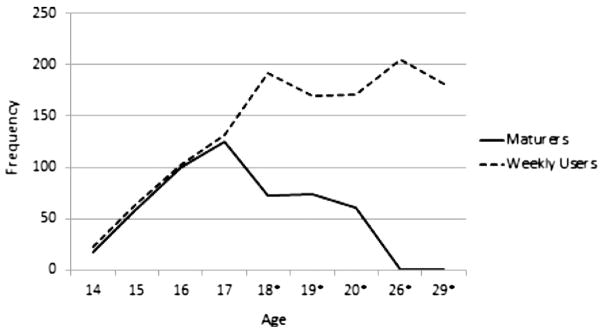
Data came from 503 young men who were followed annually from the first grade through mean age 20 and then re-interviewed at mean ages 26 and 29. Young men who used marijuana at least monthly at least one year between ages 14 and 17 (N=140) were compared to their peers who had not tried marijuana by age 17 (N=244). The former group was divided into those who used at least weekly in adulthood (N=54) and those who did not use at all in adulthood (N=66) and these groups were compared to each other.
Logistic regression analyses indicated that all except one of the adolescent risk factors significantly differentiated AMMU from nonusers. None of the predictors differentiated those who matured out from those who used weekly in young adulthood.
Future research on marijuana cessation should incorporate subjective life experiences, such as reasons for using and negative consequences from use, to help identify adolescents who are at risk for problematic use in adulthood.
尽管多项研究已明确青少年经常使用大麻的风险因素,但很少有研究确定那些能区分哪些人在成年早期会最终停止使用大麻而哪些人不会的因素。本研究考察了青少年风险因素,包括个人态度、气质、行为以及同伴、家庭和邻里因素,在多大程度上能够前瞻性地识别哪些青春期开始每月使用大麻的人(AMMU)在成年早期会停止使用大麻,以及种族是否会调节这些关联。
数据来自503名年轻男性,他们从一年级开始每年接受随访,直至平均年龄20岁,然后在平均年龄26岁和29岁时再次接受访谈。将在14至17岁之间至少有一年每月至少使用一次大麻的年轻男性(N = 140)与其在17岁时未尝试过大麻的同龄人(N = 244)进行比较。前一组又分为成年后至少每周使用一次的人(N = 54)和成年后完全不使用的人(N = 66),并将这两组相互比较。
逻辑回归分析表明,除一个因素外,所有青少年风险因素都能显著区分AMMU和非使用者。没有一个预测因素能区分在成年早期不再使用大麻的人和每周使用大麻的人。
未来关于大麻戒断的研究应纳入主观生活经历,如使用原因和使用带来的负面后果,以帮助识别成年后有问题使用风险的青少年。