Aboyade O M, Beauclair R, Mbamalu O N, Puoane T R, Hughes G D
South African Herbal Science and Medicine Institute, University of the Western Cape, Bellville, South Africa.
Present Address: Department of Pharmaceutical Sciences, Tshwane University of Technology, Arcadia, Pretoria, South Africa.
BMC Complement Altern Med. 2016 Oct 24;16(1):410. doi: 10.1186/s12906-016-1378-4.
Various studies have shown that non-communicable diseases (NCDs) especially diabetes and hypertension are prevalent among older women living in South African urban areas, placing a heavy burden on the healthcare system. This study aimed to understand the health-seeking behaviour, healthcare practices and prevalence of traditional herbal medicine (THM) use among older women self-reporting NCDs from the Prospective Urban Rural Epidemiology study (PURE).
A homogenous purposive sampling of PURE participants was used to recruit women who were 50 years or older (n = 250). Descriptive statistics were used to examine the number of NCDs reported by the study sample, health seeking behaviour and practices as well as THM use. Logistic regression was also employed to investigate possible associations between reported conditions and THM use or medical pluralism.
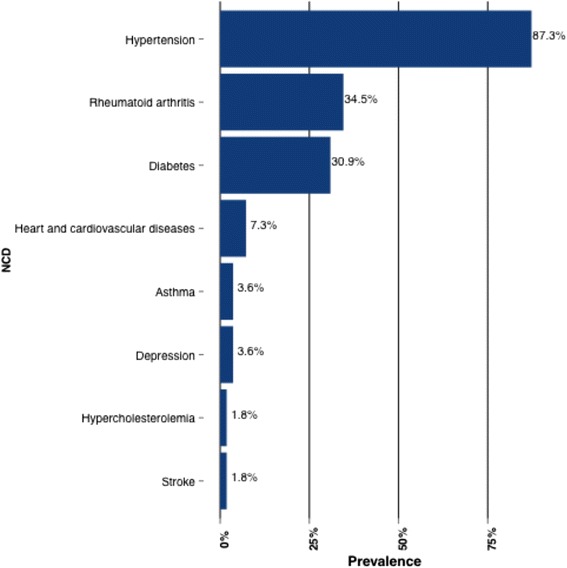
Within the study sample, 72 % self-reported an NCD. Of those with self-reported NCDs, 46 % had one, and 54 % had two or more NCDs. Those with NCDs usually visited public clinics (80 %), relied on doctors (90 %) and nurses (85 %) for health information, and mostly used conventional medicine (CM) to manage high blood pressure (81 %). About 30 % of those with NCDs indicated using THM, of whom 29 (53 %) reported practicing medical pluralism. Participants with dental problems (OR: 3.24, 95 % CI: 1.30-8.20), headaches (OR: 2.42, 95 % CI: 1.24-4.94), heart burn (OR: 2.30, 95 % CI: 1.18-4.48) and severe tiredness (OR: 2.05, 95 % CI: 1.08-3.99) were more likely to use THM. Anxiety and allergies increased the likelihood to practise medical pluralism by five and 20 times, respectively.
Self-reported NCD with co-morbidities was prevalent among the participants in the study. Most of the study participants utilized state-owned clinics and hospitals for the management of their chronic conditions. THM use was not very common. However, among those who used THM, medical pluralism was prevalent. Family history was the most common reason for THM use, with many THM patrons utilizing these for treatment of a health condition. Older black women with anxiety and allergies were more likely to practise medical pluralism.
多项研究表明,非传染性疾病(NCDs)尤其是糖尿病和高血压在生活在南非城市地区的老年女性中普遍存在,给医疗系统带来了沉重负担。本研究旨在了解前瞻性城乡流行病学研究(PURE)中自我报告患有非传染性疾病的老年女性的求医行为、医疗保健习惯以及传统草药(THM)的使用情况。
采用同质目的抽样法从PURE参与者中招募50岁及以上的女性(n = 250)。描述性统计用于检查研究样本中报告的非传染性疾病数量、求医行为和习惯以及传统草药的使用情况。还采用逻辑回归分析来研究报告的疾病与传统草药使用或医学多元主义之间的可能关联。
在研究样本中,72%的人自我报告患有非传染性疾病。在那些自我报告患有非传染性疾病的人中,46%患有一种,54%患有两种或更多种非传染性疾病。患有非传染性疾病的人通常会去公共诊所(80%),依靠医生(90%)和护士(85%)获取健康信息,并且大多使用传统医学(CM)来控制高血压(81%)。约30%患有非传染性疾病的人表示使用传统草药,其中29人(53%)报告采用医学多元主义。患有牙齿问题(比值比:3.24,95%置信区间:1.30 - 8.20)、头痛(比值比:2.42,95%置信区间:1.24 - 4.94)、烧心(比值比:2.30,95%置信区间:1.18 - 4.48)和严重疲劳(比值比:2.05,95%置信区间:1.08 - 3.99)的参与者更有可能使用传统草药。焦虑和过敏分别使采用医学多元主义的可能性增加了5倍和20倍。
研究参与者中自我报告患有合并症的非传染性疾病很普遍。大多数研究参与者利用国有诊所和医院来管理他们的慢性病。传统草药的使用并不十分普遍。然而,在使用传统草药的人中,医学多元主义很普遍。家族病史是使用传统草药最常见的原因,许多使用传统草药的人利用其来治疗健康问题。患有焦虑和过敏的老年黑人女性更有可能采用医学多元主义。